Key points
- The EHDS (Regulation (EU) 2025/327) entered into force on 26 March 2025 and applies in phases, starting on 26 March 2027.
- It sits on top of GDPR rather than replacing it. Your Article 9 condition for processing health data still matters.
- Makers of electronic health record systems, interoperable wellness apps and data-holding health businesses face the most new work.
The European Health Data Space (EHDS) does not replace GDPR: it adds product rules, data-sharing duties and new routes to health data on top of it, phased in from 26 March 2027. If you already process health data lawfully under GDPR, you have a head start. The work now is to find out which EHDS role you play and to plan for it while the detailed implementing rules are still being written.
At a glance
- What: Regulation (EU) 2025/327, the European Health Data Space
- Relationship to GDPR: builds on it; your GDPR duties stay in full
- First application date: 26 March 2027 (mainly governance), with the main phases in 2029 and 2031
- Most affected: electronic health record (EHR) system makers, apps claiming EHR interoperability, and health data holders
This is general information, not legal advice.
What is the European Health Data Space?
The EHDS is Regulation (EU) 2025/327. It gives people more control over their electronic health data and creates a common system for reusing that data. It has two main parts:
- Primary use: health data used to deliver care. People get rights to access and share their electronic health data, and EHR systems must meet common requirements for interoperability and logging.
- Secondary use: reusing health data for research, innovation, regulation and public health. This runs through national health data access bodies, which issue data permits and provide secure processing environments.
How does the EHDS fit with GDPR?
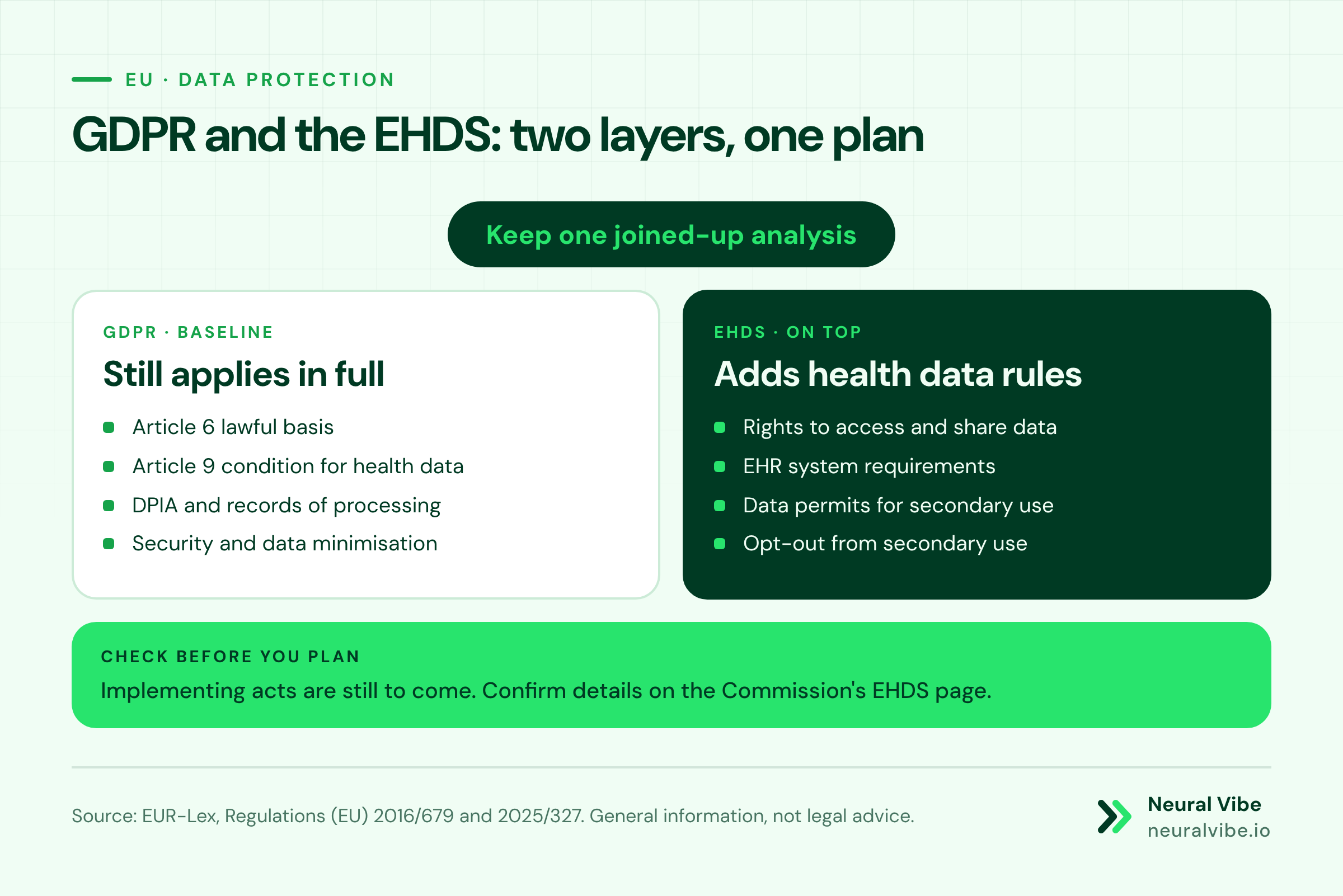
GDPR stays the baseline. Health data is a special category of personal data. Article 9(1) of GDPR prohibits processing it unless a condition in Article 9(2) applies. The conditions health-tech businesses most often rely on are:
| GDPR condition | When it is used |
|---|---|
| Article 9(2)(a) | Explicit consent |
| Article 9(2)(h) | Health or social care, including diagnosis and treatment, with safeguards |
| Article 9(2)(i) | Public interest in public health |
| Article 9(2)(j) | Scientific research, with appropriate safeguards |
Article 9(4) also lets EU countries keep or add conditions for health, genetic and biometric data. That is one reason national rules still differ.
You still need an Article 6 lawful basis, transparency, data minimisation, security, records of processing and, for most health-tech products, a data protection impact assessment (DPIA).
Our view: treat the EHDS as a second layer, not a new start. You will need to show compliance with both, so keep your GDPR and EHDS analyses joined up in one place.
When does the EHDS apply?
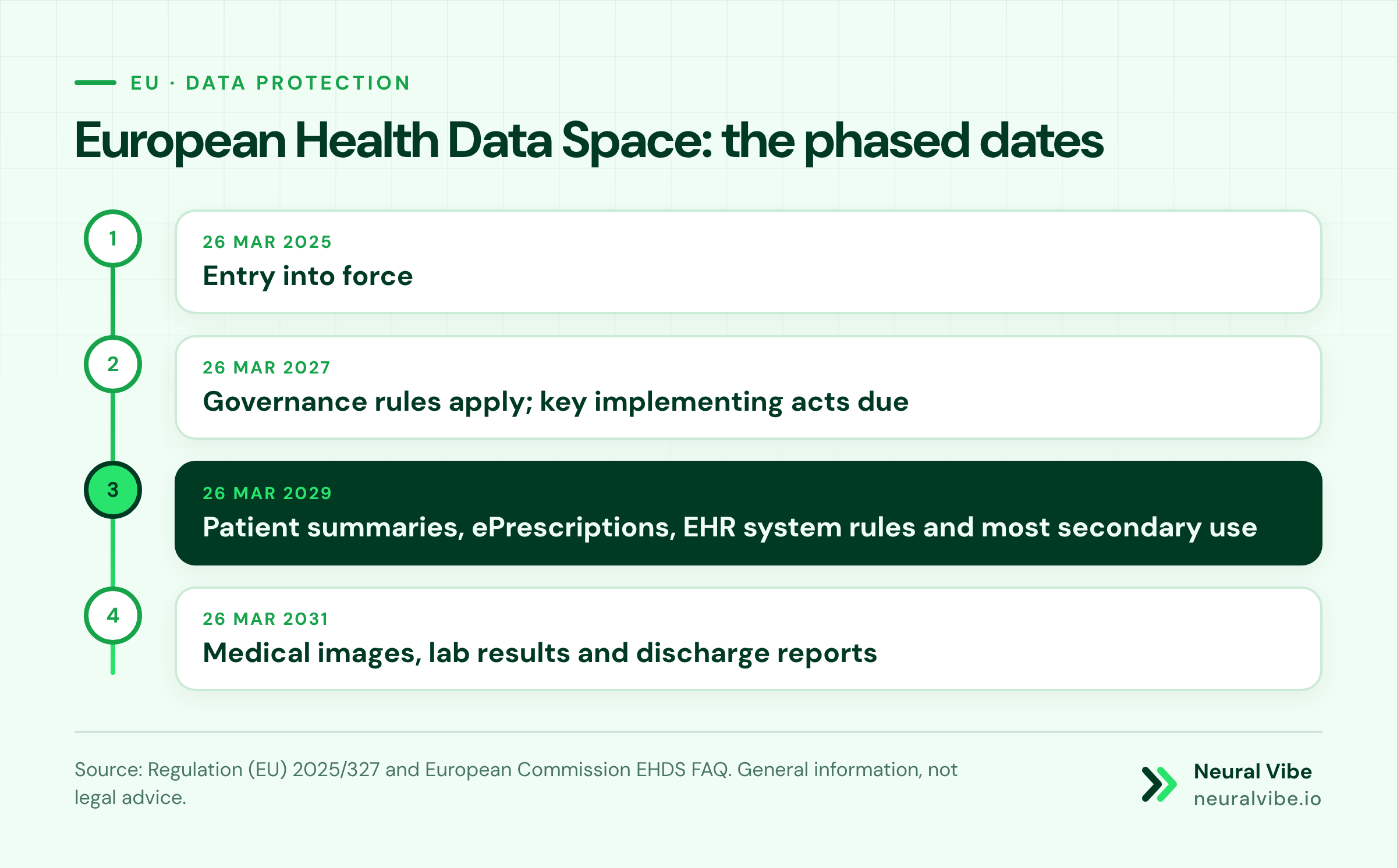
The EHDS applies in stages. It entered into force on 26 March 2025. The first provisions apply from 26 March 2027, mainly governance: by then EU countries must set up their digital health authorities, the EHDS Board starts work, and the Commission is due to adopt key implementing acts. Two later phases bring in most of the duties:
- 26 March 2029: primary use rules and EHR requirements for the first priority categories (patient summaries, ePrescriptions and eDispensations), and most secondary use rules.
- 26 March 2031: the second group of priority categories (medical images and reports, laboratory results, discharge reports), and secondary use of certain further data categories.
Check before you plan. Much of the practical detail, including technical specifications and the data exchange format, depends on Commission implementing acts, and not all of them have been adopted yet. Check progress on the Commission’s EHDS page before you lock in a roadmap.
Who is most affected by the EHDS?
EHR system manufacturers. Software that stores, imports, exports, converts, edits or views electronic health records may count as an EHR system. From 26 March 2029, only EHR systems that comply with the common specifications may be placed on the market for the first priority categories. EHR systems need:
- essential requirements on interoperability and logging;
- technical documentation and an EU declaration of conformity;
- CE marking; and
- registration in an EU database.
This sits on top of the MDR if your product is also a medical device. Our guide on whether your software is a medical device covers that first question.
Medical devices and AI systems that claim EHR interoperability. If you say your device or high-risk AI system is interoperable with EHR systems, you must show it meets the EHDS essential requirements for the interoperability and logging components.
Wellness apps. Apps that claim interoperability with EHR systems must be labelled as interoperable, so users understand what the app can share.
Data holders. Many organisations holding electronic health data may have to make certain categories available for secondary use through health data access bodies. Micro-enterprises are excluded from this duty in principle, but EU countries can extend it to them by national law, so check your national rules before relying on that.
Data users. If you want health data for research or product development, the EHDS gives you a route to apply for a data permit, with strict conditions on purpose, security and outputs.
What should you prepare now? A nine-step checklist
- Map your health data. List what you collect, generate and hold, where it comes from, where it goes and which systems touch it.
- Revisit your Article 9 conditions. Confirm your Article 6 basis and Article 9(2) condition for each activity, and check national rules under Article 9(4) in each country you serve.
- Classify your products under the EHDS. Decide whether any product is, or contains, an EHR system, or makes interoperability claims. Record your reasoning.
- Check your MDR position too. The Commission’s software guidance, MDCG 2019-11 rev.1, now includes material on EHR systems and the EHDS. See our guide to EU MDR Rule 11.
- Plan for interoperability and logging. Follow the European electronic health record exchange format as it develops, and build access logging into your roadmap.
- Decide whether you are a data holder. If so, think about data quality, dataset descriptions and how you would answer a health data access body.
- Prepare for opt-outs. Article 71 gives people the right to opt out of secondary use of their data. Consider how this affects datasets you rely on.
- Update your DPIAs and privacy notices. Reflect new data flows, rights and secondary uses.
- Monitor implementing acts. Name someone to track Commission implementing acts and national designations of health data access bodies and digital health authorities.
If you also build AI, read this alongside our guide to the EU AI Act for health-tech.
FAQ
Does the EHDS replace GDPR for health data?
No. GDPR continues to apply in full. The EHDS adds specific rules for electronic health data, EHR systems and secondary use, so you need to comply with both.
Does the EHDS apply to companies outside the EU?
Partly. If you place EHR systems or interoperable wellness apps on the EU market, the product rules apply wherever you are based. The data holder duties for secondary use apply to data holders established in the EU, so a non-EU company is usually caught through an EU establishment.
Can we use EHDS data to train an AI model?
Yes, potentially. Training AI algorithms that could be used in health or care is among the purposes for which a data permit can be sought, subject to conditions. You will still need to meet GDPR, the permit conditions and any AI Act requirements.
When do we need an EHDS-ready EHR system?
The first EHR requirements apply from 26 March 2029 for the first priority data categories, with more from 26 March 2031. Development, testing and documentation take time, so plan well ahead.
Get ready for the EHDS with us
We run GDPR and EHDS readiness reviews for health-tech teams, alongside MDR work where you need it. Get an instant quote, or send us a note. We reply within one working day.
This article is general information, not legal advice.
Sources

About the author
Brett Marshall
Founder and Principal Consultant at Neural Vibe. 25+ years in regulated technology, ISO lead implementer and auditor, and external DPO for health-tech companies.