Key points
- AI medical device software that needs a notified body under the MDR or IVDR is a high-risk AI system under Article 6(1) of the AI Act.
- High-risk obligations for AI in medical devices now apply from 2 August 2028, under the Digital Omnibus on AI (Regulation (EU) 2026/1744).
- You keep one technical file, one quality system and one conformity assessment. Start with an AI inventory, then close the data governance and human oversight gaps.
If your medical device software uses AI and needs a notified body under the MDR or IVDR, it is a high-risk AI system under the EU AI Act. Those high-risk obligations apply from 2 August 2028. That sounds a long way off, but the data and oversight evidence takes longer to build than most teams expect.
Below we explain the test, how it fits with the device file you already have, and the seven things we would do first.
At a glance
- Who is in scope: anyone placing an AI system on the EU market, wherever they are based
- The high-risk test: Article 6(1). The AI is a device, or a safety component of one, and needs a notified body
- Key date: 2 August 2028 for AI medical devices and IVDs
- The good news: one technical file, one quality system, one conformity assessment
This is general information, not legal advice.
Does the EU AI Act apply to my medical device software?
The AI Act applies to providers that place an AI system on the EU market or put it into service there, wherever the company is based. A UK or US company selling into the EU is in scope in the same way as an EU one.
An “AI system” is defined broadly in Article 3(1). It is a machine-based system that infers from its inputs how to generate outputs such as predictions, content, recommendations or decisions.
If your product uses machine learning to detect, triage, predict or recommend, assume it is an AI system. If you believe it is not, write down why.
When is AI medical device software high-risk?
The key test is in Article 6(1). An AI system is high-risk when both of these are true:
- it is a medical device itself, or a safety component of one; and
- the device must undergo third-party conformity assessment by a notified body under the MDR or IVDR.
The Digital Omnibus added a clarification in new Article 6(1a) to (1c): AI used only for non-safety aspects of a product is not a “safety component” unless its failure would endanger health and safety.
In practice, that captures most AI software in MDR Class IIa, IIb and III. That is where software usually lands under classification Rule 11, which we unpack in EU MDR Rule 11 in plain English.
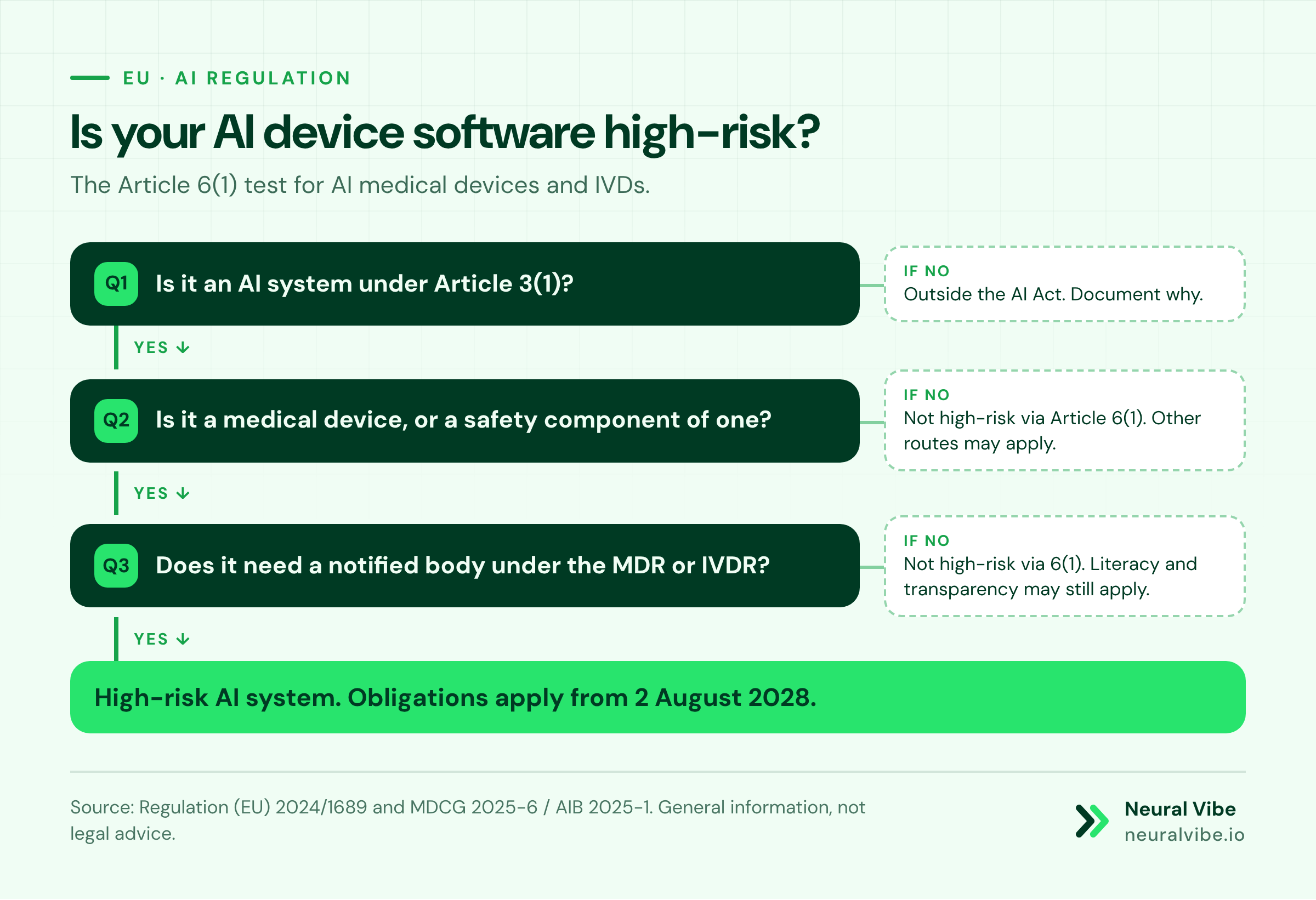
The joint MDCG 2025-6 / AIB 2025-1 FAQ, from the Medical Device Coordination Group and the AI Board, confirms where the line sits:
| Position | Device classes |
|---|---|
| Not high-risk via Article 6(1) | MDR Class I self-certified (non-sterile, no measuring function, not reusable surgical instruments); IVDR Class A non-sterile; in-house devices under Article 5(5) MDR or IVDR |
| High-risk | MDR Class I sterile, measuring or reusable surgical; MDR Class IIa, IIb and III; IVDR Class B, C and D; sterile IVDR Class A |
Outside the high-risk route is not outside the Act. Prohibited practices still apply. Article 4 requires providers and deployers to take measures to support the AI literacy of their staff. Article 50 transparency duties apply to certain systems, for example those that interact directly with people.
Not yet sure your product is a medical device at all? Start with Is my software a medical device?
How does the AI Act fit with the MDR and IVDR?
The Act was written to sit alongside sectoral product law, not on top of it. Three provisions do most of the work:
- One technical file. Article 11(2) requires a single set of technical documentation containing both the MDR or IVDR information and the AI Act information. Article 8(2) lets you build AI Act testing, reporting and documentation into the procedures you already run.
- One quality system. Article 17(3) lets manufacturers with a sectoral quality management system (QMS) include the AI Act’s QMS elements in it. For most device makers, that means extending an ISO 13485 based system.
- One conformity assessment. Under Article 43(3), you follow the MDR or IVDR procedure and the AI Act requirements are assessed as part of it.
The Digital Omnibus also makes clear that being high-risk under the AI Act does not, on its own, change your MDR or IVDR conformity assessment route.
What about ISO/IEC 42001? In our view it is a useful framework for AI governance, but not a substitute for the Act’s specific requirements. We cover it in ISO 42001: does your company need an AI management system?
Where do most device files fall short?
MDR and IVDR files often touch these topics, but rarely at the depth Articles 10 to 15 require:
- Data governance: relevance, representativeness and quality of training, validation and test data, and examination for bias.
- Human oversight: how users can understand, override or stop the system.
- Record-keeping and logging across the lifecycle.
- Accuracy, robustness and cybersecurity, maintained over time.
Can my notified body assess the AI Act requirements?
In many cases, yes. Your MDR or IVDR notified body can assess AI Act requirements as part of the device assessment. The condition is that its compliance with the AI Act’s competence requirements (Article 31(4), (5), (10) and (11)) has been assessed through its existing notification.
The Digital Omnibus adds two points:
- these notified bodies must apply for designation under the AI Act by 28 January 2028;
- a body designated under more than one product law can make a single application.
Not every notified body will have AI capacity in place at the same time. Ask yours now about its plans and timelines.
When do the AI Act rules apply to medical devices?
The timetable was changed by the Digital Omnibus on AI, Regulation (EU) 2026/1744. This is adopted law, not a proposal:
- 19 November 2025: proposed by the Commission
- 7 May 2026: political agreement between Parliament and Council
- 8 July 2026: signed; published in the Official Journal on 24 July 2026
- 27 July 2026: entered into force
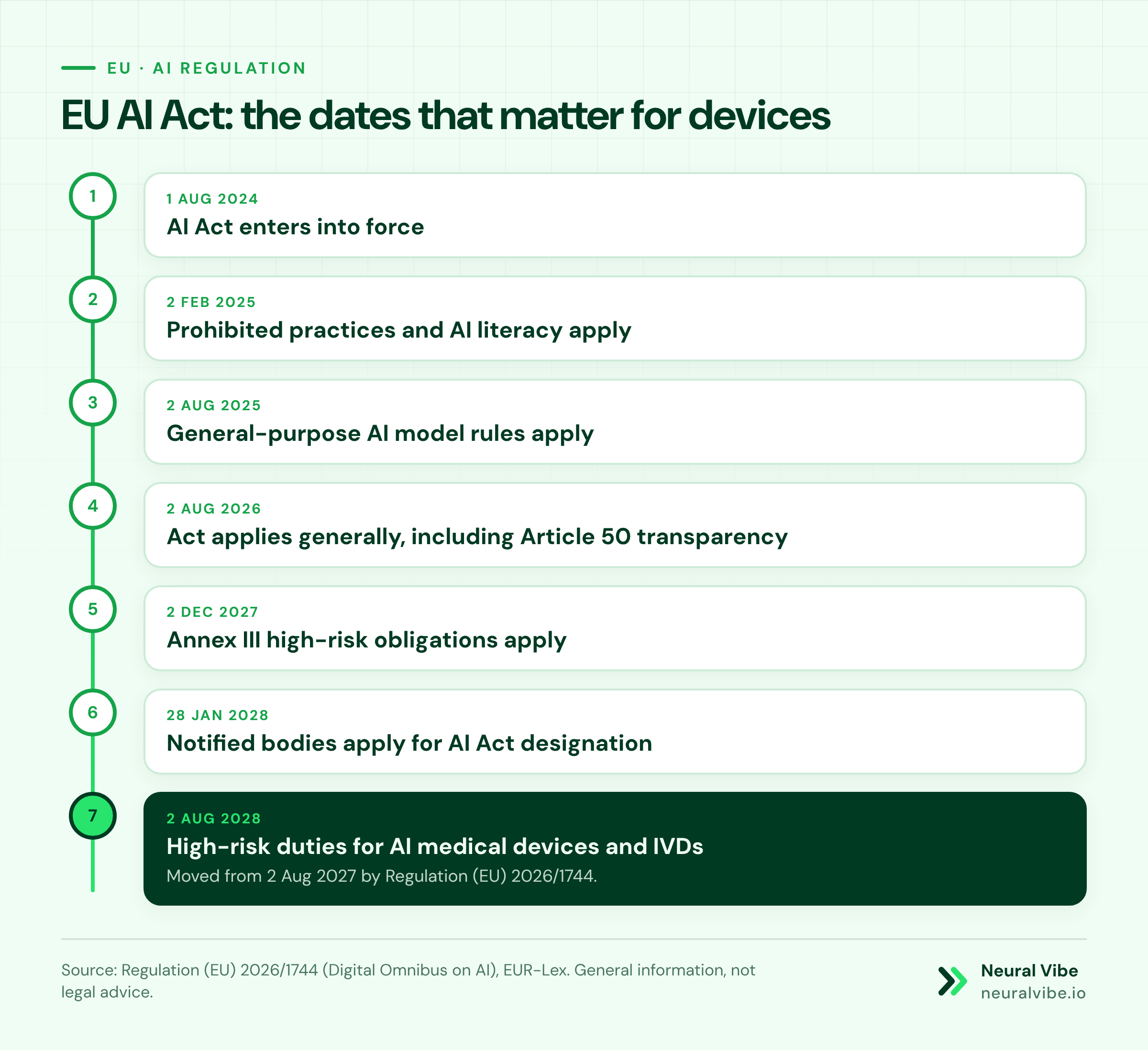
| Date | What applies |
|---|---|
| 1 August 2024 | AI Act enters into force |
| 2 February 2025 | Prohibited practices and AI literacy provisions apply |
| 2 August 2025 | Governance rules and obligations for general-purpose AI models apply |
| 2 August 2026 | The Act applies generally, including Article 50 transparency duties, with the exceptions below |
| 2 December 2027 | High-risk obligations for Annex III systems (for example employment, education, biometrics), moved from 2 August 2026 |
| 28 January 2028 | Deadline for sectoral notified bodies to apply for designation under the AI Act |
| 2 August 2028 | High-risk obligations for Article 6(1) / Annex I systems, including AI medical devices and IVDs, moved from 2 August 2027 |
Watch out: the MDCG 2025-6 / AIB 2025-1 FAQ dates from June 2025, before the Omnibus. Its references to 2 August 2027 are out of date, but its analysis of classification and integration is still useful.
The Act also has transitional rules for systems already on the market. Under Article 111(2), as amended, a high-risk AI system placed on the market or put into service before the high-risk obligations apply (2 August 2028 for AI medical devices) is caught only if, from that date, it is subject to significant changes in its design. How that works for your product, including any planned approach to change control, deserves a careful check rather than an assumption.
What should we do first?
- Build an AI inventory. List every AI system in your products and internal tools, what it does, its intended purpose and who uses it.
- Classify each one. High-risk under Article 6, literacy and transparency duties only, or out of scope? Record your reasoning, including the MDR or IVDR class it relies on.
- Map against your MDR or IVDR file. For each high-risk system, compare Articles 9 to 15 with what your technical documentation, risk management file and clinical or performance evaluation already cover.
- Close the data and oversight gaps. These are usually the biggest. Document data sources, data management and human oversight now, while models are still in development. Retrofitting data provenance is slow.
- Extend your QMS. Add AI-specific procedures (data management, model change control, post-market monitoring of performance) to your existing system. Do not build a parallel one.
- Talk to your notified body early. Ask whether it assesses AI Act requirements, whether it plans to apply for AI Act designation, and how it will run combined assessments.
- Track the timetable. The dates are now in law, but guidance, harmonised standards and Commission templates are still arriving. Review your plan each quarter.
FAQ
Does the EU AI Act apply if my company is in the UK?
Yes, if you place your product on the EU market or put it into service in the EU. The Act applies to providers wherever they are established. It does not apply in Great Britain, which has its own approach to AI as a medical device.
Is a Class I AI medical device high-risk under the AI Act?
Usually not, if it is self-certified. It becomes high-risk under Article 6(1) when a notified body is involved, for example a Class I sterile or measuring device. Other AI Act duties, such as AI literacy and transparency, can still apply.
When do the high-risk rules apply to AI medical devices?
From 2 August 2028, following the Digital Omnibus on AI (Regulation (EU) 2026/1744). The original date was 2 August 2027.
Do I need a second technical file or a second notified body?
No. The Act requires a single set of technical documentation. The AI Act requirements are assessed within your MDR or IVDR conformity assessment, provided your notified body is able to assess them.
Talk to us
Want a second opinion on how the AI Act applies to your product? Get an instant quote, or send us a short note about what you are building. We reply within one working day.
Sources
- Regulation (EU) 2024/1689 (Artificial Intelligence Act), Official Journal of the EU
- Regulation (EU) 2026/1744 (Digital Omnibus on AI), Official Journal of the EU
- AI Act Service Desk (European Commission): consolidated AI Act text as at 27 July 2026, Articles 111 and 113
- Regulation (EU) 2017/745 on medical devices (MDR)
- Regulation (EU) 2017/746 on in vitro diagnostic medical devices (IVDR)
- MDCG 2025-6 / AIB 2025-1: Interplay between the MDR, IVDR and the AI Act (FAQ), June 2025
- European Commission: AI Act regulatory framework and timeline
- European Commission press release IP/26/1024: EU agrees to simplify AI rules (7 May 2026)
- Council of the EU press release: Council and Parliament agree to simplify and streamline AI rules (7 May 2026)

About the author
Brett Marshall
Founder and Principal Consultant at Neural Vibe. 25+ years in regulated technology, ISO lead implementer and auditor, and external DPO for health-tech companies.