Key points
- The AI in Mental Health Airlock tests methods for evaluating AI risks in mental health tech, such as benchmarks, taxonomies and frameworks. It does not test or approve your product.
- Up to five organisations will be selected. Taking part is free but unfunded. Applications close at 14:00 on Friday 22 January 2027, and testing is expected to start in April 2027.
- Whether or not you apply, build one evidence plan from your intended purpose that satisfies both the MHRA (regulation) and NICE (health technology assessment).
Apply to the AI in Mental Health Airlock only if you have a method for evaluating AI risks in mental health tech that could work beyond your own product. The sandbox, launched by the MHRA and NICE on 23 November 2026, tests evaluation methods such as benchmarks, risk taxonomies and frameworks. It does not test, approve or clear your product.
If what you need is a route to market for your app, we recommend putting that effort into one evidence plan instead. We show you how below.
At a glance
- Places: up to five
- Cost: free to apply and take part, but unfunded
- Deadline: 14:00, Friday 22 January 2027 (online portal only)
- Testing starts: April 2027 (anticipated)
This is general information, not legal advice.
What is the AI in Mental Health Airlock?
It is an expansion of the AI Airlock, the regulatory sandbox run by the Medicines and Healthcare products Regulatory Agency (MHRA). It runs with the HTA Innovation Laboratory (HTA Lab) at the National Institute for Health and Care Excellence (NICE). HTA stands for health technology assessment.
It forms part of phase two of the Wellcome-funded MHRA and NICE programme on digital mental health technologies (DMHTs), which began in 2023.
Selected organisations work with the MHRA, NICE, other regulators, clinicians, subject experts and people with lived experience. Together they explore how to identify, assess and manage AI risks such as:
- hallucination and unsafe generated advice
- performance drift over time
- failure to detect a crisis
- bias and inappropriate personalisation
- dependency risks
- weak safeguards for minors and vulnerable users
The key line: the focus “is not on testing or generating evidence on the performance of a digital mental health technology (DMHT) itself”. The sandbox is “strictly exploratory”. It is not a route to market and not an MHRA assessment.
Who can apply, and what do you get?
| What the official pages say | |
|---|---|
| Who | Organisations of any size: commercial, charity, academic, NHS, educational, regulated professionals |
| Location | UK and international applicants. Most of the final cohort must be UK-based |
| Places | Up to five |
| Cost | No fee to apply or take part |
| Funding | None. You pay for your own studies, testing, data access and travel |
| You get | A tailored testing plan, workshops, virtual test environments (real or synthetic data), lived experience input and an end-of-project summary report |
| You give | Regular meetings, reporting, terms of engagement and confidentiality agreements |
Your company-specific results will not be published without your explicit agreement. Findings will feed into a NICE HTA Lab report and a wider Airlock report.
If you plan to test with real user data, line up your data protection basis early. Our guide to UK GDPR for health apps covers DPIAs and lawful basis.
When do applications close?
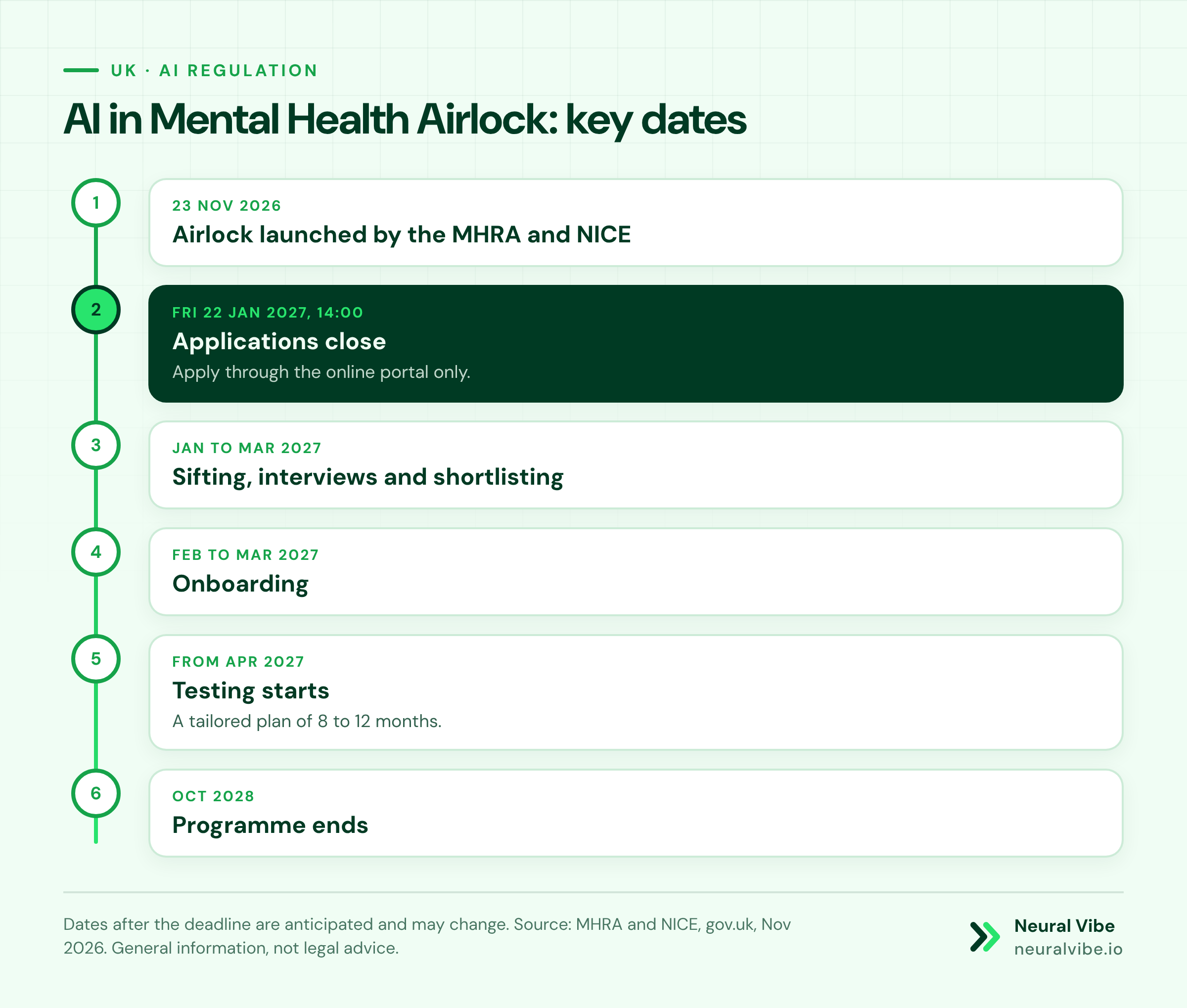
- 23 November 2026: launched
- 14:00, Friday 22 January 2027: applications close
- January to March 2027: sifting, interviews and shortlisting
- February to March 2027: onboarding
- April 2027: testing starts, with an 8 to 12 month testing plan
- October 2028: programme ends
Dates after the deadline are anticipated and may change.
Watch the deadline time. The press release and MHRA’s LinkedIn post say 17:00. The apply page says 14:00, twice. Submit before 14:00 to be safe.
You can only submit through the online portal. A Word form is available for drafting, but Word submissions will not be accepted.
Should your startup apply?
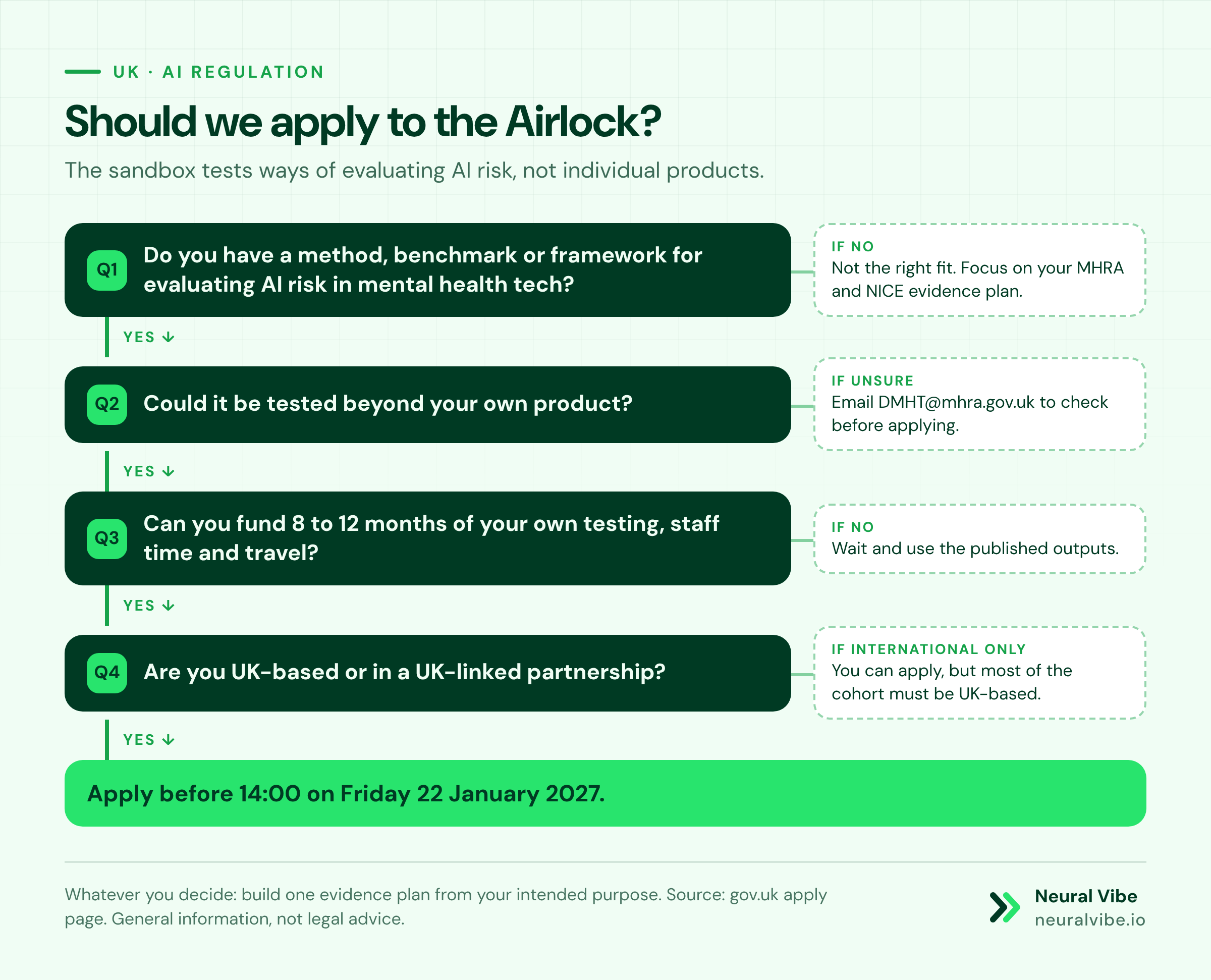
Work through these four questions.
- Do you have an evaluation approach, not just a product? Think of a crisis-detection test harness, a red-teaming method for chatbot advice, a drift monitoring framework or a bias benchmark.
- Could it be tested more widely than your own product? The official pages do not say whether a product developer can apply with an in-house method. If you are unsure, email [email protected] before you write.
- Can you fund it? There is no grant. Count staff time across an 8 to 12 month testing plan, plus data access and travel.
- Can you show UK relevance and commitment to lived experience? Both are explicit requirements.
No to question 1? This round is not for you, and that is fine. The next section is still the most valuable work you can do.
How do you build one evidence plan for MHRA and NICE?
Founders often build evidence for the MHRA, then rebuild it for NICE and NHS buyers. We recommend one plan from day one, anchored on your intended purpose.
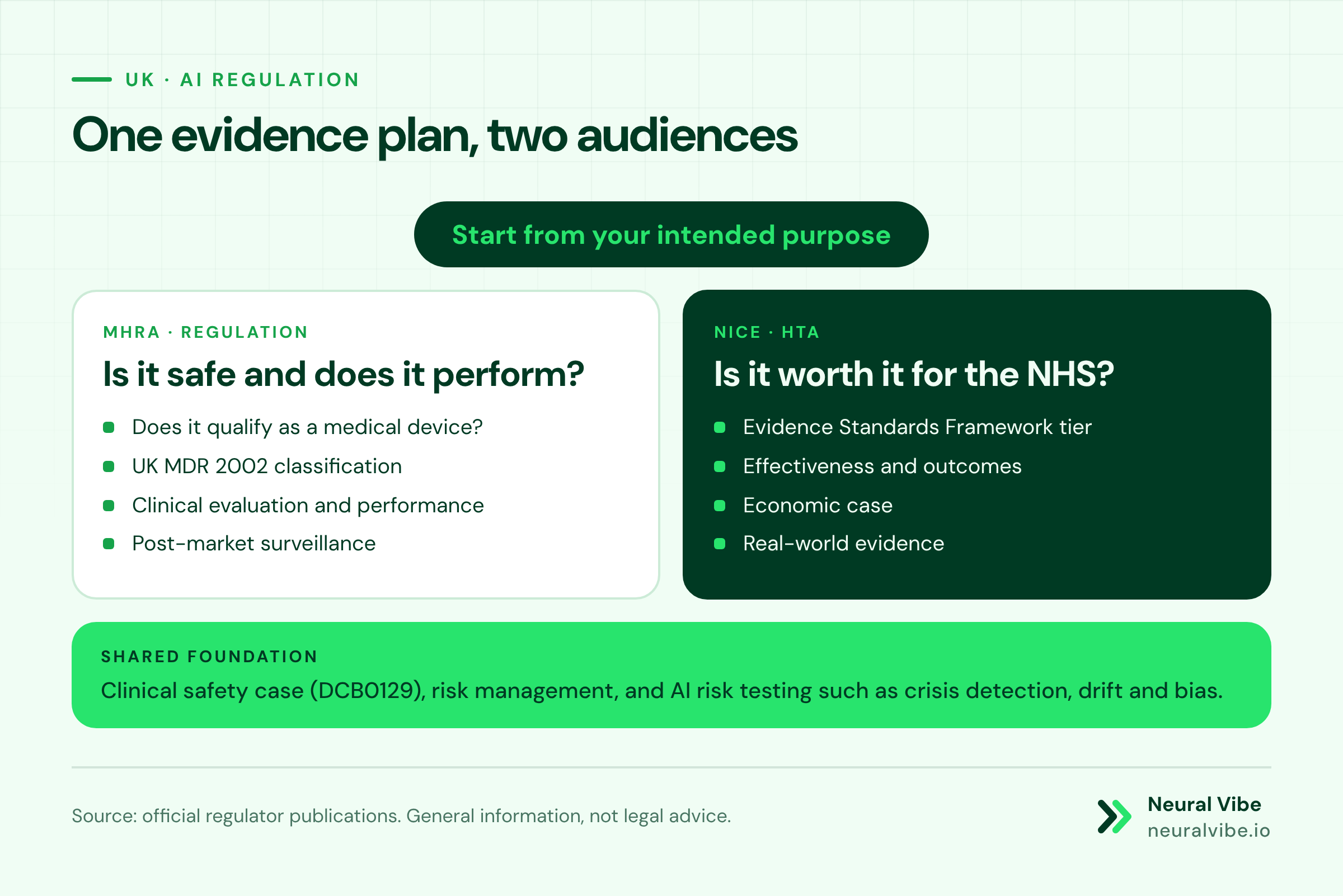
1. Write the intended purpose first. State who it is for, what it does, which condition and what decisions it informs. Everything else follows from this.
The MHRA’s guidance, Digital mental health technology: qualification and classification (February 2025), covers how to describe intended purpose and when a DMHT counts as software as a medical device (SaMD). Our guide Is my software a medical device? walks through the qualification question.
2. Take a classification view under UK MDR. Decide whether the product qualifies as a medical device and, if so, its likely class under the UK Medical Devices Regulations 2002 (UK MDR).
- Class I is self-certified.
- Class IIa and above need an Approved Body.
Some mental health chatbots have a medical purpose and some do not. Your claims decide which side you fall on. See UKCA, CE and the MHRA for the GB market route.
3. Map NICE’s Evidence Standards Framework (ESF). The ESF for digital health technologies sets out the evidence expected at each tier. Reuse the same studies for clinical evaluation and HTA where you can.
4. Build the clinical safety case. DCB0129 applies to manufacturers of health IT used in the NHS. Your hazard log should name the AI risks listed above.
NHS England is reviewing DCB0129 and DCB0160, so check the current version before you rely on it.
5. Plan post-market monitoring. Drift and crisis-detection failures appear after launch. Show how you will detect them and act. Our guide to post-market surveillance in Great Britain explains the rules.
Application checklist
- One-paragraph intended purpose
- Written view on qualification and UK MDR class
- ESF tier and evidence gaps mapped
- DCB0129 hazard log covering AI-specific risks
- Clear description of the method you want to test, and why it generalises
- Lived experience involvement, planned or in place
- Budget for 8 to 12 months of participation
- Drafted offline, submitted on the portal before 14:00 on 22 January 2027
What if you don’t get a place?
Only five places are available, so most applicants will miss out. The work still pays off:
- Reuse your evidence. Your intended purpose, evidence plan and safety case all support UK market entry and NHS procurement.
- Use what is already published. The DMHT programme has released qualification and classification guidance, patient-reported outcome resources and adverse event reporting work on GOV.UK.
- Follow the main AI Airlock. It covers AI as a medical device. Its pilot and phase 2 reports are public, and the MHRA has published a phase 3 application page.
- Watch for the reports. The HTA Lab and Airlock reports may shape future guidance and evidence standards.
FAQ
Is the AI in Mental Health Airlock a route to market?
No. The official pages say it is exploratory, not a route to market and not a form of MHRA assessment. You still need your own conformity route if your product is a medical device.
Does my product need to be a medical device to apply?
The apply page does not require it. The sandbox evaluates methods, not devices, and is open to commercial, academic, charity and NHS organisations.
Is the AI in Mental Health Airlock funded?
No. There is no fee, but participants pay for their own studies, testing, data access and travel.
What time do AI in Mental Health Airlock applications close?
The apply page says 14:00 on Friday 22 January 2027. The press release says 17:00. We recommend you submit before 14:00.
How we can help
The deadline is under two months away. We help health-tech teams write their intended purpose, take a UK MDR classification view, map evidence against the NICE ESF and build DCB0129 safety cases. We can also prepare and review your Airlock application before 22 January.
Get an instant quote or send us a note. We reply within one working day.
Sources
- GOV.UK: AI in Mental Health Airlock to support safe innovation (MHRA and NICE, 23 November 2026)
- GOV.UK: Apply for the AI in Mental Health Airlock
- GOV.UK: Digital mental health technology collection (MHRA)
- GOV.UK: Digital mental health technology: qualification and classification
- GOV.UK: AI Airlock, the regulatory sandbox for AIaMD
- NICE: Evidence standards framework for digital health technologies (ECD7)
- NHS England Digital: DCB0129 Clinical Risk Management

About the author
Brett Marshall
Founder and Principal Consultant at Neural Vibe. 25+ years in regulated technology, ISO lead implementer and auditor, and external DPO for health-tech companies.