Key points
- Your intended purpose, as shown in your labelling, website and app store copy, decides whether your software is a medical device.
- Software that diagnoses, monitors, predicts or treats a condition for an individual patient is likely to be a device in the UK, EU and US.
- Wellness, admin, simple record-keeping and some clinical decision support tools usually fall outside regulation, but the boundaries are narrow.
Your software is a medical device if you intend it to be used for a medical purpose for individual people, such as diagnosing, monitoring, predicting or treating a disease or condition. Regulators judge this from what you say the product does. Your labelling, website, app store listing and marketing all count.
Wellness, admin and simple record-keeping tools usually fall outside regulation, but the line is narrower than most founders expect.
At a glance
- The deciding factor: your intended purpose, in everything you publish
- Likely a device: diagnoses, screens, triages, predicts, monitors or treats an individual
- Usually not: wellness, admin, booking, simple records and data storage
- Disclaimers do not work if you make medical claims elsewhere
This is general information, not legal advice. Your answer depends on your exact intended purpose.
Why does the question matter?
If your software is a medical device, you must meet device regulations before you sell or supply it. That means a quality management system, clinical evidence, technical documentation and, for most products, an independent review.
Getting it wrong in either direction hurts:
- Over-regulating burns runway.
- Under-regulating can mean enforcement action, delisting from app stores and lost NHS, hospital or investor deals.
The good news: the UK, EU and US all start from the same idea. Intended purpose decides.
How does the MHRA decide in Great Britain?
The Medicines and Healthcare products Regulatory Agency (MHRA) guidance on stand-alone software and apps says a medical purpose “is determined by what the manufacturer states in the device’s labelling”. That includes promotional material such as app store descriptions.
A general disclaimer such as “this product is not a medical device” does not work if you make medical claims elsewhere.
Words that point towards a device when linked to a disease or condition include “screening”, “triage”, “predicts”, “detects”, “risk of” and “calculates”.
Pointing the other way: the MHRA says monitoring general fitness, health and wellbeing “is not usually considered to be a medical purpose”. An electronic record that simply replaces a paper file is not a device.
Market access note: on 21 October 2026 the government confirmed it will continue to accept CE marked medical devices in Great Britain on a long-term basis. This still has to be implemented in legislation, which the government says it will make, subject to parliamentary approval, before 30 June 2028. Until then, current deadlines remain: EU MDR devices until 30 June 2030, and most devices under the older EU directives until 30 June 2028 or earlier certificate expiry. UKCA marking remains the domestic route. Northern Ireland applies the EU MDR and IVDR.
We cover GB market access in detail in UKCA, CE and the MHRA in 2026.
How does the EU decide?
Article 2(1) of the EU Medical Devices Regulation (MDR) 2017/745 names software explicitly. A device is any “instrument, apparatus, appliance, software” intended for specific medical purposes, including “diagnosis, prevention, monitoring, prediction, prognosis, treatment or alleviation of disease”.
The key guidance is MDCG 2019-11 rev.1 (June 2025) from the Medical Device Coordination Group. Its decision steps ask:
- Is it software?
- Is it an accessory, or does it drive or influence a hardware device?
- Does it do more than store, archive, communicate, run a simple search or compress data losslessly?
- Is that action for the benefit of individual patients?
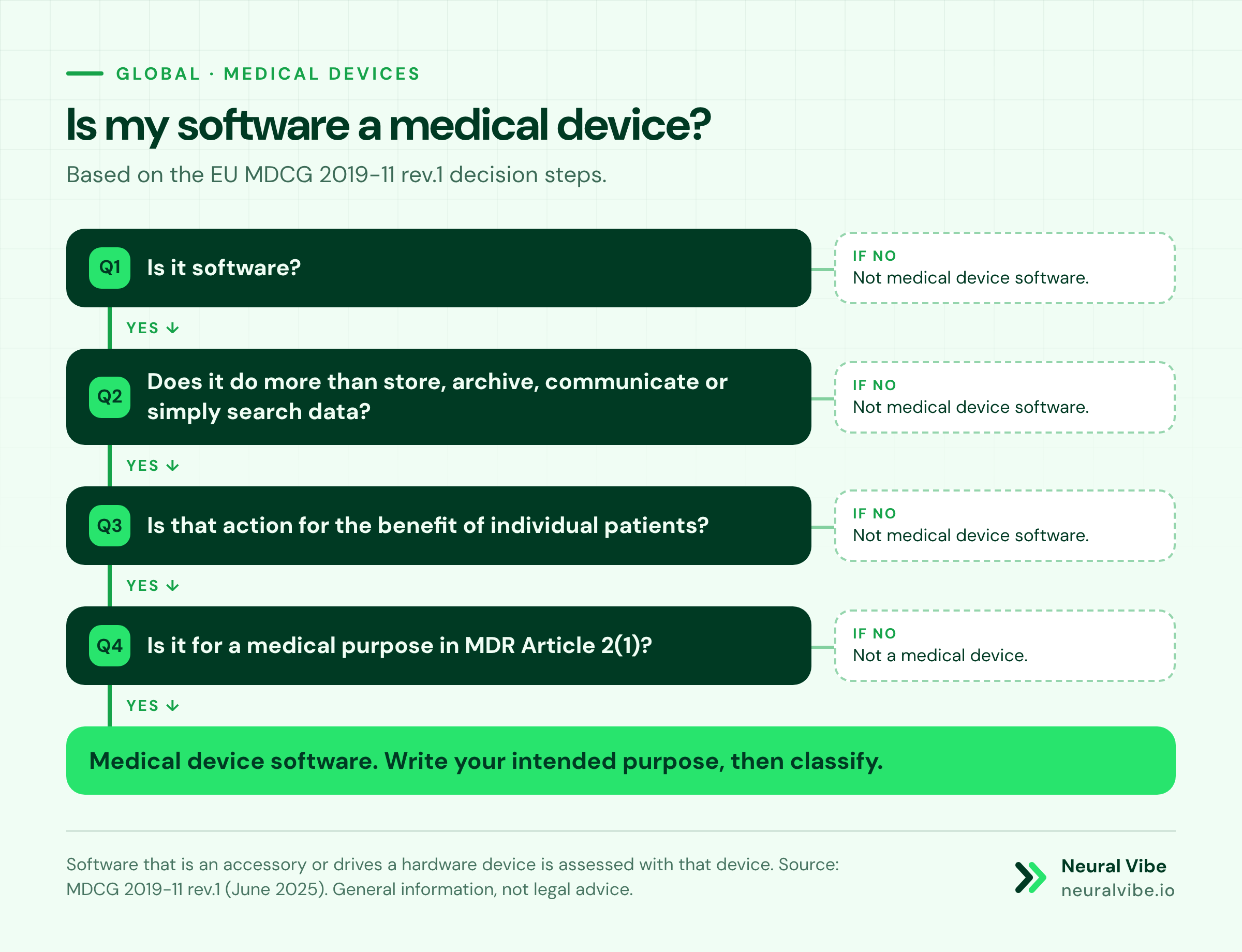
If the answers lead to yes, it is medical device software. Rev.1 stresses that:
- a clear, complete intended purpose is essential;
- each module of a modular product needs its own defined purpose;
- AI-based devices must also consider the EU AI Act (see EU AI Act for health-tech: what to do first).
How does the FDA decide in the US?
Section 201(h) of the Federal Food, Drug, and Cosmetic Act covers products “intended for use in the diagnosis of disease or other conditions”, or in their cure, mitigation, treatment or prevention.
The 21st Century Cures Act then removed certain software functions from that definition (section 520(o)):
- administrative support, such as billing and scheduling
- software for a healthy lifestyle, unrelated to disease
- electronic patient records, within set conditions
- software that only transfers, stores, converts or displays lab or device data without interpreting it
- certain clinical decision support (CDS) software for healthcare professionals
Two guidances were revised in January 2026:
- Clinical Decision Support Software: issued 6 January 2026, corrected version 29 January 2026. Non-device CDS must not analyse medical images or signals, must display or analyse medical information, must support a healthcare professional’s recommendations, and must let that professional independently review the basis. Time-critical functions do not meet the last criterion.
- General Wellness: Policy for Low Risk Devices (6 January 2026): now covers some non-invasive products that estimate parameters such as heart rate variability or oxygen saturation, for wellness only. Naming diseases, clinical thresholds or prompts to act clinically takes you out of the policy.
The FDA’s device software functions and mobile medical apps guidance also says it does not intend to enforce requirements for some low-risk device functions.
Quick test: is your software likely to be regulated?
Answer honestly, based on your marketing as well as your code.
- Does it make a claim about a specific disease, injury or condition?
- Does it diagnose, screen, triage, predict risk, monitor or treat for an individual?
- Does it analyse medical images, physiological signals or lab data?
- Does it calculate a dose or recommend a specific treatment?
- Does it drive or control a hardware medical device?
- Do patients or clinicians rely on its output without being able to check how it got there?
One or more ticks means you are probably regulated in at least one market. No ticks is a good sign, but check your planned features and claims too.
What are common examples?
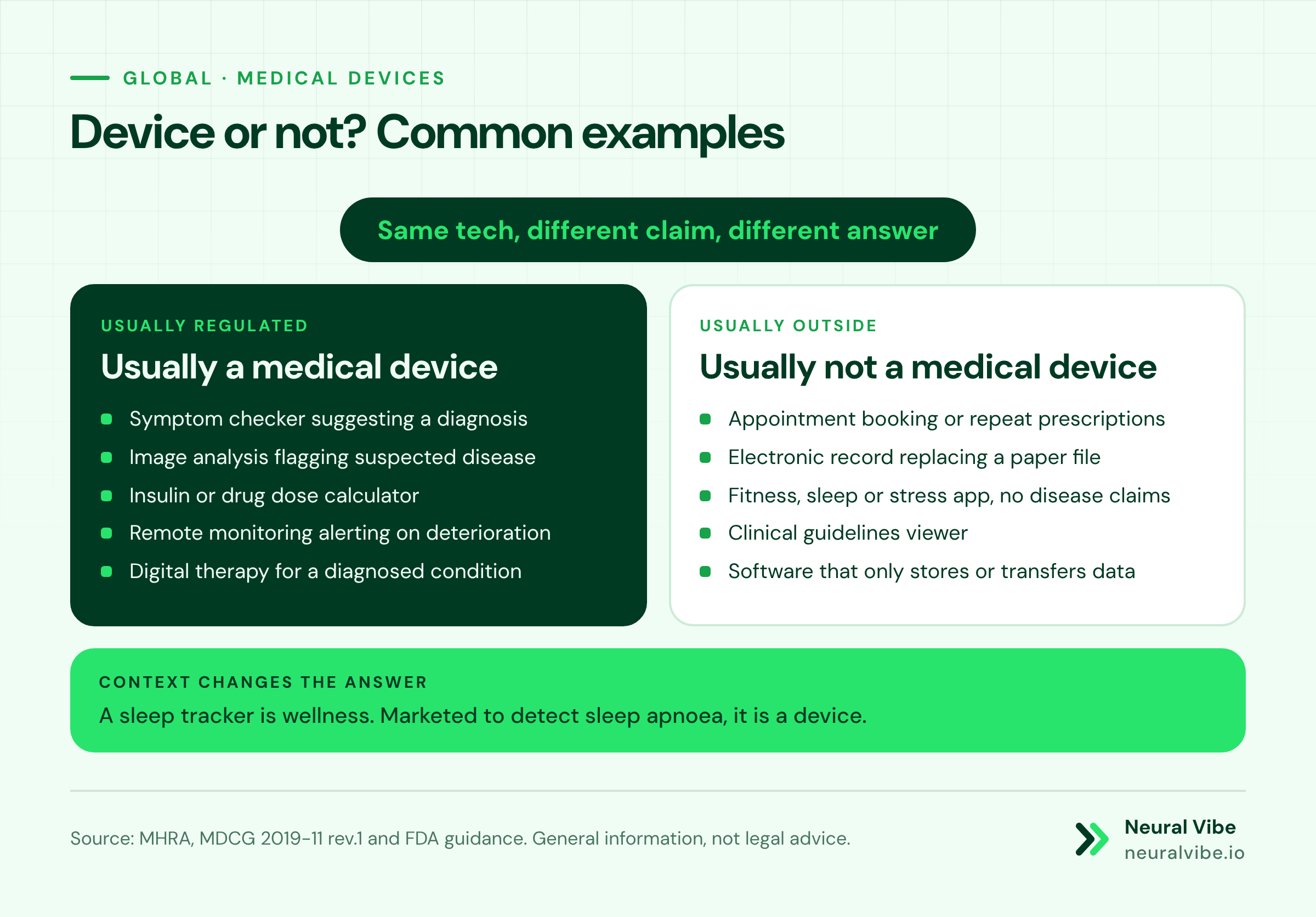
| Usually a medical device | Usually not a medical device |
|---|---|
| Symptom checker that suggests a likely diagnosis | Appointment booking or repeat prescription requests |
| Image analysis that flags suspected disease | Electronic record that replaces a paper file |
| Insulin or drug dose calculator | General fitness, sleep or stress app with no disease claims |
| Remote monitoring app that alerts on deterioration | Reference library or clinical guidelines viewer |
| Digital therapy that treats a diagnosed condition | Software that only stores or transfers data |
| AI risk score used for a patient’s treatment | Population analytics or epidemiology dashboards |
Context changes the answer. A sleep tracker is wellness. The same tracker marketed to “detect sleep apnoea” is a device.
What happens if the answer is yes?
- Write your intended purpose. It drives everything else. The MHRA publishes guidance on crafting an intended purpose for software.
- Classify per market. Classes differ (see below).
- Build your quality system and evidence. Plan a quality management system (usually ISO 13485), software lifecycle and risk processes, cybersecurity, usability and clinical evaluation.
- Pick your market sequence. With CE recognition set to continue in Great Britain, many startups plan EU first and use the CE mark for GB access. That depends on your class and timeline.
| Market | How software is classified |
|---|---|
| EU | Rule 11: decision-informing software is class IIa by default, IIb for serious deterioration or surgery, III for death or irreversible deterioration. Monitoring is IIa, or IIb for vital parameters with immediate danger. All other software is class I |
| Great Britain | Current UK rules differ. In our experience much stand-alone software is class I, with IIa or IIb for some diagnostic and monitoring functions. Class I is self-declared; all devices must be registered with the MHRA; non-UK manufacturers need a UK Responsible Person |
| US | Class I, II or III. Most class II need 510(k) clearance, most class III need premarket approval (PMA). Novel low to moderate risk devices can use De Novo |
For the EU detail, read EU MDR Rule 11 in plain English.
What about other markets?
Canada, Australia and Brazil follow a similar logic:
- Canada: Health Canada’s SaMD guidance uses an intended-use approach, with four exclusion criteria for decision support software.
- Australia: the TGA excludes set categories, such as general wellness, clinical workflow and electronic health records. See TGA rules for software-based medical devices.
- Brazil: ANVISA regulates SaMD under RDC 657/2022, in force since 1 July 2022, with exclusions for wellness and administrative software.
Each market classifies differently, so do not assume your EU or US class carries over.
FAQ
Can I avoid regulation by adding a disclaimer?
No. The MHRA says general disclaimers are not acceptable if you make medical claims, and EU and US regulators look at your intended purpose across all your materials. Change the claims, not the small print.
My app is only for clinicians. Does that make it exempt?
Not on its own. In the US, some CDS for healthcare professionals is excluded, but only if it meets all four criteria. In the UK and EU there is no general exemption for clinician-facing tools.
Is AI software treated differently?
The qualification test is the same: intended purpose decides. AI products often sit in higher classes, and in the EU the AI Act may add requirements for AI medical devices.
What if only one feature is medical?
Regulators can look at modules separately. MDCG 2019-11 rev.1 says each module needs its own intended purpose, so you may be able to ring-fence the regulated part.
Not sure where your product sits?
Tell us what your software does and what you plan to claim. Get an instant quote, or send us a note. We reply within one working day.
Sources
- MHRA: Medical device stand-alone software including apps (including IVDMDs)
- MHRA: Software and artificial intelligence (AI) as a medical device
- UK Government: Government confirms indefinite recognition of CE marked medical devices (21 October 2026)
- MHRA: Timelines for acceptance of CE marked medical devices in Great Britain
- Regulation (EU) 2017/745 on medical devices (MDR)
- MDCG 2019-11 rev.1: Qualification and classification of software (June 2025)
- FDA: How to determine if your product is a medical device
- FDA: Clinical Decision Support Software (final guidance, January 2026)
- FDA: General Wellness: Policy for Low Risk Devices (January 2026)
- FDA: Changes to Existing Medical Software Policies Resulting from Section 3060 of the 21st Century Cures Act
- FDA: Policy for Device Software Functions and Mobile Medical Applications
- Health Canada: Software as a Medical Device (SaMD): Definition and Classification
- TGA: Excluded software

About the author
Brett Marshall
Founder and Principal Consultant at Neural Vibe. 25+ years in regulated technology, ISO lead implementer and auditor, and external DPO for health-tech companies.