Key points
- Your route follows your device classification: a suitable predicate points to 510(k), no predicate and low to moderate risk points to De Novo, and Class III points to PMA.
- eSTAR is mandatory for 510(k) and De Novo submissions to CDRH, so plan your documentation around its structure from day one.
- A Pre-Submission through the Q-Submission programme is the best way to test your pathway and testing plan with FDA before you file.
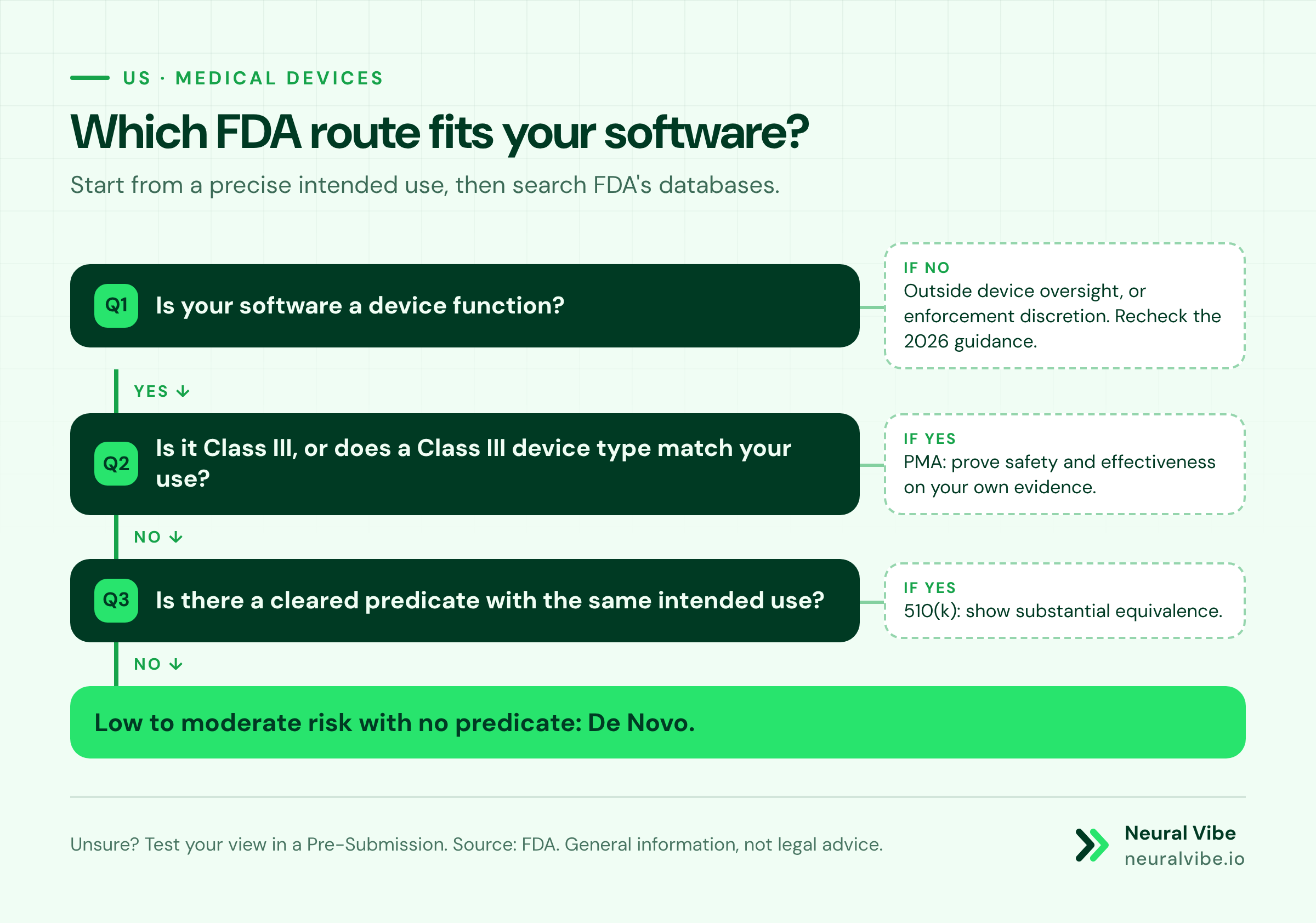
If FDA has already cleared a device with the same intended use and similar technology, you will usually file a 510(k). If your software is novel but low to moderate risk, De Novo lets you create a new classification. If it is high risk (Class III), you need Premarket Approval (PMA).
The right route depends on your intended use and risk, not on how innovative your code feels. Here is how to choose, and how to test your choice with FDA before you file.
At a glance
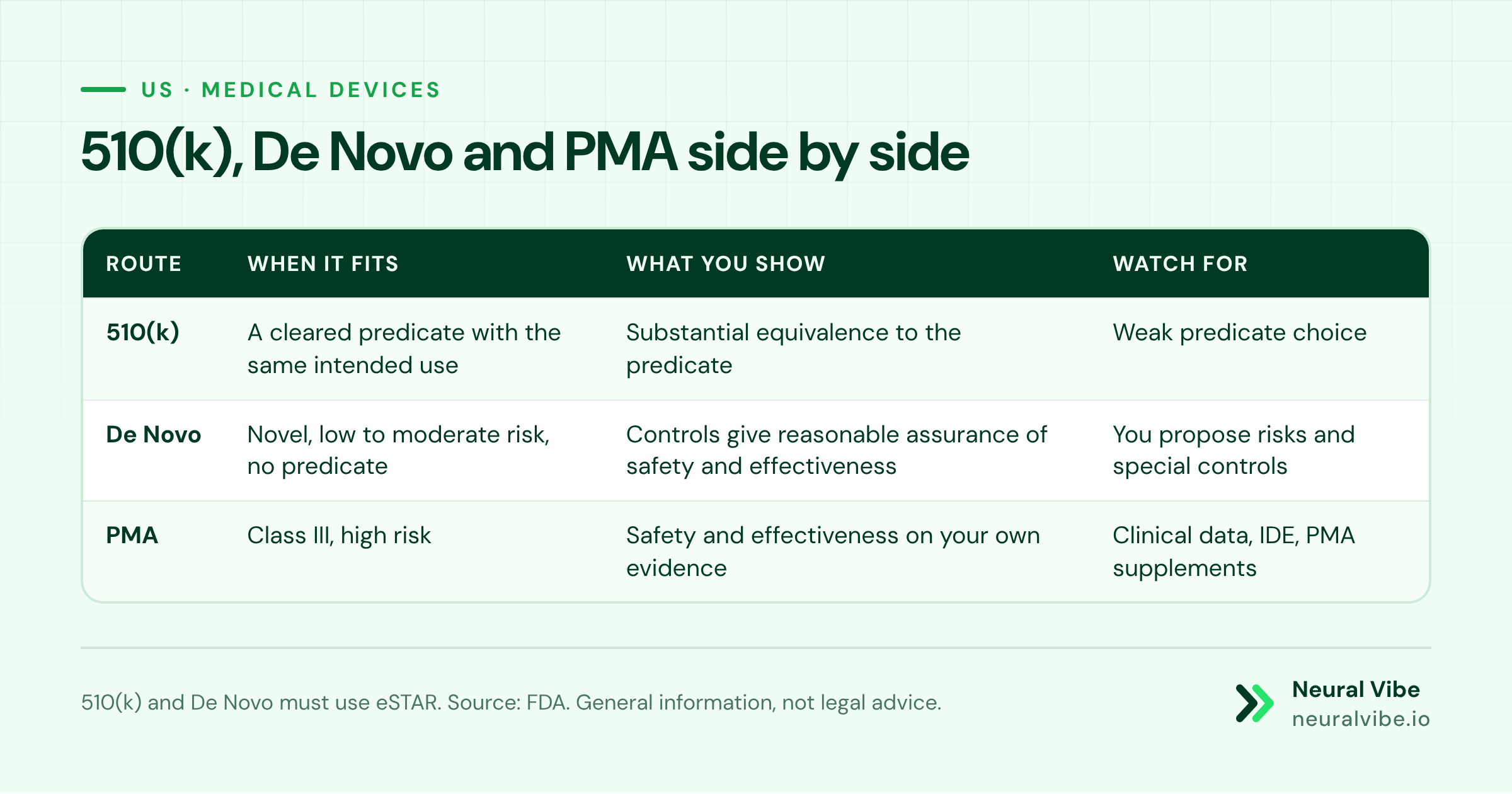
- 510(k): a suitable predicate exists. Show substantial equivalence.
- De Novo: no predicate, low to moderate risk. Create a new classification.
- PMA: Class III. Prove safety and effectiveness on your own evidence.
- eSTAR is mandatory for 510(k) and De Novo. A Pre-Sub lets you check your plan first.
This article is general information, not legal advice.
Is your software a device at all?
Check this first. Some software functions, such as certain clinical decision support (CDS) and general wellness tools, fall outside FDA device oversight or are subject to enforcement discretion. FDA issued updated final guidance on both in January 2026, so recheck any earlier assessment. Our guide Is my software a medical device? walks through it.
Why does classification decide your pathway?
FDA places devices in three classes based on risk:
- Class I: low risk. Many are exempt from premarket submission.
- Class II: moderate risk. Most need a 510(k), and special controls apply.
- Class III: high risk, for example supporting or sustaining life, or presenting a potential unreasonable risk of illness or injury. These generally need a PMA.
Most software as a medical device (SaMD) reaches the market through 510(k) or De Novo. Your practical first step is to search FDA’s product classification database and the 510(k), De Novo and PMA databases for devices with a similar intended use. What you find tells you a lot.
When does a 510(k) fit?
A 510(k) is a premarket notification. You show your device is substantially equivalent to a legally marketed device, the predicate. That means the same intended use, and either the same technology or differences that do not raise different questions of safety and effectiveness, backed by performance data.
It fits when:
- there is a cleared predicate with the same intended use, and
- your technical differences, such as a new algorithm, can be addressed by testing.
Watch for:
- Predicate choice. A weak or poorly matched predicate is a common cause of additional information requests.
- Later changes. Significant changes, including some software changes, can need a new 510(k). For AI-enabled software, a predetermined change control plan (PCCP) authorised in your submission can allow certain planned changes without one. See our guide to FDA PCCPs for AI-enabled devices.
When should you choose De Novo?
De Novo is for novel devices of low to moderate risk where no predicate exists. If FDA grants your request, it creates a new classification regulation and places the device in Class I or II, with special controls where needed. Your device can then act as a predicate for future 510(k)s, including your competitors’.
It fits when:
- your intended use or technology is genuinely new, with no suitable predicate, and
- general controls, or general and special controls, can give reasonable assurance of safety and effectiveness.
Watch for:
- More thinking up front. You propose the risks and mitigations yourself, and often draft the special controls.
- Timing. You can file De Novo directly, or after a “not substantially equivalent” decision on a 510(k). Going direct usually saves time if you already know no predicate fits. FDA recommends considering a Pre-Submission first.
When is PMA required?
PMA is FDA’s most demanding pathway. You must show reasonable assurance of safety and effectiveness on your own evidence, not by comparison. PMAs usually need valid scientific evidence from clinical investigations, a detailed manufacturing review and often a pre-approval inspection.
- A significant risk clinical study may need an Investigational Device Exemption (IDE) approved by FDA before you start.
- Post-approval changes often need PMA supplements.
Few software-only products need a PMA, but it does happen, so check classification early.
What is eSTAR and when must you use it?
eSTAR (electronic Submission Template And Resource) is FDA’s interactive PDF template for premarket submissions. It guides you through each section and checks completeness.
- Mandatory: 510(k)s and De Novo requests to FDA’s device centre (CDRH) must use eSTAR, unless exempted, and go through the CDRH Portal. For De Novo, this has applied since 1 October 2025.
- Voluntary: eSTAR can also be used for PMAs, IDEs and 513(g) requests. A version called PreSTAR covers Pre-Submissions and other Q-Submissions.
- No partial files: the CDRH Portal will not accept an eSTAR that the template flags as incomplete.
Our tip: eSTAR has fixed sections for software, cybersecurity, labelling, biocompatibility and performance testing. Structure your technical documentation the same way from day one.
Two FDA guidances shape the software content:
- Content of Premarket Submissions for Device Software Functions (final, June 2023) sets a Basic or Enhanced documentation level based on your software’s risk.
- Cybersecurity in Medical Devices: Quality Management System Considerations and Content of Premarket Submissions, reissued in February 2026 to align with the Quality Management System Regulation (QMSR), covers section 524B for “cyber devices”, broadly devices that include software and can connect to the internet. See our guide to FDA section 524B.
How can you test your route with FDA first?
Use the Q-Submission programme. The most useful type for founders is the Pre-Submission (Pre-Sub): you send specific questions, for example on pathway, predicate, test plan or study design, and FDA replies in writing, with an optional meeting. FDA’s guidance was updated on 29 May 2025.
- Timing: FDA aims to give written feedback within 70 days, or at least 5 days before a scheduled meeting, whichever is sooner.
- Format: written feedback only, or feedback plus a meeting, normally a one hour video call. You draft the minutes.
- Status: feedback is FDA’s best advice, not a decision. FDA generally will not change it if your later submission is consistent and no important new issues arise.
- Scope: specific questions, not a pre-review of your whole submission.
Other Q-Sub types include Breakthrough Device designation requests, Submission Issue Requests, Study Risk Determinations and Informational Meetings. Separately, a 513(g) request gives FDA’s view on the classification and requirements for your device.
Your step-by-step plan
- Write your intended use and indications for use precisely. Everything flows from this.
- Confirm device status and check for exemptions or enforcement discretion.
- Search FDA databases for product codes, classification regulations and possible predicates.
- Pick a working pathway: 510(k), De Novo or PMA.
- Set your software documentation level (Basic or Enhanced) and decide if you have a cyber device.
- Draft a Pre-Sub with focused questions on pathway, predicate and testing.
- Put your quality system in place. Since 2 February 2026, FDA’s Quality Management System Regulation aligns with ISO 13485:2016. See FDA’s QMSR explained.
- Build your submission in eSTAR and check every section before filing.
FAQ
Can we choose De Novo to avoid using a competitor’s device as a predicate?
Not really. If a suitable predicate exists, FDA will expect a 510(k). A Pre-Sub is a sensible way to test your view if the answer is unclear.
How long does FDA review take?
FDA has review time goals under its user fee agreements, but total time also depends on how quickly you answer questions, because the clock pauses when FDA asks for more information. A complete, well organised submission is the best way to avoid delays.
Do we need clinical data for a 510(k)?
Not always. Many software 510(k)s rely on analytical and performance testing. Clinical data is more common where your algorithm makes diagnostic claims or differs from the predicate in ways testing cannot address.
Can a UK or EU company file with FDA directly?
Yes. Foreign manufacturers can submit, but a foreign establishment must name a US agent in its establishment registration, and you must register and list your device when you begin commercial distribution.
Talk to us
Want a second opinion on your FDA route? Get an instant quote, or send us a note and we will reply within one working day. We can prepare your Pre-Sub and eSTAR submission for you.
Sources
- The 510(k) Program: Evaluating Substantial Equivalence in Premarket Notifications, FDA guidance
- De Novo Classification Request, FDA
- Step 3: Pathway to Approval, FDA
- eSTAR Program, FDA
- Requests for Feedback and Meetings for Medical Device Submissions: The Q-Submission Program, FDA guidance
- Guidances with Digital Health Content, FDA
- Cybersecurity in Medical Devices: Quality Management System Considerations and Content of Premarket Submissions, FDA guidance

About the author
Brett Marshall
Founder and Principal Consultant at Neural Vibe. 25+ years in regulated technology, ISO lead implementer and auditor, and external DPO for health-tech companies.