Key points
- A PCCP, authorised as part of your 510(k), De Novo or PMA, lets you make specified changes to an AI-enabled device later without a new marketing submission.
- FDA expects three parts: a description of modifications, a modification protocol and an impact assessment.
- FDA's wider AI-enabled device lifecycle guidance is still in draft, but it is the best guide to what reviewers expect.
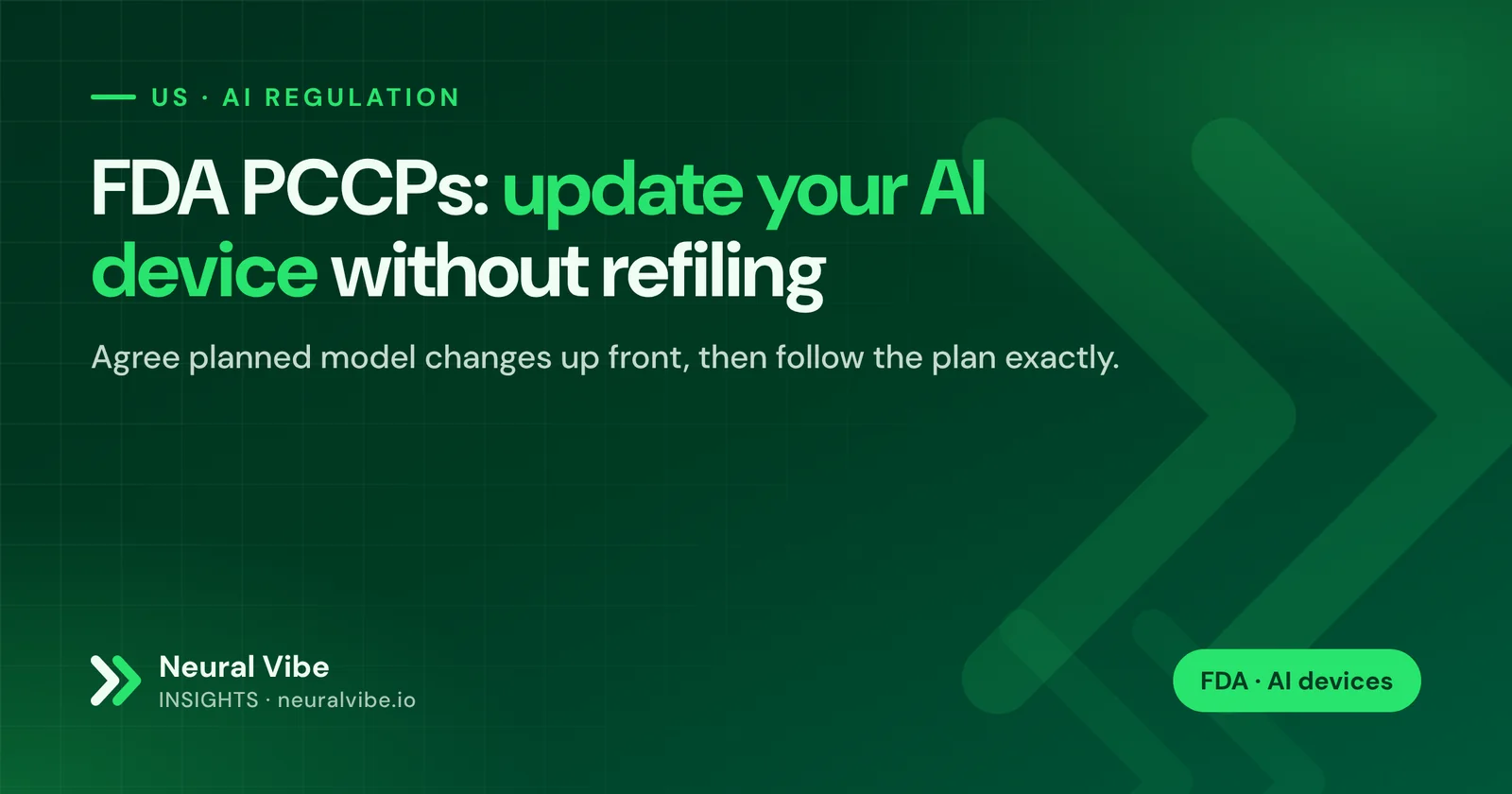
A predetermined change control plan (PCCP) lets you agree with FDA, up front, the changes you will make to your AI-enabled device later, so you can make them without a new marketing submission. You set out the planned changes and how you will develop, validate and roll them out in your original 510(k), De Novo or premarket approval (PMA) submission. Once FDA authorises the device with its PCCP, you can make those specific changes, provided you follow the plan exactly.
For AI products that need regular retraining or performance updates, it is one of the most useful tools in the US system.
At a glance
- What: a plan, authorised with your device, for specified future changes
- Three parts: description of modifications, modification protocol, impact assessment
- Pathways: 510(k), De Novo and PMA
- Limits: no change to intended use; stay inside the plan
This is general information, not legal advice.
Why do PCCPs exist?
Under the normal rules, a significant change to a cleared or approved device can need a new marketing submission. For AI software, where models are retrained, thresholds tuned and inputs extended, that can mean filing again and again.
Section 515C of the Federal Food, Drug, and Cosmetic Act (FD&C Act), added by the Food and Drug Omnibus Reform Act (FDORA), allows FDA to authorise a PCCP as part of a device’s marketing authorisation. Changes made in line with an authorised PCCP do not need a new submission. FDA’s final guidance on PCCPs for AI-enabled device software functions sets out what it expects to see.
Where does FDA’s AI guidance stand in 2026?
There are two FDA documents to know, and they are designed to be read together.
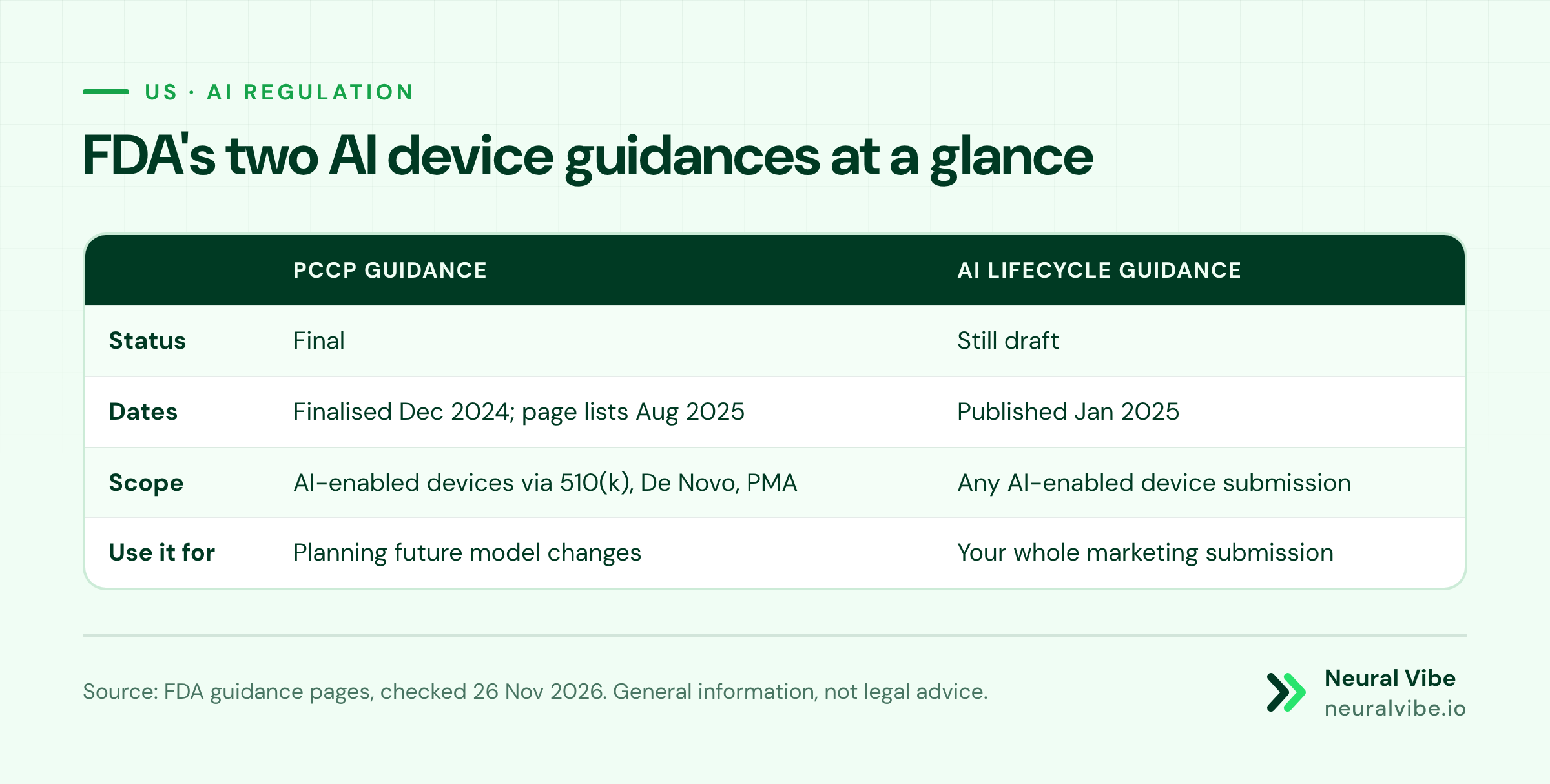
The PCCP guidance (final). “Marketing Submission Recommendations for a Predetermined Change Control Plan for Artificial Intelligence-Enabled Device Software Functions” was finalised in December 2024. FDA’s page now lists an issue date of August 2025. It covers AI-enabled devices reviewed through the 510(k), De Novo and PMA pathways, including the device part of device-led combination products. The final version covers AI-enabled device software functions generally, not only machine learning.
The lifecycle guidance (still draft). “Artificial Intelligence-Enabled Device Software Functions: Lifecycle Management and Marketing Submission Recommendations” was published as a draft in January 2025 (docket FDA-2024-D-4488). As at the date of this article, FDA’s page still shows it as draft, with comments accepted at any time. It covers device description, data management, model design, performance validation, bias, transparency, cybersecurity and postmarket monitoring.
Draft guidance is not for implementation. In our experience, though, it is a sensible guide to the questions reviewers ask.
What are the three parts of a PCCP?
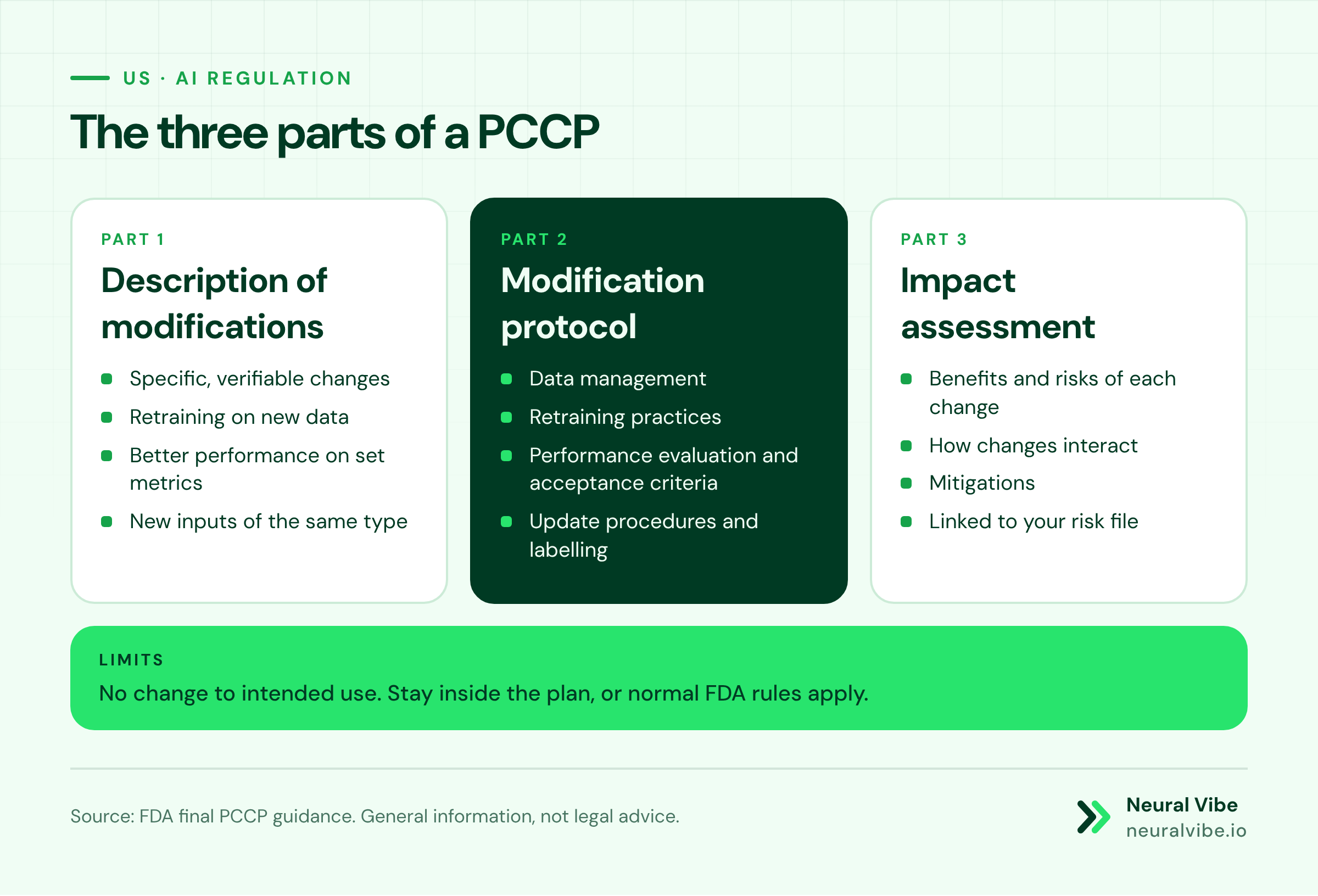
1. Description of modifications
A specific list of the changes you plan to make, with enough detail to understand each one. Examples include:
- retraining on new data from the same intended population;
- improving performance against defined metrics; or
- supporting new input devices of the same type.
Each change should be verifiable and validatable. “The model will improve over time” will not work.
2. Modification protocol
The methods you will use to develop, validate and implement each change. FDA’s guidance says it should cover:
- data management: how new training and test data are collected, curated and kept separate, and how they represent the intended population;
- retraining practices: which parts of the model may change, and how;
- performance evaluation: the metrics, statistical methods and acceptance criteria each change must meet before release; and
- update procedures: how you deploy the change, tell users and update labelling.
3. Impact assessment
An assessment of the benefits and risks of the planned changes, including how they might interact and how you will mitigate risks. Link it to your risk management file.
What can a PCCP not do?
A PCCP is a contract with FDA, not a blank cheque.
- It cannot change the intended use. Changes that would alter intended use, or significantly change indications, generally belong in a new submission.
- You must stay inside the plan. A change outside the authorised PCCP, or one that fails its acceptance criteria, falls back to FDA’s normal rules on whether a new submission is needed.
- It sits inside your quality system. Document each change under your quality management system, which since February 2026 means the Quality Management System Regulation (QMSR).
- Labelling must keep up. FDA recommends that labelling states the device has an authorised PCCP and, as changes are made, describes what has changed.
How do you build a PCCP? Eight steps
- Decide whether you need one. If you expect to retrain or extend your model in the first few years, it is usually worth the upfront work.
- Keep the scope narrow. A few well-defined modifications are easier to authorise than a wish list.
- Define acceptance criteria first. Set metrics and thresholds tied to your original validation.
- Lock down data management. Document how future data is sourced, labelled and held back, and how you stop test data leaking into training.
- Link it to your risk file. Reference specific hazards and controls.
- Use the Q-Submission programme. FDA strongly encourages sponsors to discuss a proposed PCCP through a Pre-Submission before filing. A pre-submission meeting is the best place to test your scope.
- Plan labelling and user communication for updates and version changes.
- Build it into your QMS so every PCCP change is executed, verified and recorded the same way. Our guide to ISO 13485 for startups helps here.
Remember that connected AI software is very likely a cyber device too. See our guide to FDA section 524B.
How does this compare with the UK, EU and Canada?
FDA, Health Canada and the UK MHRA have jointly published guiding principles for PCCPs, so the concepts travel. The legal mechanics differ. Health Canada, for example, has its own PCCP route for machine learning devices, covered in our guide to Health Canada licences. For Europe, start with the EU AI Act for health-tech.
Design your change management process once and map it to each regime, rather than building three.
FAQ
Can a PCCP cover a model that keeps learning in the field?
The guidance is written around planned, controlled changes that are verified and validated before release. Continuous unsupervised learning in the field is much harder to fit within a PCCP, and we would expect it to need very careful discussion with FDA.
Can we add a PCCP to a device already on the market?
A PCCP is authorised as part of a marketing submission, so adding one usually means a new submission for that device. A planned change is a good moment to do it.
Is FDA’s AI-enabled device lifecycle guidance binding?
No FDA guidance is legally binding, and this one is still in draft. It reflects FDA’s current thinking, so following it reduces the risk of review questions.
Does a PCCP replace postmarket monitoring?
No. You still need to monitor real-world performance, handle complaints and meet your reporting duties. Monitoring results often feed the next PCCP update.
Plan your PCCP with us
We help AI health-tech teams design PCCPs, prepare Q-Submissions and build the data management and change control procedures that make them work. Get an instant quote, or send us a note. We reply within one working day.
This article is general information, not legal advice.
Sources
- FDA: Marketing Submission Recommendations for a Predetermined Change Control Plan for Artificial Intelligence-Enabled Device Software Functions (final guidance)
- Federal Register notice of availability, final PCCP guidance (4 December 2024)
- FDA: Artificial Intelligence-Enabled Device Software Functions: Lifecycle Management and Marketing Submission Recommendations (draft guidance, January 2025)
- Federal Register notice of availability, draft AI-enabled device software functions guidance (7 January 2025)

About the author
Brett Marshall
Founder and Principal Consultant at Neural Vibe. 25+ years in regulated technology, ISO lead implementer and auditor, and external DPO for health-tech companies.