Key points
- Use the Commission's NANDO database to confirm a notified body is designated under the MDR for the exact codes your device needs.
- Notified bodies are still handling large volumes of legacy devices moving to the MDR before the 2027 and 2028 deadlines, so approach them early.
- Structured dialogue lets you ask procedural and regulatory questions, but a notified body cannot act as your consultant.
Choose the EU notified body that is designated for your exact device codes, has room to take you on within your timeline, and works in a way your small team can keep up with. Check designation in the Commission’s NANDO database first, then shortlist two to four bodies and talk to them early. Capacity is still tight while legacy devices move across to the Medical Device Regulation (MDR).
You need a notified body if your device is Class IIa or above, or is a Class I device that is sterile, has a measuring function or is a reusable surgical instrument. Here is how we approach the choice with founders.
At a glance
- Check first: NANDO designation under Regulation (EU) 2017/745, for your codes
- Shortlist: two to four designated bodies
- Watch: legacy deadlines of 31 December 2027 and 31 December 2028 are keeping notified bodies busy
- Remember: a notified body assesses you; it cannot advise you
This is general information, not legal advice.
What does a notified body do, and what can it not do?
A notified body is an independent organisation designated by an EU country’s authority to assess whether devices meet the MDR. For most startups, its work has two parts:
- an audit of your quality management system (QMS); and
- a review of your technical documentation, including clinical evidence.
If you pass, it issues certificates. It then carries out surveillance audits and reviews for as long as those certificates are in place.
What it cannot do is help you design your compliance. The MDR prohibits notified bodies from providing consultancy services to the manufacturers they assess. That is why many startups pair a notified body with a regulatory partner who builds the quality system and technical file.
How do you choose a notified body? Five steps
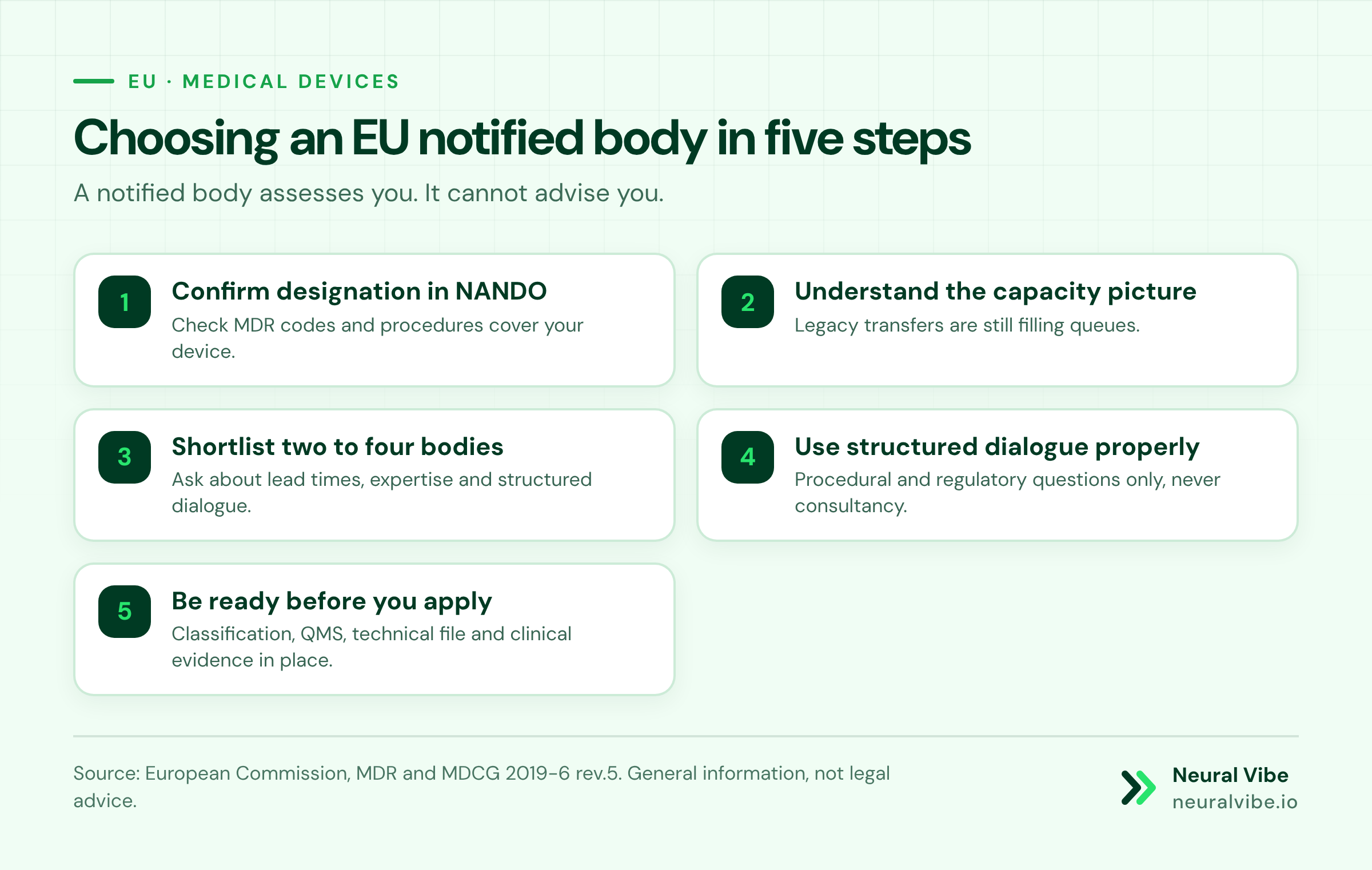
Step 1: confirm designation in NANDO
NANDO is the European Commission’s official database of notified bodies. For each body it lists the legislation it is designated under and the scope of that designation.
Under the MDR, scope is expressed as codes for device types and technologies. A body may be designated for some codes and not others. Before you shortlist anyone:
- Filter NANDO by Regulation (EU) 2017/745.
- Check the designation covers the codes that fit your device, such as codes for active non-implantable devices or software, plus any horizontal codes such as devices incorporating software.
- Check the conformity assessment procedures it is designated for, such as the QMS and technical documentation route in Annex IX.
- Note its four-digit number. It will appear next to your CE mark.
No code, no certificate. If a code you need is missing, that body cannot certify your device, however helpful it seems. Recheck NANDO before you sign, because designations can be extended, restricted, suspended or withdrawn.
Step 2: understand the capacity picture
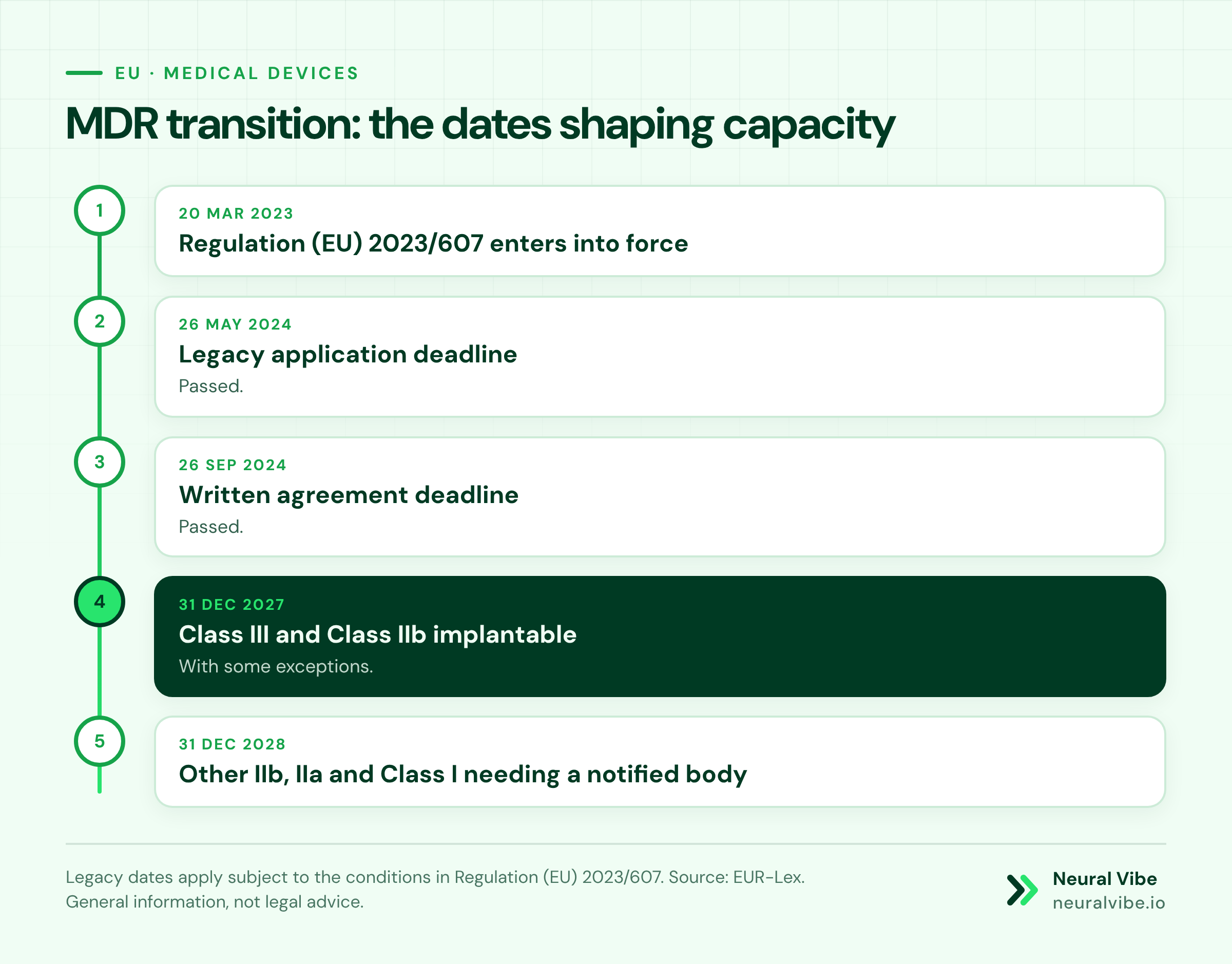
Regulation (EU) 2023/607 extended the transition period for devices certified under the old directives. Subject to the conditions in that Regulation, legacy devices can stay on the market until:
| Deadline | Devices |
|---|---|
| 31 December 2027 | Class III, and Class IIb implantable (with some exceptions) |
| 31 December 2028 | Other Class IIb, Class IIa, and Class I devices that need a notified body |
To benefit, manufacturers had to apply to a notified body by 26 May 2024 and sign a written agreement by 26 September 2024. Those dates have passed.
For a startup with a new device, the extension does not help directly: you need full MDR certification before you sell. But it does mean notified bodies are still working through legacy transfers as those deadlines approach.
The Commission publishes regular notified body surveys on applications and certificates, most recently updated on 8 May 2026. They show progress across the system, not how busy any one body is. So ask each body directly.
Step 3: shortlist and ask the right questions
Contact each of your two to four designated candidates. Ask for their application process, standard terms and published list of standard fees, which the MDR requires notified bodies to make publicly available.
Questions we always ask:
- Are you accepting new manufacturers, and do you prioritise any device types?
- What is your lead time from signed agreement to first audit, and to a certificate decision?
- Do you have assessors with experience in our technology, such as software or AI?
- If our device uses AI, are you designated, or seeking designation, under the EU AI Act?
- Do you offer structured dialogue, and how is it booked and documented?
- Can you audit in our language and time zone, and remotely where the rules allow?
- How do you handle significant changes after certification?
Write the answers down. Compare bodies on scope, timing, experience and communication, not just availability.
Step 4: use structured dialogue properly
The Medical Device Coordination Group (MDCG) guidance on notified body requirements, MDCG 2019-6, was last revised in February 2025 (rev.5). It addresses structured dialogue between notified bodies and manufacturers, before and during conformity assessment.
In practice, structured dialogue helps you clarify procedural and regulatory questions, such as:
- which documents the body expects;
- how it plans the assessment; and
- how it reads a specific requirement.
It must not become consultancy. A notified body will not tell you how to design your device, write your clinical evaluation or fix a gap in your file. Bring clear, specific questions and keep a record of the answers.
Step 5: be ready before you apply
Notified bodies check applications for completeness. An incomplete application wastes your place in the queue. Before you apply, aim to have:
- A clear intended purpose and a documented classification. Our guide to EU MDR Rule 11 for software helps here.
- A working QMS, typically built to ISO 13485, with records showing it operates. See ISO 13485 for startups.
- Technical documentation structured to MDR Annexes II and III.
- A clinical evaluation plan and the clinical evidence your class requires.
- Risk management, usability and, for software, lifecycle and cybersecurity evidence.
- A named person responsible for regulatory compliance, as the MDR requires.
Be open about your history, too. The MDR requires you to declare any earlier application for the same device that another notified body refused, or that you withdrew before a decision. You also cannot apply to two notified bodies in parallel for the same procedure.
Is MDR reform about to change the picture?
Not yet. On 16 December 2025 the Commission proposed changes to the MDR and the In Vitro Diagnostic Regulation (IVDR), reference COM(2025) 1023, aimed at simplifying the rules and reducing the burden on manufacturers. It is still a proposal before the European Parliament and Council, so it is not law. Choose your notified body under the rules that apply today.
FAQ
Can I change notified body later?
Yes, but it takes planning. The MDR sets out a procedure for changing notified body, based on an agreement between you, the incoming body and, where practicable, the outgoing body. It covers points such as when the old certificates stop being valid and how documents are transferred. Choosing well at the start saves this effort.
Does our notified body have to be in our home country?
No. Any notified body designated under the MDR for your device’s codes can certify it, wherever it is based in the EU. A non-EU manufacturer also needs an EU authorised representative.
Can a notified body review our documents before we apply?
It can hold structured dialogue on procedural and regulatory questions. It cannot review your documents to help you improve them before assessment, because that would be consultancy.
How many notified bodies should a startup approach?
We suggest two to four that are designated for your codes. Fewer leaves you with no fallback; more takes time a small team rarely has.
Ready to shortlist your notified body?
We shortlist notified bodies with startups, prepare complete applications and run the assessment with you end to end. If you also plan to sell in the UK, our guide to UKCA, CE and the MHRA covers the GB route.
Get an instant quote, or send us a note. We reply within one working day.
This article is general information, not legal advice.
Sources
- Regulation (EU) 2017/745 on medical devices (MDR)
- Regulation (EU) 2023/607 amending the MDR transitional provisions
- European Commission: Notified bodies and the NANDO information system
- European Commission: Notified bodies for medical devices
- MDCG 2019-6 rev.5: Questions and answers, requirements relating to notified bodies (February 2025)
- European Commission: Notified bodies survey on certifications and applications (update, 8 May 2026)

About the author
Brett Marshall
Founder and Principal Consultant at Neural Vibe. 25+ years in regulated technology, ISO lead implementer and auditor, and external DPO for health-tech companies.