Key points
- Rule 11 starts most decision-support software at Class IIa, and moves it up to IIb or III depending on the harm a wrong decision could cause.
- Your intended purpose drives the class, so write it carefully and keep it consistent across your labelling, website and technical file.
- The Commission's December 2025 proposal to reform the MDR is still going through the legislative process. Rule 11 as written today is the rule you must apply.
Under Rule 11 of the EU Medical Device Regulation (MDR), software that informs diagnostic or therapeutic decisions is Class IIa by default, rising to IIb or III if a wrong decision could cause serious harm or death. Monitoring software is Class IIa, or IIb for vital parameters where changes could mean immediate danger. All other medical device software is Class I.
That is the whole rule. The hard part is applying it honestly to your product, and that is what this guide covers.
At a glance
- Rule 11a, decision support: Class IIa, or IIb or III depending on potential harm
- Rule 11b, monitoring: Class IIa, or IIb for vital parameters with immediate danger
- Rule 11c, everything else: Class I
- Main guidance: MDCG 2019-11 rev.1 (June 2025)
- Reform: the December 2025 proposal is not law, so today’s Rule 11 applies
This is general information, not legal advice.
Is your software a medical device first?
Rule 11 only matters once your software qualifies as medical device software (MDSW). The main reference is MDCG 2019-11 from the Medical Device Coordination Group, revised in June 2025 (rev.1).
It defines MDSW as software intended, alone or in combination, for a purpose within the medical device definition. That applies wherever it runs: on a phone, in the cloud or on another platform.
In plain terms, ask:
- Does it do more than store, archive, communicate, search simply or compress data without loss?
- Does it act for the benefit of individual patients, rather than populations or general wellbeing?
- Does its intended purpose match the device definition, such as diagnosis, prevention, monitoring, prediction, prognosis, treatment or alleviation of disease?
Yes throughout? You are likely dealing with MDSW, and Rule 11 applies. Our guide Is my software a medical device? walks through this in more depth for the UK, EU and US.
The June 2025 revision also confirms the same principles apply to software using artificial intelligence. It points to separate guidance on how the MDR and the EU AI Act interact.
What does Rule 11 actually say?
The rule in Annex VIII of the MDR has three parts. MDCG 2019-11 calls them sub-rules 11a, 11b and 11c.
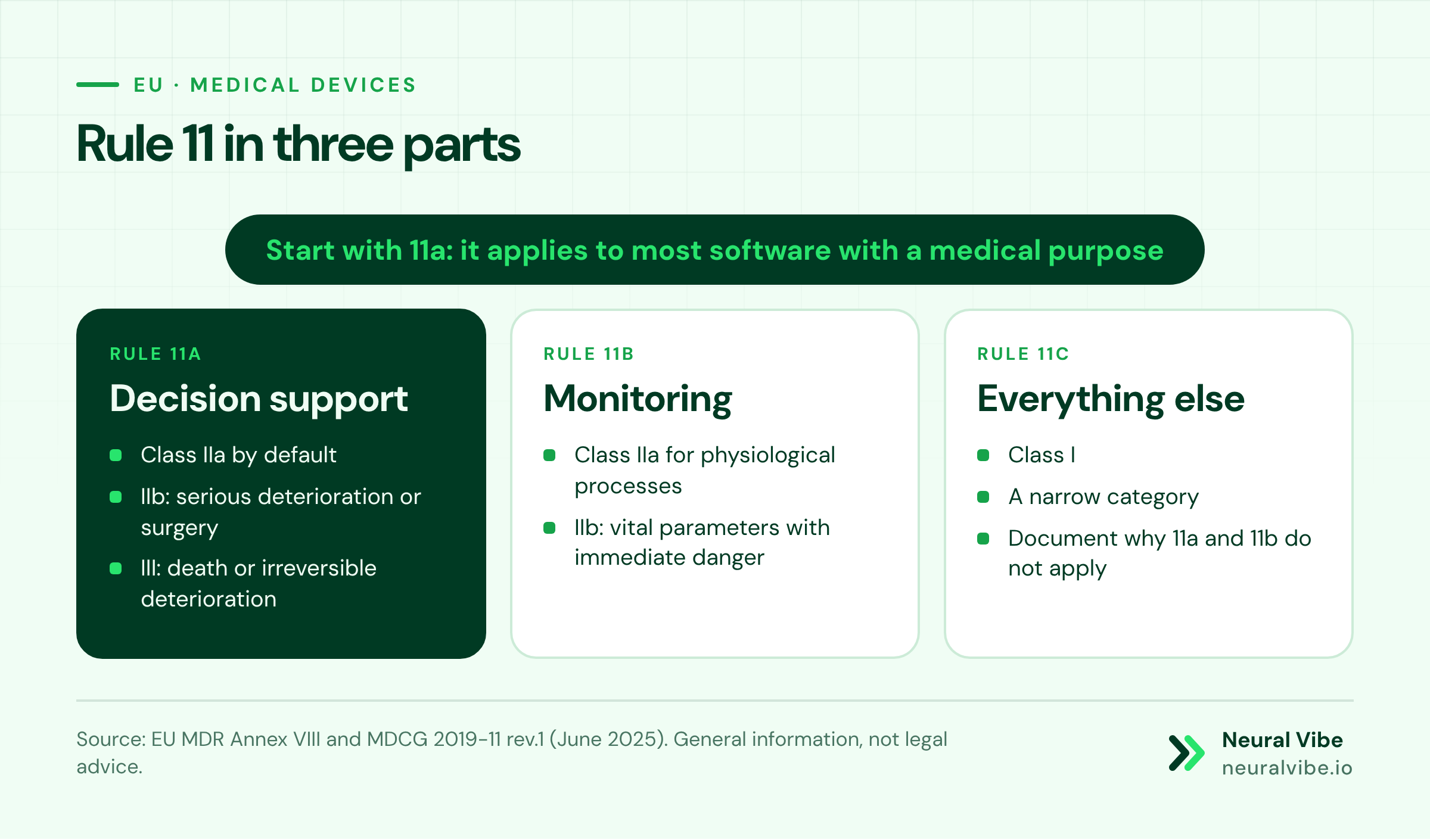
Rule 11a: decision support. Software that provides information used to take diagnostic or therapeutic decisions is Class IIa, unless those decisions could cause:
- death or an irreversible deterioration of a person’s state of health: Class III;
- a serious deterioration of a person’s state of health or a surgical intervention: Class IIb.
Rule 11b: monitoring. Software that monitors physiological processes is Class IIa. If it monitors vital physiological parameters where variations could result in immediate danger to the patient, it is Class IIb.
Rule 11c: everything else. All other software is Class I.
The guidance notes that 11a is generally relevant to all MDSW with a medical purpose, so test against it first.
How do you read the MDCG 2019-11 table?
To make Rule 11a easier to apply, MDCG 2019-11 provides a grid. You place your software on two axes: how significant the information is to the healthcare decision, and how serious the patient’s situation or condition is.
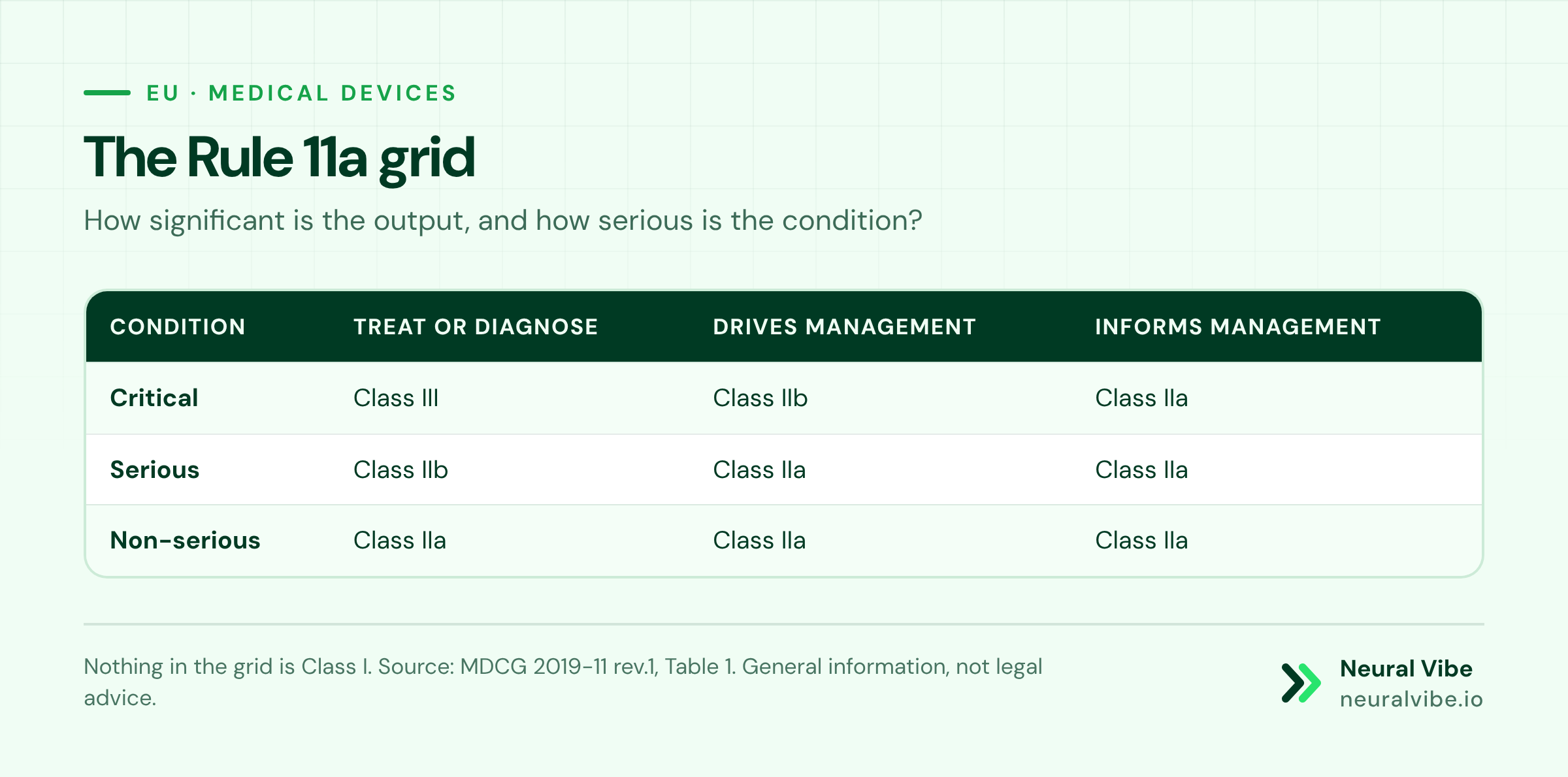
| Situation or condition | Treat or diagnose | Drives clinical management | Informs clinical management |
|---|---|---|---|
| Critical | Class III | Class IIb | Class IIa |
| Serious | Class IIb | Class IIa | Class IIa |
| Non-serious | Class IIa | Class IIa | Class IIa |
Two things stand out:
- Nothing in this grid is Class I. If your software informs a diagnostic or therapeutic decision, it starts at IIa.
- The class depends on the condition and the role of the output, not on how clever the code is.
Worked examples from the guidance
| Example | Class |
|---|---|
| Image analysis supporting treatment decisions in acute stroke | III (11a) |
| Mobile app analysing heartbeats to help a physician diagnose | IIb (11a) |
| Continuous surveillance of vital processes in intensive care | IIb (11b) |
| Monitoring of non-vital physiological processes | IIa (11b) |
| Fertility tracking or communication aids, where they qualify as MDSW | I (11c) |
Why does most software end up Class IIa or higher?
Under the older Medical Devices Directive, a lot of standalone software self-certified as Class I. Rule 11 changed that. So much clinical software feeds information into decisions that most of it now lands in Class IIa or above.
That matters because every class above Class I needs a notified body to assess your technical documentation and quality management system before you can CE mark. Our guide to choosing an EU notified body helps with that step.
“Informational only” rarely works. Notified bodies look at the whole picture: intended purpose, instructions for use, marketing claims, user interface and clinical evidence. If your website says the tool “detects” a condition, that claim carries weight.
How do you classify your software, step by step?
- Write a precise intended purpose. State the medical purpose, condition, patient population, intended user and setting. The June 2025 revision puts extra emphasis on this.
- Confirm qualification. Work through the MDCG 2019-11 decision tree and record your reasoning. If you build modules, decide which are medical device modules.
- Test against Rule 11a first. Does your output treat or diagnose, drive clinical management or inform it? How serious is the condition?
- Check 11b if you monitor. Are the parameters vital, and could variations create immediate danger?
- Check the other rules. Rule 11 is not the only rule that can apply to software. Check every rule that could apply. If more than one applies, Annex VIII says the strictest rule, giving the higher class, wins. The Commission’s general classification guidance, MDCG 2021-24, was revised in April 2026 and is worth reading alongside 2019-11.
- Align your claims. Your website, app store listing, labelling and sales material should match the intended purpose you classified against.
- Document it. Put the classification rationale in your technical documentation. Your notified body will ask for it.
- Revisit it on every significant change. New features, users or claims can move you up a class.
What about the MDR reform proposal?
On 16 December 2025, the European Commission published a proposal to simplify the MDR and the In Vitro Diagnostic Regulation, reference COM(2025) 1023. It is a proposal, not law.
According to the European Parliament’s Legislative Observatory, the file (2025/0404(COD)) is still awaiting a committee decision in Parliament, with a first-reading plenary listed only as an indicative date. No final text has been agreed or published.
The proposal does include a rewritten Rule 11. It would classify software by how its output is used, for example to drive or to inform clinical management, and by how serious the patient’s situation is, with Class I as the default where none of the higher tiers applies. That could change the class some software lands in, but the text can still change in Parliament and Council. Until a revised regulation is adopted and published in the Official Journal, Rule 11 as it stands today applies to every conformity assessment. We recommend you classify against the current text, watch the proposal, and do not build your plan around changes that may not survive the process.
FAQ
Can medical device software be Class I under the MDR?
Yes, but only under Rule 11c, where the software neither provides information for diagnostic or therapeutic decisions nor monitors physiological processes. That is a narrow category, so document carefully why 11a and 11b do not apply.
Does using AI change the class of my software?
Not by itself. The class depends on the intended purpose and potential harm, not the technique. AI software in Class IIa or above will usually also be high-risk under the EU AI Act: see EU AI Act for health-tech: what to do first.
Is the MDCG table legally binding?
MDCG guidance is not legally binding, but notified bodies and competent authorities rely on it heavily. Departing from it without a strong, documented justification is a risk.
Who decides the final class?
You do, as the manufacturer, and you must justify it. Your notified body will review your rationale. If you cannot agree, take advice early: under Article 51(2) of the MDR, a dispute between you and your notified body is referred to the competent authority for a decision.
Get help with your classification
Getting the class right early saves months later. If you would like us to review your intended purpose and classification rationale, get an instant quote or send us a note. We reply within one working day.
Sources
- Regulation (EU) 2017/745 on medical devices (MDR), Annex VIII
- MDCG 2019-11 rev.1: Qualification and classification of software (June 2025)
- European Commission: MDCG endorsed documents and other guidance
- European Commission: Proposal for a regulation to simplify rules on medical and in vitro diagnostic devices, COM(2025) 1023
- European Parliament Legislative Observatory: procedure 2025/0404(COD)

About the author
Brett Marshall
Founder and Principal Consultant at Neural Vibe. 25+ years in regulated technology, ISO lead implementer and auditor, and external DPO for health-tech companies.