Key points
- You are a business associate if you create, receive, maintain or transmit protected health information on behalf of a HIPAA covered entity.
- Business associates are directly liable under HIPAA and need a business associate agreement with each covered entity customer.
- Consumer health apps outside HIPAA can still be caught by the FTC Health Breach Notification Rule.
You are a HIPAA business associate if your company creates, receives, maintains or transmits protected health information (PHI) on behalf of a covered entity, such as a hospital, clinic, physician practice or health plan. If you sell to providers or payers and their patient data flows through your product, you almost certainly are one. If you sell direct to consumers and no covered entity is involved, HIPAA may not apply, but the Federal Trade Commission (FTC) Health Breach Notification Rule may.
The test comes down to one question: whose behalf are you acting on?
At a glance
- Business associate: handles PHI on behalf of a covered entity
- You will need: a business associate agreement (BAA) with each covered entity customer and each subcontractor that handles PHI
- Security Rule: applies to you in full; a January 2025 proposal to tighten it is not yet final
- Outside HIPAA? Check the FTC Health Breach Notification Rule
This is general information, not legal advice.
Who does HIPAA actually cover?
The Health Insurance Portability and Accountability Act (HIPAA) applies to two groups.
Covered entities are health plans, health care clearinghouses, and health care providers that carry out certain transactions, such as billing insurers, electronically.
Business associates perform functions or services for a covered entity that involve PHI. Under 45 CFR 160.103, that includes anyone who creates, receives, maintains or transmits PHI on behalf of a covered entity. It also covers providers of legal, accounting, consulting, data aggregation, management and administrative services where PHI is disclosed to them.
Two points matter most for startups:
- Subcontractors count. If you are a business associate and a vendor such as a cloud host handles PHI for you, that vendor is a business associate too. Obligations flow down the chain.
- Encryption does not take you out. The Office for Civil Rights (OCR) cloud computing guidance says a cloud provider storing electronic PHI (ePHI) is a business associate even if it holds only encrypted data and has no key.
Are you a business associate? Who is your customer?
OCR’s guidance for health app developers turns on one question: are you acting for a covered entity, or for the consumer?
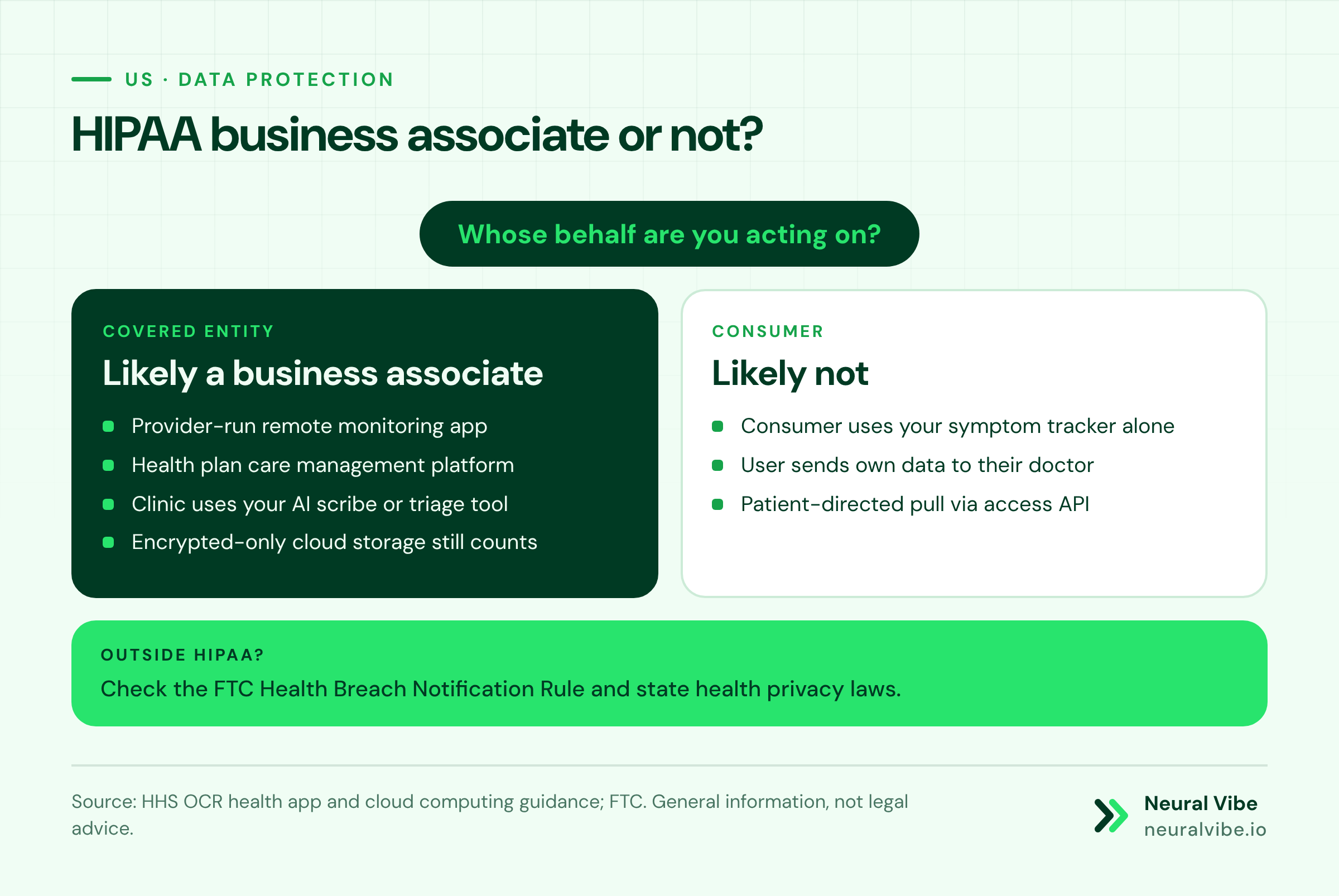
Likely a business associate:
- A provider contracts with you to offer a remote monitoring app to its patients, and data flows back into its clinical record.
- A health plan pays you to run a care management platform for its members.
- A clinic uses your AI scribe or triage tool with patient records.
Likely not a business associate:
- A consumer downloads your symptom tracker and uses it independently.
- A consumer chooses to send their own data from your app to their doctor.
- Your app pulls a patient’s records through a provider’s patient access API at the patient’s direction.
One product, two answers. A wellness app sold direct to consumers and also licensed to a health system must treat the two data flows differently.
What does being a business associate mean in practice?
Since the HITECH Act and the 2013 Omnibus Rule, business associates are directly liable for HIPAA compliance, not just contractually liable to customers. OCR can investigate and fine you directly. You will need to:
- Sign a BAA with each covered entity customer, and with any subcontractor that handles PHI for you. It sets permitted uses, safeguards, breach reporting and what happens to data at the end.
- Comply with the Security Rule in full: a documented risk analysis, risk management, administrative, physical and technical safeguards, and written policies.
- Use and disclose PHI only as the BAA and the Privacy Rule allow. No reusing customer PHI for your own analytics or model training unless both permit it.
- Report breaches of unsecured PHI to the covered entity without unreasonable delay, and no later than 60 days after discovery.
- Support individual rights, such as access requests, where the BAA requires it.
Customers will often ask for evidence. Our guide to ISO 27001 or SOC 2 explains which assurance helps most when selling into the US.
Is the HIPAA Security Rule changing?
In January 2025, HHS published a proposed rule to overhaul the Security Rule. Among other things, it proposed:
- removing the distinction between “required” and “addressable” safeguards;
- requiring encryption of ePHI and multi-factor authentication, with limited exceptions;
- requiring a technology asset inventory and network map; and
- requiring business associates to give covered entities written verification of their technical safeguards at least once a year.
As at the date of this article, the proposal has not been finalised, and the current Security Rule still applies.
Our advice: do not wait for a final rule. Most of the proposed controls are good practice already, and covered entity customers often ask for them in security questionnaires and BAAs.
Not covered by HIPAA? Check the FTC rule
Many consumer health apps fall outside HIPAA. That does not mean there are no rules. The FTC Health Breach Notification Rule applies to vendors of personal health records and related entities that HIPAA does not cover. The FTC updated it in 2024 to make clear that it covers health apps and similar technologies.
- A “breach of security” includes an unauthorised disclosure, such as sharing health data with advertising platforms without the user’s authorisation, not just a hack.
- You must notify affected individuals and the FTC, and in larger breaches the media, within set deadlines.
- Breaches can lead to civil penalties.
State consumer health privacy laws and the FTC’s general powers over unfair and deceptive practices also apply. Your privacy notice must match what your product actually does.
Checklist: what to do this quarter
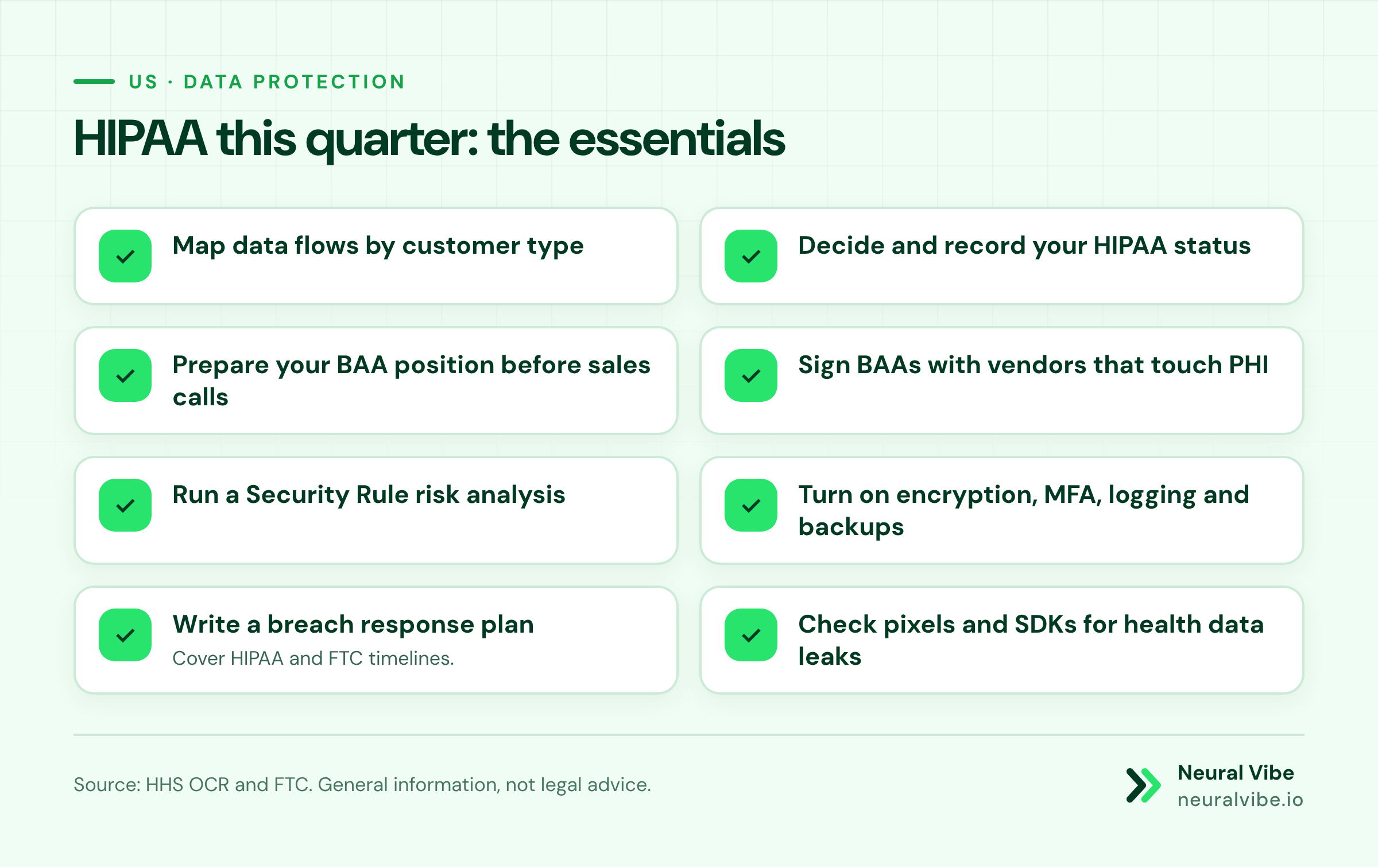
- Map your data flows. For each customer type, record whose behalf you act on and whether PHI is involved.
- Decide your status. Business associate, subcontractor, outside HIPAA, or a mix. Write it down.
- Prepare a BAA position. Have a template or a list of acceptable terms before sales calls.
- Sign BAAs with your vendors. Hosting, email, support desks and analytics tools that touch PHI all need one.
- Run a Security Rule risk analysis. Document it, act on it, and repeat it when your product changes.
- Turn on the basics. Encryption at rest and in transit, multi-factor authentication, access logging and tested backups.
- Write a breach response plan covering HIPAA and, where relevant, FTC timelines.
- Check your tracking tools. Make sure pixels and SDKs are not sending health data to third parties without authorisation.
- Train your team. Everyone with PHI access needs recorded HIPAA training.
FAQ
Is there such a thing as HIPAA certification?
No. HHS does not certify companies as HIPAA compliant. Customers may accept a documented risk analysis, policies, or an independent assessment such as SOC 2 or ISO 27001, but none of these is a formal HIPAA certificate.
We only store encrypted data we cannot read. Are we still a business associate?
According to OCR’s cloud computing guidance, yes. Holding ePHI on behalf of a covered entity or business associate makes you one, even if you cannot decrypt it.
Can we use customer PHI to train our AI models?
Only if your BAA and the Privacy Rule allow it, because business associates may use PHI only for permitted purposes. De-identifying data to HIPAA’s standard first is one possible route, but agree it with the customer.
Our app is direct to consumer. Can we ignore HIPAA?
Possibly, if no covered entity is involved. Check the FTC Health Breach Notification Rule and state health privacy laws, and revisit the question whenever you sign a deal with a provider or health plan.
Get your HIPAA position clear
We help health-tech startups work out their HIPAA status, set up BAAs and run Security Rule risk analyses, alongside SOC 2 and ISO 27001 readiness. Selling in the UK too? See our guide to UK GDPR for health apps.
Get an instant quote, or send us a note. We reply within one working day.
This article is general information, not legal advice.
Sources
- HHS OCR: Business Associates
- 45 CFR 160.103 (definitions), eCFR
- HHS OCR: Health Apps
- HHS OCR: Health app use scenarios and HIPAA (2016)
- HHS OCR: Guidance on HIPAA and Cloud Computing
- HHS OCR: HIPAA Security Rule notice of proposed rulemaking
- Federal Register: HIPAA Security Rule To Strengthen the Cybersecurity of Electronic Protected Health Information (proposed rule, 6 January 2025)
- Federal Register: FTC Health Breach Notification Rule (final rule, 30 May 2024)

About the author
Brett Marshall
Founder and Principal Consultant at Neural Vibe. 25+ years in regulated technology, ISO lead implementer and auditor, and external DPO for health-tech companies.