Key points
- NIS2 lists medical device and IVD manufacturers as important entities, but only once they reach medium size.
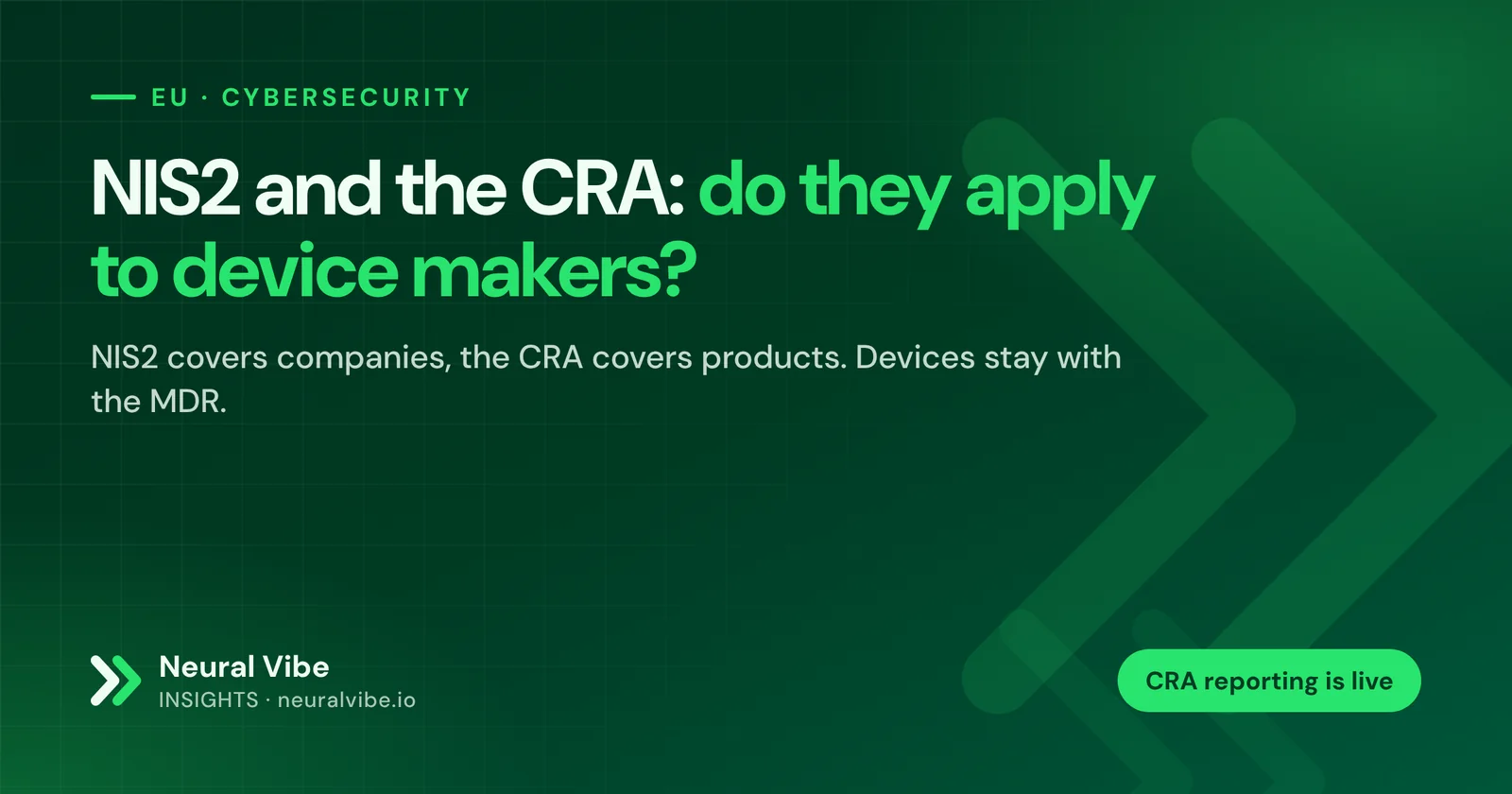
- The CRA does not apply to products covered by the MDR or IVDR; device cybersecurity stays under the MDR, with MDCG 2019-16 as the main guidance.
- Non-device products such as wellness apps, companion tools or software components can fall under the CRA, whose reporting duties have applied since 11 September 2026.
Partly. NIS2 can apply to your company if you make medical devices or IVDs and you are at least medium-sized. The Cyber Resilience Act (CRA) does not apply to products regulated under the MDR or IVDR, but it can catch any connected product you sell that is not a medical device.
So most device makers face a split answer: one law for the company, another for some products, and the MDR for the devices themselves. Here is how to work out which parts apply to you.
At a glance
- NIS2 regulates organisations. Device makers are in scope only from medium size.
- The CRA regulates products. MDR and IVDR devices are excluded.
- Your non-device products, such as wellness apps or SDKs, may be caught by the CRA.
- CRA reporting has applied since 11 September 2026. Full application is 11 December 2027.
This article is general information, not legal advice.
What is the difference between NIS2 and the CRA?
They target different things.
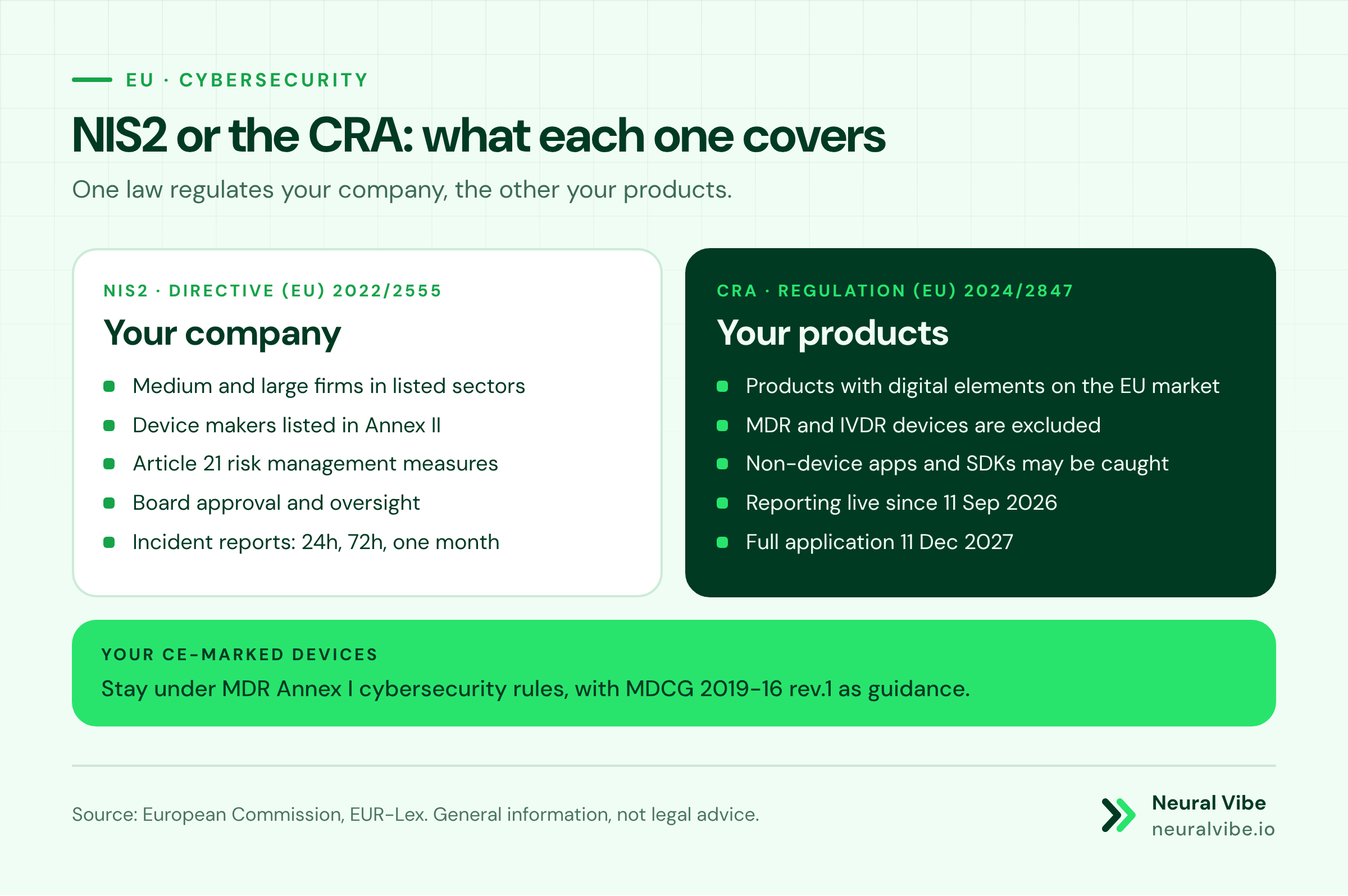
- NIS2 (Directive (EU) 2022/2555) regulates organisations. Certain companies must manage cybersecurity risk across their own networks and systems, and report significant incidents. As a directive, it works through national law in each Member State.
- The CRA (Regulation (EU) 2024/2847) regulates products. It sets cybersecurity rules for “products with digital elements”, meaning hardware or software and its remote data processing, placed on the EU market. As a regulation, it applies directly and the same way across the EU.
A device maker can be inside NIS2 as a company and outside the CRA for its devices at the same time.
Does NIS2 apply to your company?
NIS2 lists the sectors it covers in two annexes, and health appears in both.
- Annex I (sectors of high criticality), Health covers areas such as healthcare providers, research and development of medicinal products, pharmaceutical manufacturing, and the manufacture of medical devices considered critical during a public health emergency.
- Annex II (other critical sectors), Manufacturing includes the manufacture of medical devices and in vitro diagnostic medical devices.
Being in a listed sector is not enough. NIS2 applies a size cap: it covers medium and large companies, using the EU SME definition (Commission Recommendation 2003/361/EC). Broadly, you become medium-sized at 50 staff, or when annual turnover and balance sheet are both above EUR 10 million. If you are part of a group, group figures may count too, so check the definition with an adviser.
Most early-stage startups are below the line. Member States can still bring smaller, high-risk entities into scope, so read your national law.
Important or essential entity?
- A medium or large device manufacturer under Annex II is normally an important entity.
- Large entities in Annex I sectors are normally essential entities. A maker of devices on the EU’s public health emergency critical list may fall under Annex I, so check this with an adviser.
The security duties are much the same. Supervision and fines differ:
| Essential entity | Important entity | |
|---|---|---|
| Supervision | More intensive | Less intensive |
| Maximum fine, at least | EUR 10 million or 2% of worldwide turnover | EUR 7 million or 1.4% of worldwide turnover |
What does NIS2 ask of you?
- Risk management measures (Article 21): risk analysis and security policies, incident handling, business continuity and backups, supply chain security, secure development and vulnerability handling, cyber hygiene and training, cryptography, access control and multi-factor authentication.
- Management accountability (Article 20): your management body must approve and oversee the measures, and senior managers can be held personally liable.
- Incident reporting (Article 23): for a significant incident, an early warning within 24 hours, a notification within 72 hours and a final report within one month.
Member States had to transpose NIS2 by 17 October 2024. Many were late, and the Commission called on 23 Member States to complete it. Details such as registration vary by country.
Does the CRA apply to your products?
The CRA excludes products with digital elements to which the MDR (Regulation (EU) 2017/745) or IVDR (Regulation (EU) 2017/746) apply, because those regulations already cover device cybersecurity. So your CE-marked medical device software or hardware is not subject to the CRA.
The exclusion follows the product, not the company. Check everything else you place on the EU market:
- Non-device apps. A wellness, fitness or lifestyle app that is not a medical device is a product with digital elements and is likely in scope.
- Products sold to other manufacturers. A software library, SDK, connectivity module or platform component sold separately is not itself a medical device, so the exclusion may not cover it. Check carefully.
- Products that leave MDR scope, for example after a change of intended purpose. Our guide on whether your software is a medical device helps here.
Which CRA dates matter?
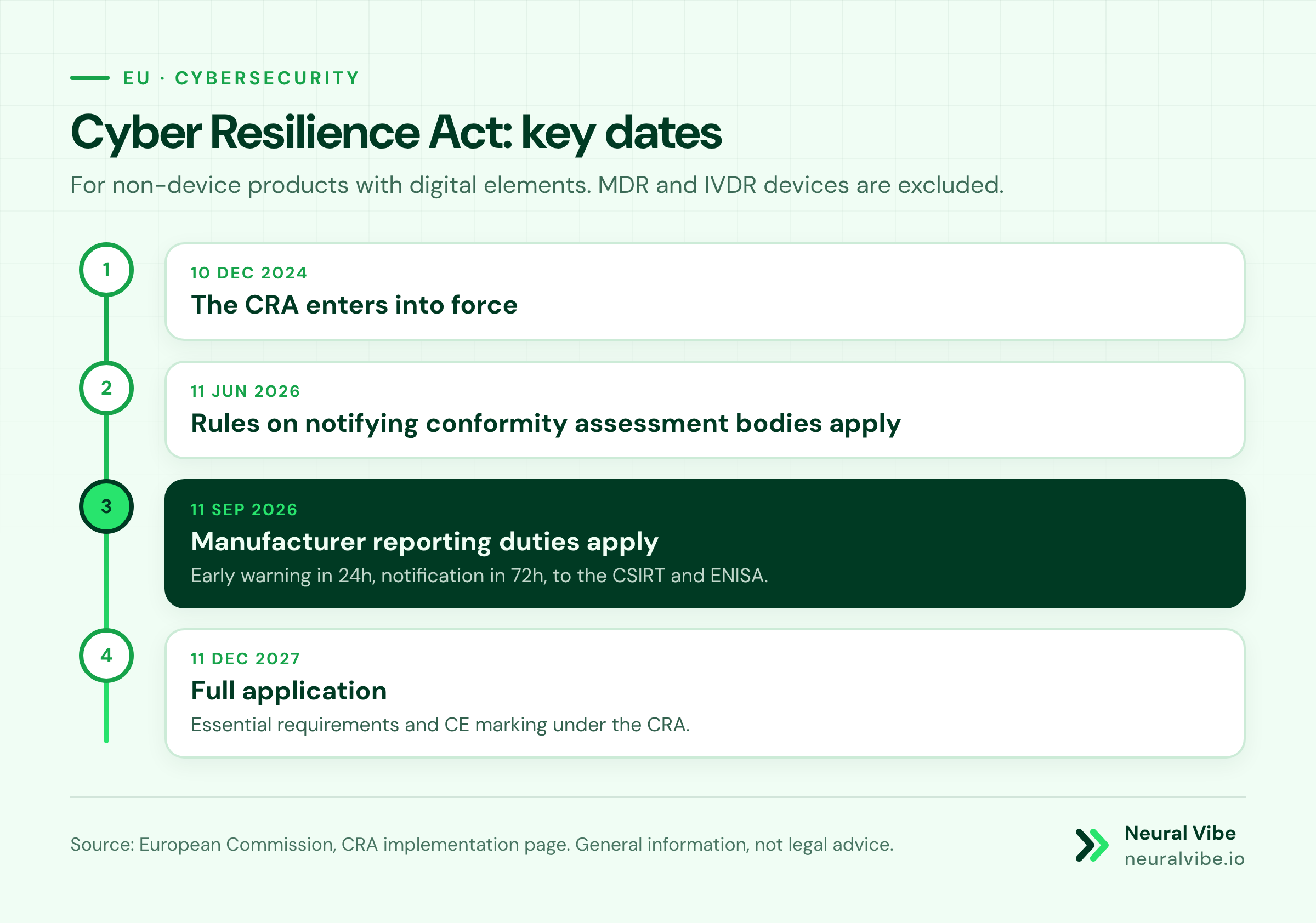
- 10 December 2024: the CRA entered into force.
- 11 June 2026: rules on notifying conformity assessment bodies started to apply.
- 11 September 2026: manufacturer reporting duties (Article 14) started to apply.
- 11 December 2027: full application, including the essential requirements and CE marking under the CRA.
Reporting is already live. For an actively exploited vulnerability or a severe incident affecting an in-scope product, send an early warning within 24 hours and a notification within 72 hours to the relevant CSIRT and ENISA, then a final report.
If you only make medical devices, what covers cybersecurity?
The MDR does. Annex I requires software to be developed to the state of the art, including risk management, information security, and verification and validation (section 17.2). You must also set minimum requirements for hardware, IT networks and IT security, including protection against unauthorised access (section 17.4), and state them in your instructions for use.
The main EU guidance is MDCG 2019-16 rev.1, Guidance on cybersecurity for medical devices (December 2019, revised July 2020). It covers:
- secure design and threat modelling
- joint responsibility with integrators and operators
- technical documentation
- post-market surveillance and vigilance
- vulnerability management
Your notified body will expect your technical documentation to reflect it. See our guide to choosing an EU notified body.
Much of the work overlaps. Secure development, vulnerability handling, supplier controls and incident response serve NIS2, the CRA and the MDR alike. ISO 27001 can help organise this, although no certificate replaces the legal duties (see ISO 27001 or SOC 2?).
Your step-by-step check
- List every product you place on the EU market and mark which are CE marked under the MDR or IVDR.
- Flag non-device products with digital elements. These are your CRA candidates.
- Check your size against the EU SME definition, including linked and partner enterprises.
- Identify your Member State of establishment and read its NIS2 law and registration rules.
- Map Article 21 measures against what you already have under ISO 13485, ISO 27001 or MDCG 2019-16. Fill the gaps.
- Set up incident and vulnerability reporting that can meet 24 hour and 72 hour clocks, with named owners.
- Brief your board or directors on their NIS2 accountability if you are in scope.
- Plan for 11 December 2027 for any CRA products: support periods, conformity assessment and technical documentation.
FAQ
We are a pre-revenue startup with eight people. Does NIS2 apply?
Probably not directly, because of the size cap. You will still feel it: hospitals and other customers in scope must manage supply chain security, so expect security questionnaires and contract clauses.
Our SaMD is CE marked under the MDR. Do we also need CRA CE marking?
No. Products to which the MDR applies are excluded from the CRA. Your cybersecurity duties for that product come from the MDR, with MDCG 2019-16 as guidance.
Is a non-device companion app covered by the CRA?
It may be. If the app is not itself a medical device or an accessory regulated under the MDR, it is a product with digital elements and the CRA is likely to apply. Its reporting duties have applied since 11 September 2026.
Does a UK company need to worry about NIS2 and the CRA?
For the CRA, yes: it applies to products made available on the EU market, wherever the manufacturer is based. NIS2 generally applies through the Member State where an entity is established, so a UK device maker with no EU establishment is usually outside it directly. An EU subsidiary may be in scope.
Talk to us
Not sure which of your products or entities are in scope? Get a costed proposal, or send us a note and we will reply within one working day. We will map your duties across NIS2, the CRA and the MDR, and do the work for you.
Sources
- NIS2 scope overview (Centre for Cybersecurity Belgium)
- SME definition (European Commission)
- Directive (EU) 2022/2555 (NIS2 Directive), EUR-Lex
- Regulation (EU) 2024/2847 (Cyber Resilience Act), EUR-Lex
- Cyber Resilience Act: summary of the legislative text, European Commission
- Cyber Resilience Act: implementation, European Commission
- MDCG 2019-16 rev.1: Guidance on cybersecurity for medical devices

About the author
Brett Marshall
Founder and Principal Consultant at Neural Vibe. 25+ years in regulated technology, ISO lead implementer and auditor, and external DPO for health-tech companies.