Key points
- Since 25 February 2021, software is classified in Australia by the harm it could cause if it gives wrong information, and the transition period ended on 1 November 2024.
- Some low-risk software is excluded altogether, and some clinical decision support software is exempt from ARTG inclusion, but the exemption was narrowed from 1 November 2026 and the TGA is reviewing these boundaries.
- You need an Australian sponsor and an ARTG entry before supply, and overseas approvals can often be used as evidence.
If your software is intended to diagnose, monitor, treat or prevent a disease, the Therapeutic Goods Administration (TGA) will usually regulate it as a medical device. Before you supply it, you need an Australian sponsor, evidence against the Essential Principles and an entry in the Australian Register of Therapeutic Goods (ARTG). Your class, and so the scrutiny you face, depends on how much harm wrong information could cause.
We explain how the rules work in practice for founders planning an Australian launch.
At a glance
- Rules in force: since 25 February 2021
- Transition: ended 1 November 2024
- Classes: I, IIa, IIb and III; the highest applicable rule wins
- Before supply: an Australian sponsor and ARTG inclusion
- CDSS exemption: narrowed from 1 November 2026
- Watch: exclusions and AI rules are under review
This is general information, not legal advice.
What changed in the TGA’s software rules?
Australia reformed its software rules from 25 February 2021. The changes:
- introduced software-specific classification rules, based on potential harm from incorrect information;
- amended the Essential Principles, including Essential Principle 12.1 on cyber security, data management, and development and maintenance, plus a new principle on showing version and build numbers;
- carved out some lower-risk software and exempted some clinical decision support software from ARTG inclusion.
Sponsors of products already on the ARTG had to notify the TGA by 25 August 2021 and apply under the new rules by 1 November 2024. That transition has ended. If your software is caught and not correctly included, it should not be supplied.
Is your software a medical device in Australia?
Start with intended purpose: what do your labelling, website and marketing say the product does? Software that analyses patient data to inform a diagnosis or treatment decision is usually in scope. Our guide Is my software a medical device? walks through the test.
The TGA’s exclusions take some software out of regulation altogether, if it meets the stated conditions:
| Exclusion group | Examples |
|---|---|
| Consumer health | Self-management apps for non-serious conditions with no specific treatment advice; wellness tools; patient-reported outcome surveys; some digital mental health tools that follow referenced clinical guidelines |
| Enabling technology | Telehealth communication; practice management; image storage or transmission; clinical workflow tools and middleware that do not recommend diagnosis or treatment |
| Digitisation | Digitised paper-based or published clinical rules; simple dose calculators; health records that do not control dosing |
| Other | Population-level analytics; laboratory information management systems |
Watch your roadmap: a feature added later, such as a risk score or a treatment suggestion, can take a product out of an exclusion.
How does the TGA classify software?
Australia uses Classes I, IIa, IIb and III. Where several rules apply, the highest class wins. The main software rules in Schedule 2 to the Therapeutic Goods (Medical Devices) Regulations 2002 are:
- Rule 4.5, diagnosis and screening. Class III for life-threatening conditions or high public health risk, Class IIb for serious conditions, Class IIa otherwise. If it only informs a health professional who makes the decision, each tier drops one class.
- Rule 4.6, monitoring. Class IIb where results could indicate immediate danger, Class IIa for other danger, Class I otherwise.
- Rule 4.7, specifying or recommending treatment. Class III to Class IIa, depending on potential harm. Recommendations given only to a health professional sit one class lower.
- Rule 4.8, information-based therapy. Class III to Class I, depending on potential harm. This can include some digital therapeutics.
Software that drives or influences another device generally takes that device’s class. Anything not caught elsewhere defaults to Class I.
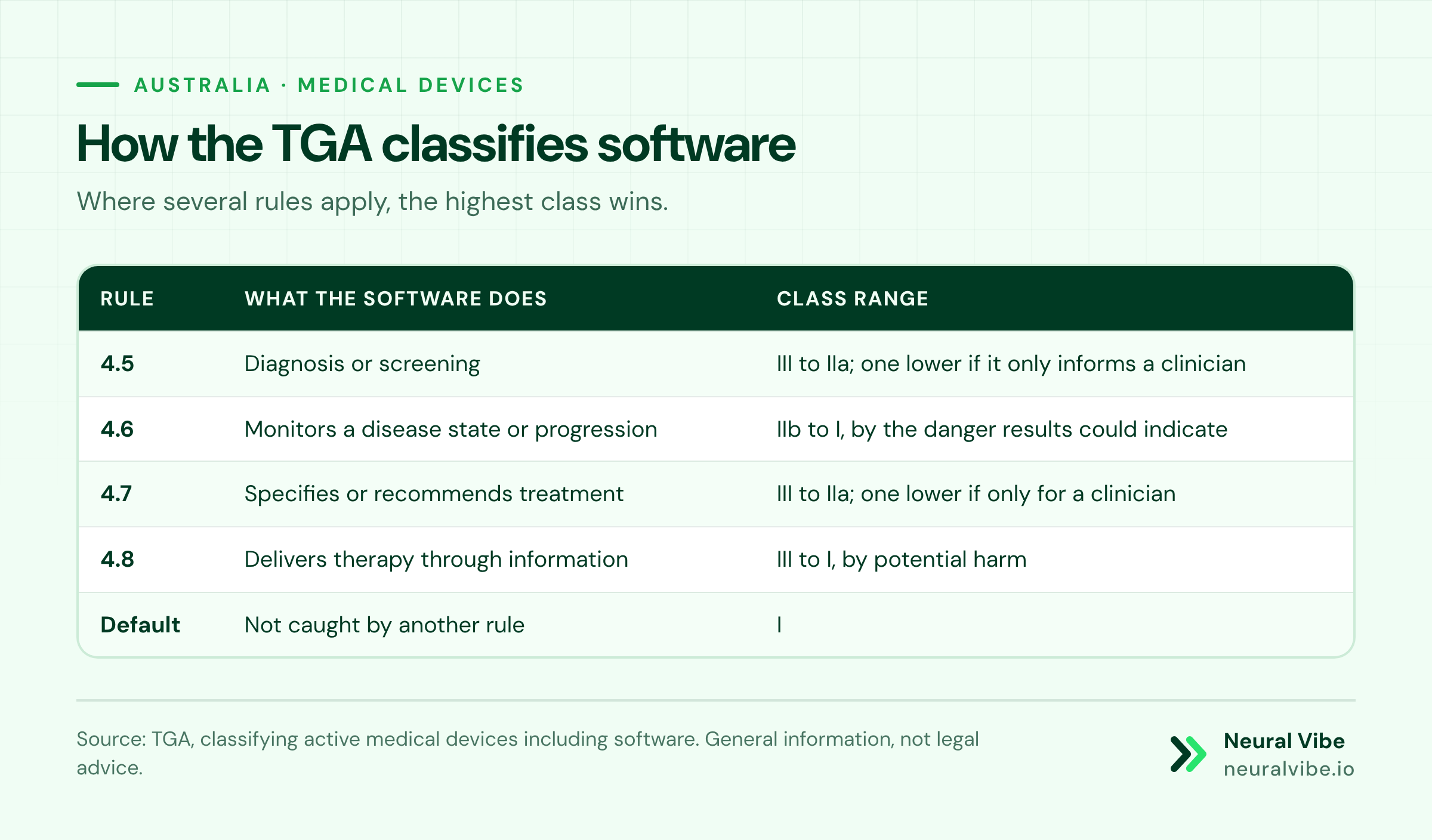
A real “health professional in the loop” can lower your class, but only if your intended purpose reflects it.
Is clinical decision support software exempt?
Some clinical decision support system (CDSS) software is exempt from ARTG inclusion. It is still a medical device, so duties such as meeting the Essential Principles and reporting adverse events continue, and the TGA expects to be notified.
The exemption is narrow, and it tightened on 1 November 2026. Under the amended item 2.15 of Schedule 4 to the Medical Devices Regulations, the software must meet all of these conditions:
- it makes a recommendation to a health professional, for the sole purpose of helping them make a decision about preventing, diagnosing or treating a condition;
- it does not process, analyse, compress or decompress a medical image or signal from another medical device;
- it does not replace the health professional’s clinical judgement;
- it does not itself make a clinical diagnosis or treatment decision, including where it is in vitro diagnostic software; and
- it displays the clinical practice guidelines, calculations or logic it uses, so a health professional can readily interpret and verify its recommendations in the intended clinical setting.
The last two conditions are new, and the image and signal condition is wider. The amended exemption applies to software made on or after 1 November 2026, and to software made earlier but intended for use from that date, so existing products are not carved out. If your tool does not show the logic behind its recommendations, it is unlikely to meet the new conditions.
The TGA’s CDSS guidance says it is being updated to reflect the amendments, so check the current guidance before you rely on the exemption, and keep a record of your reasoning.
How do you get onto the ARTG?
Overseas manufacturers work through an Australian sponsor: a person or company in Australia that takes legal responsibility for supply, lodges the application and handles post-market duties. Choose one who understands software.
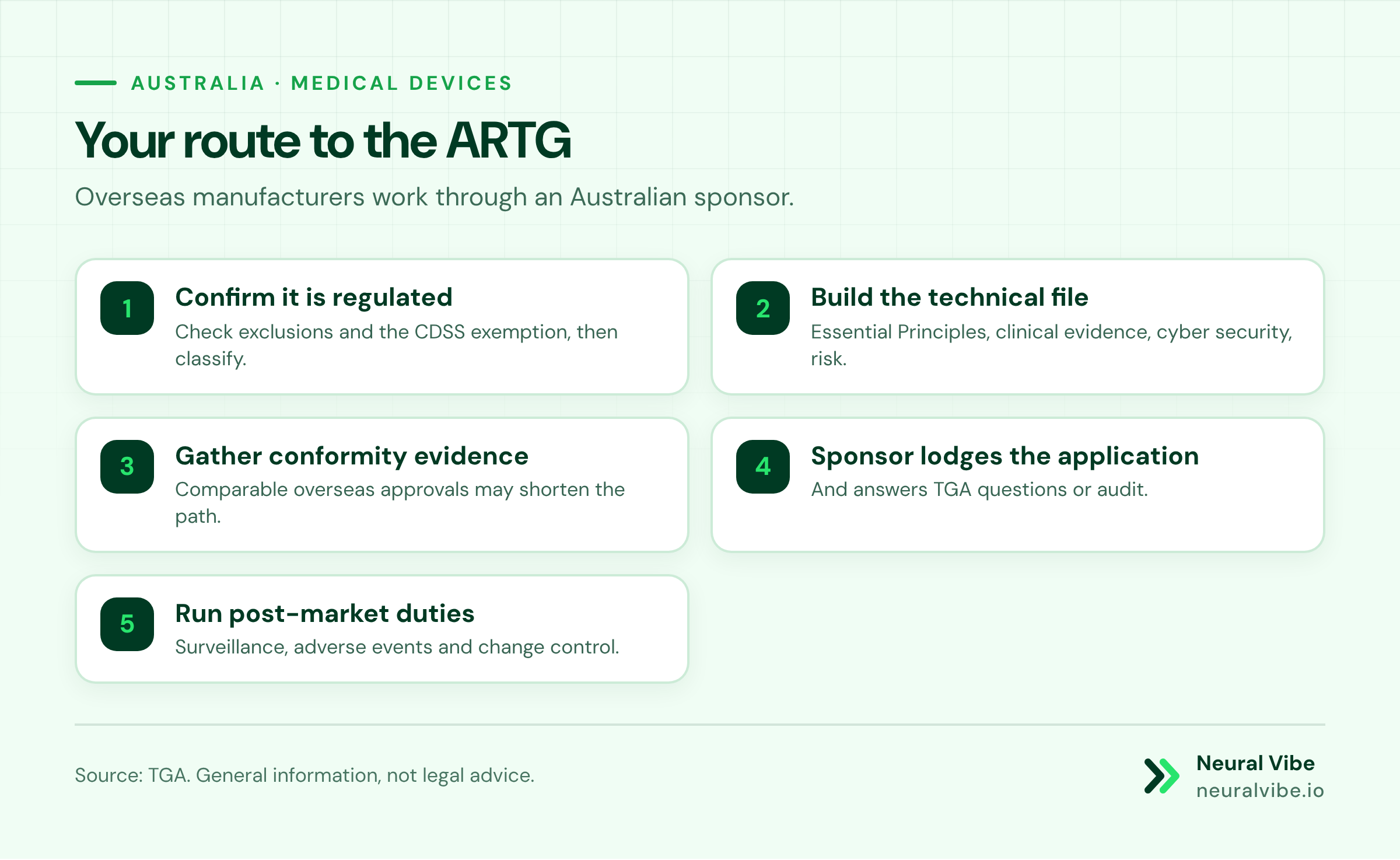
- Confirm the device is regulated, and its class.
- Build a technical file against the Essential Principles: clinical evidence, software lifecycle, cyber security and risk management.
- Gather conformity assessment evidence. The TGA can use evidence from comparable overseas regulators and assessment bodies, including EU notified bodies, FDA, Health Canada and Japanese approvals, which may shorten the path. MDSAP certificates and audit reports are accepted as quality management system evidence, provided the audit covered Australian requirements; see MDSAP explained.
- Lodge. Your sponsor submits the ARTG application and answers any TGA questions or audit.
- Run post-market duties: surveillance, adverse event reporting and change control.
What has the TGA changed for software and AI since 2025?
- AI review outcomes. After a 2024 consultation, the TGA published its report on medical device software, including AI, in July 2025. It found the framework largely fit for purpose, but said stakeholders need more support. Work runs in five areas: supporting stakeholders, robust regulation, roles and responsibilities, transparency about AI use, and compliance.
- Transparency. The TGA has published a list of AI-enabled medical devices in the ARTG.
- Digital scribes. A scribe that only records, transcribes or summarises a consultation for clinician review is not a medical device. One that generates diagnoses or treatment recommendations not stated in the consultation is, and needs ARTG inclusion.
- Exclusions under review. The TGA has reviewed the digital mental health tool exclusion with an expert group, and signalled consultation on options to modify or remove it. It is also scoping a chatbot review and a systematic review of exempt CDSS.
- Compliance. The TGA’s stated focus is education and assisted compliance, escalating to enforcement where needed.
If you rely on an exclusion or exemption today, plan for it to narrow.
Checklist: preparing for the Australian market
- Write a precise intended purpose and check your marketing matches it.
- Test the product against each exclusion and the CDSS exemption, and record the outcome.
- Classify under Rules 4.5 to 4.8 and any device-control rules.
- Map your technical file to the Essential Principles, including 12.1 on cyber security.
- List overseas approvals or certificates you can reuse.
- Appoint an Australian sponsor with software experience.
- Set up post-market processes that suit frequent releases.
- Watch for TGA consultations on exclusions, definitions and advertising.
FAQ
Do I need an Australian company to sell a software medical device?
You need an Australian sponsor, but it does not have to be your own subsidiary. Many overseas manufacturers use an independent sponsor, which takes legal responsibility for supply in Australia.
Can I use my CE marking or FDA clearance with the TGA?
Often, as evidence. The TGA can rely on evidence from comparable overseas regulators, but you still need ARTG inclusion through a sponsor, and the TGA can ask for more.
Is a wellness app regulated by the TGA?
Usually not, if it supports general wellness and gives no specific treatment advice for a serious condition. Once it diagnoses, monitors a disease or recommends treatment, it is likely to be a medical device.
Are AI scribes medical devices in Australia?
Not if they only record and summarise a consultation for the clinician to check. If they generate diagnoses or treatment recommendations that were not part of the conversation, the TGA treats them as medical devices.
Talk to us
Planning an Australian launch, or unsure whether an exclusion still fits? Get a costed proposal, or send us a note. We reply within one working day.
Sources
- TGA: Regulatory changes for software based medical devices (v1.3, June 2024)
- TGA: Classifying active medical devices in Australia (including software-based medical devices)
- TGA: Excluded software, interpretation of software exclusion criteria
- TGA: Medical devices reforms, software regulation
- TGA: Software and AI compliance and reforms (presentation, 2026)
- TGA: Understanding clinical decision support system software regulation
- Therapeutic Goods Legislation Amendment (2026 Measures No. 1) Regulations 2026 (F2026L01167)
- TGA: Steps to supply for device manufacturers

About the author
Brett Marshall
Founder and Principal Consultant at Neural Vibe. 25+ years in regulated technology, ISO lead implementer and auditor, and external DPO for health-tech companies.