Key points
- RDC 657/2022 sets the rules for software as a medical device; RDC 751/2022 sets the risk class and the route.
- Class I and II devices are notified; Class III and IV devices need full registration and an ANVISA GMP certificate.
- A foreign manufacturer needs a company legally established in Brazil to hold the notification or registration.
To sell software as a medical device (SaMD) in Brazil, classify it under ANVISA’s RDC 751/2022, follow the software rules in RDC 657/2022, then file a notification (Class I and II) or a registration (Class III and IV). A company legally established in Brazil must make the filing and hold it for you. Class III and IV products also need an ANVISA good manufacturing practice (GMP) certificate, and MDSAP audits can make that much easier.
Here is how the pieces fit together for a foreign software company.
At a glance
- Software rules: RDC 657/2022
- Classes and routes: RDC 751/2022, Class I (lowest) to IV (highest)
- Class I and II: notification, no expiry
- Class III and IV: registration, valid 10 years, plus an ANVISA GMP certificate
- Foreign makers: need a Brazilian holder
This is general information, not legal advice.
Which ANVISA rules apply to software?
ANVISA (Agência Nacional de Vigilância Sanitária) regulates devices through resolutions of its Collegiate Board, known as RDCs. For software, two matter most:
- RDC 657/2022 covers the regularisation of SaMD. It expects technical documentation specific to software. ANVISA’s questions and answers on the resolution explain what to include, and we recommend reading them in full.
- RDC 751/2022 sets the risk classification rules, the routes (notification or registration), and labelling and instructions for use requirements for medical devices generally. It replaced the older device framework, including RDC 185/2001, from 1 March 2023.
RDC 657/2022 covers standalone software, meaning software that is not part of a hardware medical device. Software embedded in a medical device is outside its scope and is regularised together with that device. If you are unsure, check how the RDC 657 questions and answers describe products like yours before you plan your route.
Is your software a medical device in Brazil?
Start from the device definition and your intended purpose. Software intended for diagnosis, prevention, monitoring, treatment or alleviation of disease is likely to be SaMD. RDC 657/2022 lists software that falls outside its scope, including software intended for wellbeing, software used only for administrative and financial management in health services, and software that processes demographic and epidemiological data with no clinical diagnostic or therapeutic purpose. Check your intended use against that list.
Your claims decide. In Brazil, as elsewhere, the claims in your labelling, website and app store listing are what regulators use to decide whether you are a device and in which class. Write your intended purpose carefully.
Our guide on whether your software is a medical device covers the wider question.
How does RDC 751/2022 classify software?
Brazil uses four risk classes, from Class I (lowest risk) to Class IV (highest). RDC 751/2022 follows international practice closely, and its Rule 11 deals with software:
- Software that informs diagnostic or therapeutic decisions is Class II by default, Class III where those decisions could cause serious deterioration of health or a surgical intervention, and Class IV where they could cause death or irreversible deterioration of health.
- Software that monitors physiological processes is Class II, or Class III where it monitors vital parameters and changes could mean immediate danger.
- Other software is Class I.
An EU MDR Rule 11 classification is a useful reference point. Our guide to EU MDR Rule 11 explains it. But do not assume the Brazilian result will match. Document your reasoning against the Brazilian rules.
Notification or registration: which route applies?
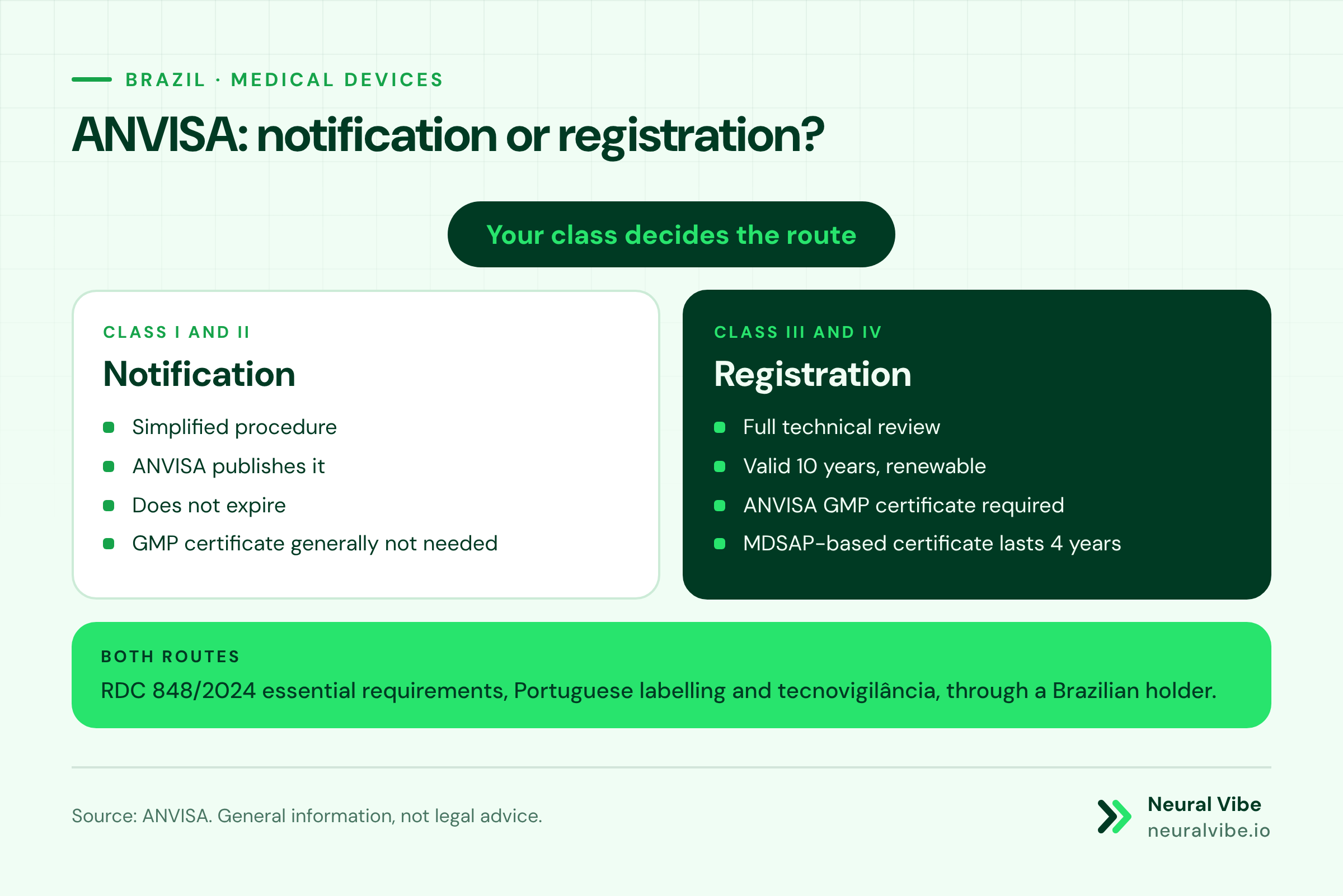
- Class I and II: notification (notificação). A simplified procedure. You submit the required information and documents, and ANVISA publishes the notification. Notifications do not expire, although ANVISA can still review the product and ask for information.
- Class III and IV: registration (registro). A full technical review of your dossier, including clinical evidence, before approval. A registration is valid for 10 years and can be renewed.
Both routes require you to:
- meet the essential safety and performance requirements in RDC 848/2024;
- keep a full technical file;
- comply with labelling and instructions for use rules in Portuguese; and
- maintain post-market vigilance (tecnovigilância).
Why do you need a Brazilian Registration Holder?
Foreign companies cannot hold an ANVISA notification or registration directly. ANVISA grants them only to companies legally established in Brazil. In practice the holder needs an ANVISA operating authorisation (Autorização de Funcionamento de Empresa, AFE), which ANVISA requires for companies that import, distribute, store or manufacture medical devices, and which involves an inspection by the local health surveillance authority. This partner is usually called the Brazilian Registration Holder (BRH), or detentor do registro.
The holder is legally responsible to ANVISA for your product in Brazil, including submissions, changes, complaints, vigilance and recalls. You have three main options:
| Option | Upside | Watch out for |
|---|---|---|
| Distributor as holder | Simple to set up | Registration sits in their name, which can tie you to them |
| Independent holder | You can appoint one or several distributors | Choose a partner with a strong regulatory track record |
| Your own subsidiary | The most control | You need to obtain the AFE yourself |
Agree in writing how the holder will cooperate on transfers, updates and vigilance before you file.
ANVISA also keeps records of the international manufacturers linked to devices. In 2026 it moved the registration of international manufacturers for Class I and II devices to an electronic process, so check the current guidance when you prepare your filing.
Where do Brazilian GMP and MDSAP fit?
ANVISA requires manufacturers to meet its device GMP rules, often called Brazilian GMP (BGMP), set mainly by RDC 665/2022 and built on the same principles as ISO 13485. Certification procedures are in RDC 497/2021.
- Class III and IV: you need an ANVISA GMP certificate (Certificado de Boas Práticas de Fabricação, CBPF) for the manufacturing site as a condition of registration.
- Class I and II: you must comply with BGMP, but a CBPF is generally not required for notification.
ANVISA is a member of the Medical Device Single Audit Program (MDSAP). It can use MDSAP audit reports from recognised auditing organisations as input to its GMP certification decision. A device GMP certificate is normally valid for two years, but RDC 850/2024 extends certificates granted on the basis of MDSAP to four years. ANVISA publishes a list of the auditing organisations it recognises. Our guide to MDSAP explains how one audit serves five markets.
What will ANVISA look for in a software dossier?
RDC 657/2022 lists software-specific dossier content in Article 11 (notification) and Article 12 (registration). In our experience, expect your dossier to cover:
- intended use, users, environment and contraindications;
- software description, architecture, inputs, outputs and operating platforms;
- lifecycle evidence, for example aligned with IEC 62304, and risk management aligned with ISO 14971;
- verification and validation, including clinical evaluation proportionate to class;
- cybersecurity measures;
- version control and how you will handle updates; and
- labelling and instructions for use in Portuguese.
If your software uses AI or machine learning, check the RDC 657 questions and answers for any extra information ANVISA expects, such as details of training and test data. ANVISA’s 2026 to 2027 regulatory agenda is under way, so watch for further guidance. Patient data processed in Brazil also falls under the LGPD, covered in our guide to LGPD and health data.
Seven steps to bring SaMD into Brazil
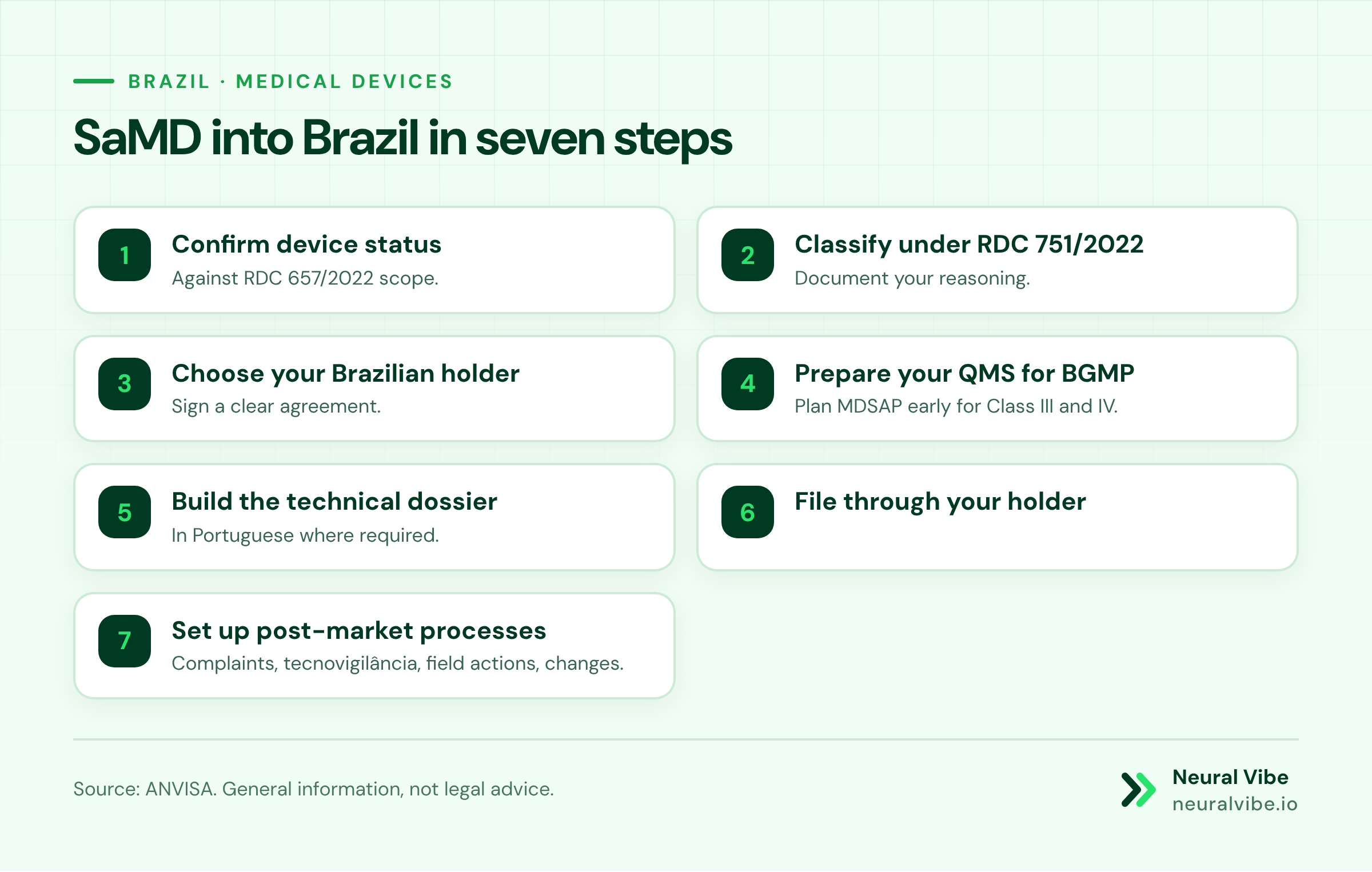
- Confirm device status against the device definition and the scope of RDC 657/2022.
- Classify under RDC 751/2022 and document your reasoning.
- Choose your Brazilian Registration Holder and sign a clear agreement.
- Prepare your quality system for BGMP. For Class III and IV, plan your MDSAP audit or ANVISA GMP certification early.
- Build the technical dossier to RDC 657/2022 and RDC 751/2022, in Portuguese where required.
- File the notification or registration through your holder.
- Set up post-market processes: complaints, tecnovigilância reporting, field actions and change management.
FAQ
Can a foreign company hold the ANVISA registration itself?
No. The notification or registration must be held by a company legally established in Brazil. You can set up a subsidiary, appoint an independent holder or use a distributor.
Does an MDSAP certificate replace ANVISA’s GMP certificate?
Not automatically. For Class III and IV you still need an ANVISA GMP certificate, but ANVISA can base its decision on MDSAP audit reports. Certificates granted on that basis can last four years.
Are CE marking or FDA clearance accepted in Brazil?
Do not plan on it. Existing approvals and evidence can support your Brazilian dossier, but you should expect to file your own notification or registration with ANVISA.
How are software updates handled after approval?
It depends on the change. Minor changes may only need recording in your technical file, while changes affecting safety, performance or intended use may need ANVISA to be told or to approve them first.
Bring your software to Brazil with us
We classify your software, prepare your RDC 657 dossier, coordinate your Brazilian holder and run your MDSAP readiness. Get a costed proposal, or send us a note. We reply within one working day.
This article is general information, not legal advice.
Sources
- RDC nº 657, de 24 de março de 2022 (software as a medical device), English version, ANVISA
- Perguntas e respostas: RDC nº 657/2022, ANVISA
- RDC nº 751, de 15 de setembro de 2022 (classification and regularisation), English version, ANVISA
- Perguntas e respostas: RDC nº 751/2022, ANVISA
- Notificação de produtos para saúde, ANVISA
- RDC nº 848/2024 (essential safety and performance requirements), listed on ANVISA medical devices page
- Medical devices, ANVISA (English)
- Good Manufacturing Practices, ANVISA (English)
- RDC nº 665/2022, RDC nº 497/2021 and RDC nº 850/2024 (GMP requirements, certification and MDSAP-based validity), as listed by ANVISA
- Lista de organismos auditores do MDSAP reconhecidos pela Anvisa
- Perguntas e respostas sobre a utilização dos resultados do MDSAP, ANVISA

About the author
Brett Marshall
Founder and Principal Consultant at Neural Vibe. 25+ years in regulated technology, ISO lead implementer and auditor, and external DPO for health-tech companies.