Key points
- The LGPD applies to foreign firms that offer services to people in Brazil or process data collected there, and health data is sensitive data with its own, narrower legal bases.
- Transfers out of Brazil need a recognised mechanism; ANPD standard contractual clauses must be used word for word.
- Most controllers must appoint an encarregado (DPO) and publish their identity and contact details.
Yes, Brazil’s data protection law can apply to you even if you have no office in Brazil. The Lei Geral de Proteção de Dados Pessoais (LGPD, Lei nº 13.709/2018) covers you if you offer services to people in Brazil or process data collected there. It treats health data as sensitive personal data, with a narrower set of legal bases.
If you move that data abroad, you also need a recognised transfer mechanism. Most firms must appoint an encarregado, the LGPD’s data protection officer (DPO). We set out each step below.
At a glance
- Reach: applies to foreign firms serving people in Brazil (Article 3)
- Health data: sensitive data; legitimate interests is not available
- Transfers: ANPD standard clauses, adopted word for word
- DPO: appoint an encarregado and publish their contact details
- Regulator: the ANPD (Agência Nacional de Proteção de Dados)
This is general information, not legal advice.
Does the LGPD apply to a company outside Brazil?
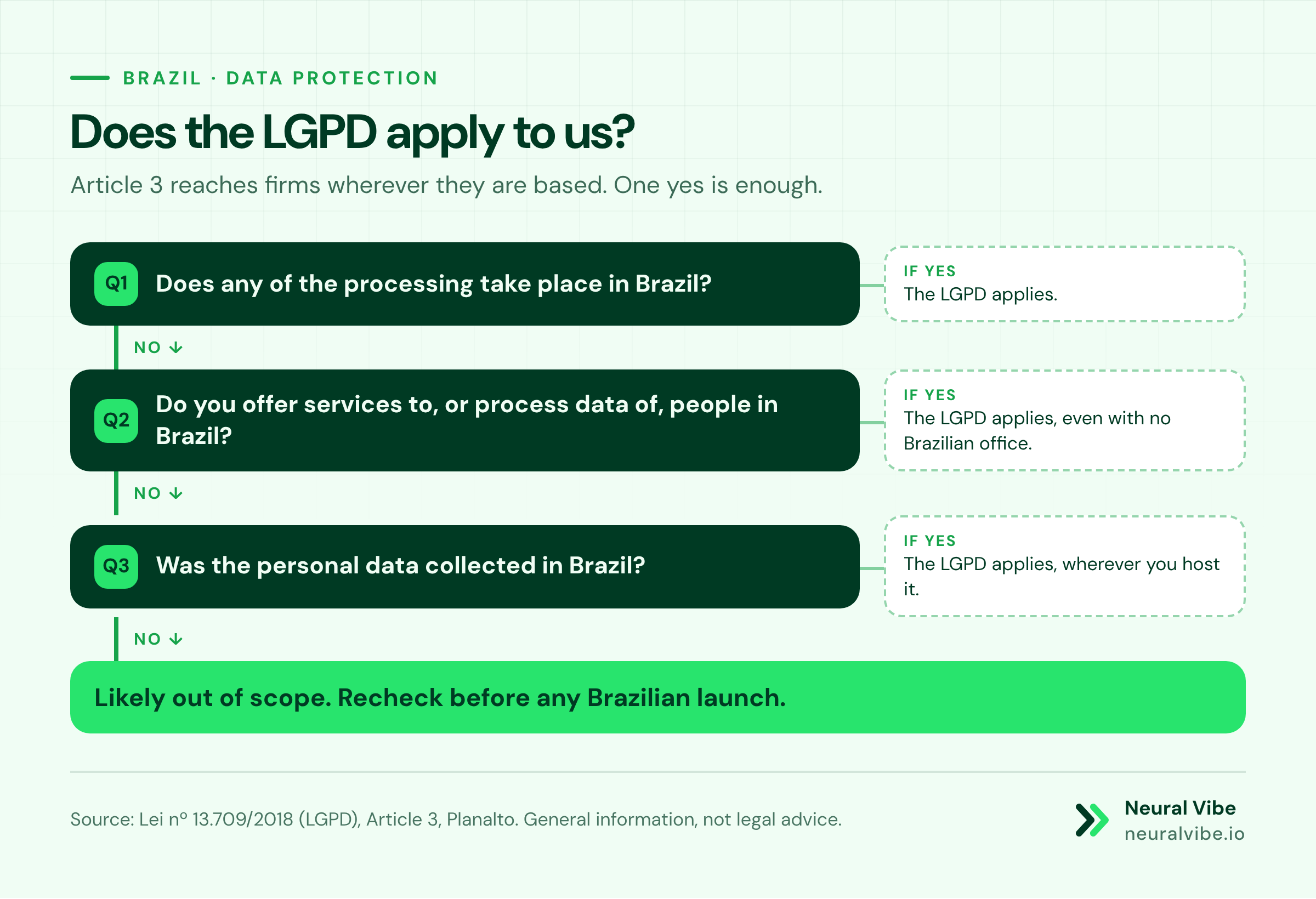
Usually, yes. Article 3 applies the law wherever the controller is based, if:
- the processing takes place in Brazil;
- the purpose is to offer goods or services to individuals in Brazil, or to process data of individuals located there; or
- the personal data was collected in Brazil.
So a UK health app available to Brazilian users is likely to be in scope. So is a remote monitoring platform used by Brazilian clinics, or a vendor hosting Brazilian patient data in another country.
The regulator is the ANPD. Following Lei nº 15.352/2026, it is now a special-status federal agency (autarquia de natureza especial), which strengthens its standing.
Why is health data treated differently?
Article 5 defines “sensitive personal data” to include health, genetic and biometric data. Article 11 then sets a closed list of legal bases. You cannot rely on legitimate interests for sensitive data.
The bases most relevant to health-tech are:
| Legal basis (Article 11) | When it fits |
|---|---|
| Specific and highlighted consent | The data subject or guardian agrees, for specific purposes |
| Legal or regulatory obligation | For example, device vigilance or record-keeping duties |
| Research by a research body | With anonymisation wherever possible |
| Regular exercise of rights | Including in a contract or legal proceedings |
| Protection of life or physical safety | Of the data subject or a third party |
| Protection of health (tutela da saúde) | Only by health professionals, health services or health authorities |
| Fraud prevention and security | In identification and authentication processes |
Two further rules affect commercial models:
- No sharing health data for economic advantage. Article 11 restricts controllers from sharing sensitive health data with each other to gain an economic advantage. There are limited exceptions for health services, pharmaceutical assistance and healthcare. Data-monetisation models need careful legal review.
- Health insurers. Health plan operators may not process health data for risk selection when contracting or excluding beneficiaries.
Our view on consent: many foreign firms default to it. Under the LGPD it must be free, informed, unambiguous and, for sensitive data, specific and highlighted. It can also be withdrawn. If your service would break without the data, check whether another basis fits better, such as health protection when you act for a health service.
How do you move health data out of Brazil?
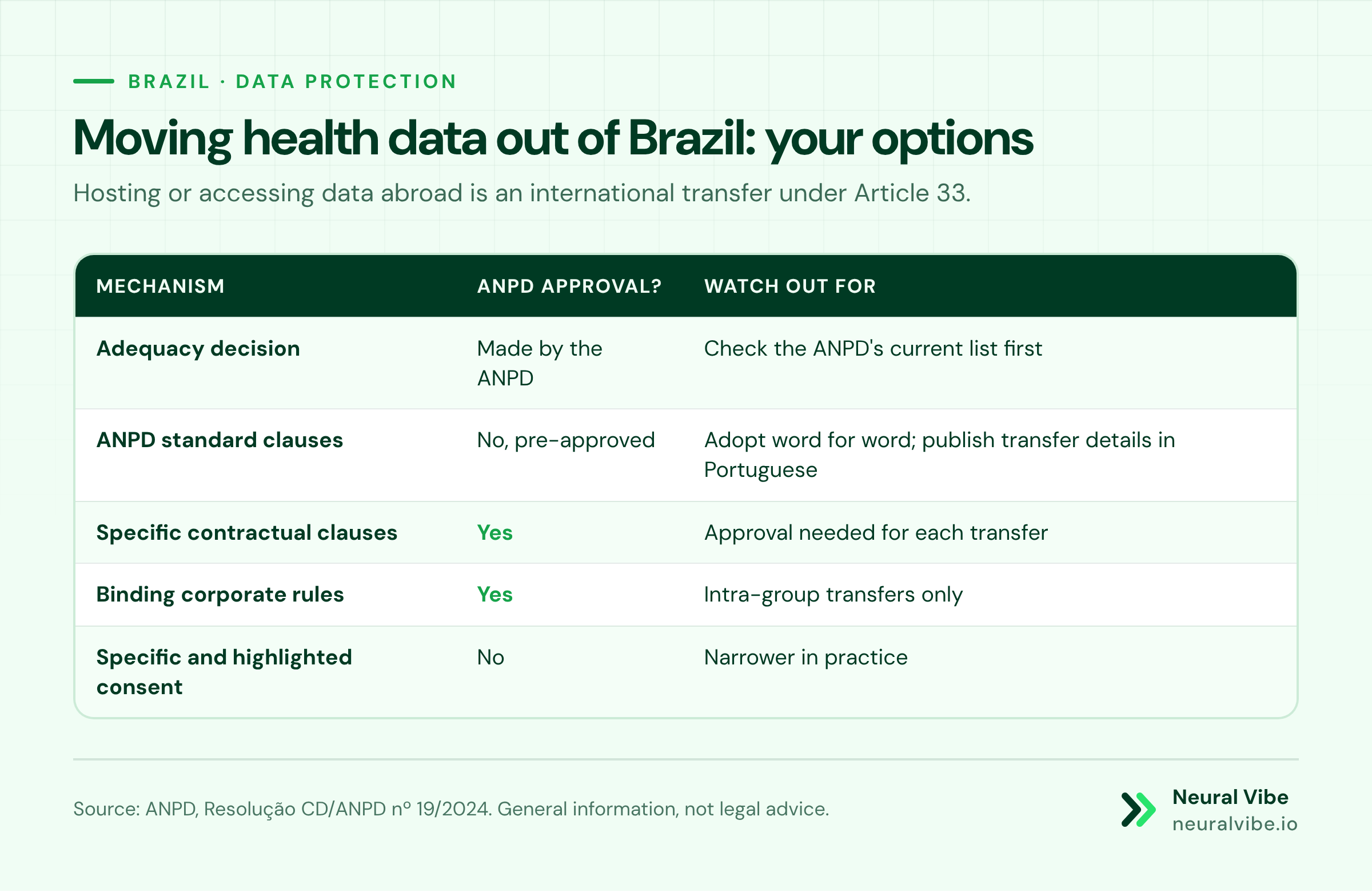
Hosting or accessing data outside Brazil is an international transfer under Article 33. Resolução CD/ANPD nº 19/2024 regulates the main mechanisms:
- Adequacy decisions by the ANPD for countries or international bodies.
- Standard contractual clauses (SCCs) approved by the ANPD.
- Specific contractual clauses for a particular transfer, which need ANPD approval.
- Binding corporate rules for intra-group transfers, also needing ANPD approval.
- Other Article 33 bases, such as specific and highlighted consent, which are narrower in practice.
Three points catch foreign firms out:
- The ANPD SCCs must be adopted in full, without changes. You can add them to a wider contract, but you cannot rewrite them. This differs from how many firms handle the EU SCCs.
- The transition period has ended. Contracts relying on clauses had until August 2025 to incorporate the ANPD SCCs.
- Transparency in Portuguese. Where you use the SCCs, you must publish information about the transfer on your website, in Portuguese.
EU and Brazil. On 26 January 2026 the European Commission adopted an adequacy decision for Brazil (Implementing Decision (EU) 2026/179), so personal data can flow from the EU to Brazil without extra safeguards. The Brazilian government has described the arrangement as mutual recognition. Check the ANPD’s current list before relying on adequacy for transfers out of Brazil. The UK is a separate jurisdiction under both laws.
If you also hold EU patient data, our guide to GDPR and the European Health Data Space covers the EU side.
Who must appoint an encarregado (DPO)?
Article 41 requires controllers to appoint an encarregado. Resolução CD/ANPD nº 18/2024 and the ANPD’s guide fill in the detail:
- Formal act. Appoint by a written, dated and signed document that you keep and show the ANPD on request.
- Who. An individual or a legal entity, internal or external.
- Publish. Show their identity and contact details clearly and prominently, ideally on your website.
- Language. They must communicate clearly with data subjects and the ANPD in Portuguese. The ANPD’s guide does not require them to live in Brazil.
- Conflicts. Manage any conflict of interest, for example where they also make decisions about processing.
Small processing agents, which can include startups, may not have to appoint an encarregado, but they must still offer a communication channel. That relief is lost for high-risk processing, and processing health data at scale may well count. Read the ANPD’s guide alongside the Resolution.
What other duties should you plan for?
- Records of processing for your activities.
- A data protection impact report (RIPD), ready in case the ANPD asks, especially for high-risk processing such as health data.
- Security measures proportionate to the risk, plus incident notification to the ANPD and data subjects where required, within the deadline set by ANPD regulation.
- Data subject rights, including access, correction, deletion, portability and information about sharing.
- Sector rules, such as ANVISA rules if your software is a medical device. See our guide to ANVISA registration for software as a medical device.
Fines can reach 2% of a company’s revenue in Brazil, capped per infringement, and the ANPD has other sanctions available too.
Checklist for foreign health-tech firms
- Map Brazilian data. Which users, clinics and datasets are in Brazil, and what health data you collect.
- Confirm your role. Controller or operator (processor), product by product.
- Pick an Article 11 basis for each health data purpose and record why it fits.
- Fix consent wording in Portuguese if you rely on consent.
- Review commercial data uses against the economic advantage restriction.
- Put transfers in place. Use the ANPD SCCs unchanged, or another Article 33 basis, and publish transfer information.
- Appoint and publish your encarregado, with Portuguese capability.
- Prepare a RIPD, an incident response plan and a data subject request process.
FAQ
Can our GDPR programme cover the LGPD?
Much of it carries across, such as records, impact assessments and security controls. But the health data bases, the SCCs, the encarregado rules and Portuguese transparency differ, so you need a Brazil-specific layer. Our guide to UK GDPR for health apps shows the UK baseline.
Do we need a company or representative in Brazil for the LGPD?
The LGPD does not require a foreign controller to set up a Brazilian entity. You do need an encarregado who can deal with data subjects and the ANPD in Portuguese. Other rules, such as ANVISA’s for medical devices, may require a local company.
Can we use the EU SCCs for transfers out of Brazil?
Not as a substitute. For contractual transfers under the LGPD, use the ANPD’s own standard clauses, adopted without changes. Many firms run both sets side by side.
Is anonymised health data outside the LGPD?
Truly anonymised data is generally outside the law. Data that can be re-identified with reasonable effort is still personal data, and pseudonymised research data remains in scope.
Talk to us
We map your Brazilian data flows, set up your transfer clauses and act as your ongoing compliance partner. Get a costed proposal, or send us a note. We reply within one working day.
Sources
- Lei nº 13.709/2018, Lei Geral de Proteção de Dados Pessoais (compiled text), Planalto
- Resolução CD/ANPD nº 19, de 23 de agosto de 2024 (international data transfers), ANPD
- Transferência internacional de dados, ANPD
- Resolução CD/ANPD nº 18, de 16 de julho de 2024 (encarregado), Biblioteca Digital do Ministério da Justiça
- Guia orientativo: atuação do encarregado pelo tratamento de dados pessoais, ANPD
- Presidente Lula sanciona lei que cria a Agência Nacional de Proteção de Dados, Planalto
- Commission Implementing Decision (EU) 2026/179 on the adequate level of protection of personal data by Brazil, EUR-Lex

About the author
Brett Marshall
Founder and Principal Consultant at Neural Vibe. 25+ years in regulated technology, ISO lead implementer and auditor, and external DPO for health-tech companies.