Key points
- Foreign manufacturers must market devices in Japan through a Japanese Marketing Authorisation Holder (MAH) with the right class of licence.
- Class II and III devices with a certification standard go to a registered certification body; others, and all Class IV, need MHLW approval after PMDA review.
- Japan has a dedicated SaMD review office, free general consultations, a two-step approval option and IDATEN for planned post-approval changes.
To sell a medical device in Japan, including software as a medical device (SaMD), you need a Japanese Marketing Authorisation Holder (MAH) and the right market authorisation under the PMD Act. Lower-risk devices go through notification or third-party certification. Higher-risk and novel devices need approval from the Ministry of Health, Labour and Welfare (MHLW) after review by the Pharmaceuticals and Medical Devices Agency (PMDA).
For software, Japan has dedicated review teams and consultation routes, so early engagement pays off. Here is what founders need before planning a Japanese launch.
At a glance
- Law: the PMD Act; MHLW decides, PMDA reviews
- You need: a Japanese MAH with the right licence class
- Classes: I to IV; software that would be Class I is not regulated
- Routes: notification, third-party certification or MHLW approval
- Help: free, unlimited general consultations with PMDA
This is general information, not legal advice.
Who regulates medical devices in Japan?
Devices are regulated under the Act on Securing Quality, Efficacy and Safety of Products Including Pharmaceuticals and Medical Devices, usually called the PMD Act. Two bodies share the work:
- MHLW takes administrative decisions, such as granting approvals and deciding whether a product is a medical device.
- PMDA carries out scientific review, consultations, QMS inspections and post-market safety work.
Standalone software came into scope in 2014, when “programs” were added to the device categories defined by Cabinet Order. To be regulated, software must have a medical intended use, such as diagnosis, treatment or prevention, and fall within that category.
Why do you need a Marketing Authorisation Holder?
PMDA states that foreign manufacturers must market their devices through a Japanese MAH, or a Japanese manufacturer they appoint. The MAH holds the marketing business licence and is responsible for the product in Japan, including quality assurance and post-market safety.
Licences are tiered by device class:
- First-class licence: Classes I to IV.
- Second-class licence: Classes I and II.
- Third-class licence: Class I only.
Your MAH’s licence must match your device’s class. Separately, each manufacturing site involved, such as design or main assembly, must be registered. Overseas sites register through MHLW, and registration lasts five years.
The big strategic call: some companies set up a subsidiary to act as MAH; others contract an independent one. Think about who controls your approval, how changes and complaints are handled, and what happens if you later change partner.
How are medical devices classified in Japan?
Japan uses four risk classes:
| Class | Risk | Typical route |
|---|---|---|
| I | Extremely low | Notification to PMDA |
| II | Low | Third-party certification where a certification standard exists, otherwise MHLW approval |
| III | Medium | Third-party certification where a certification standard exists, otherwise MHLW approval |
| IV | High | MHLW approval after PMDA review |
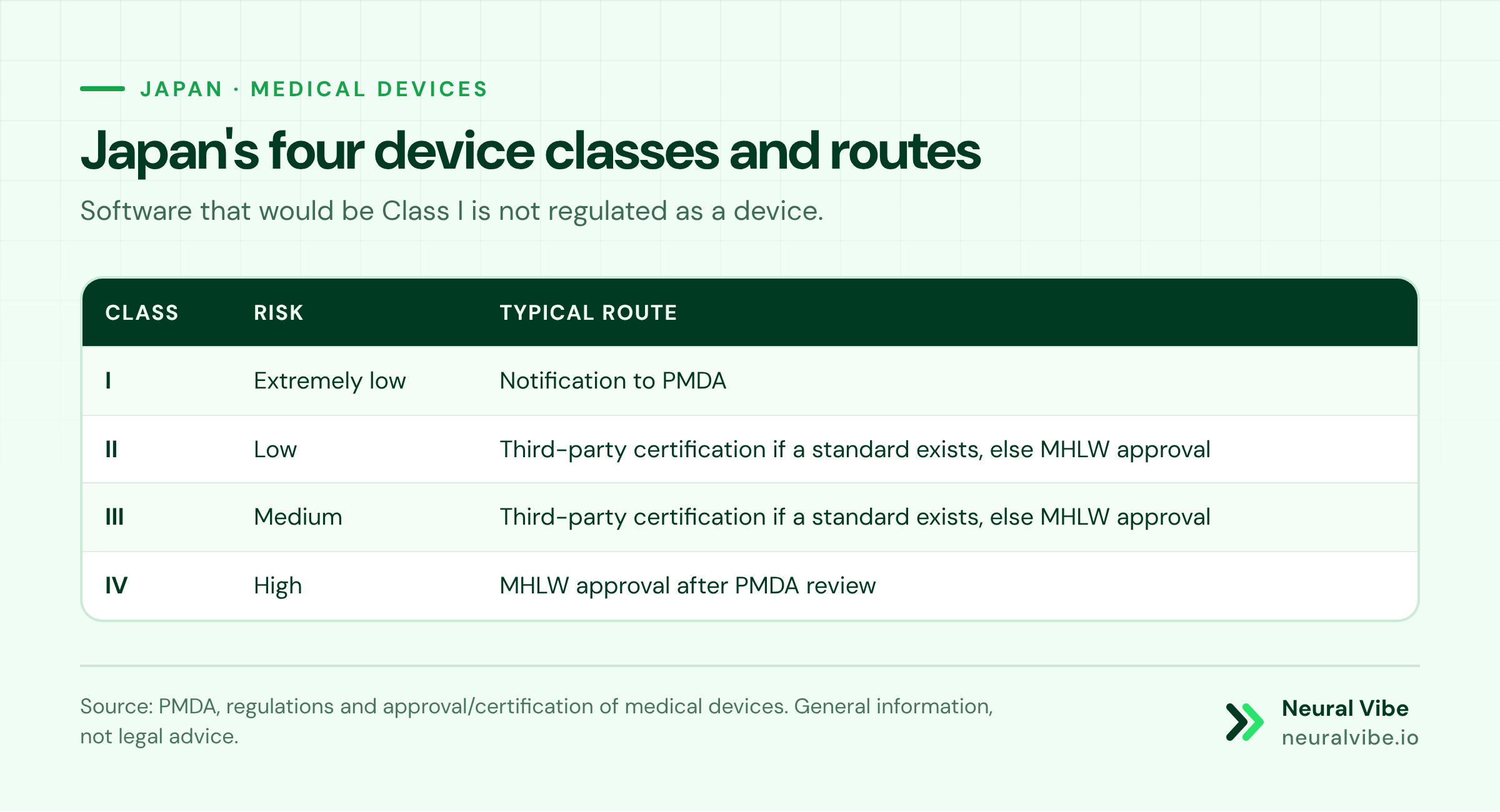
The software twist: software that would be Class I is excluded from the Cabinet Order category, so it is not regulated as a device. In practice, PMDA notes that SaMD generally needs certification or approval.
Certification or approval: which route applies?
Certification. Where MHLW has published a certification standard for a type of Class II or III device, a registered certification body reviews your application against it. This suits devices that closely match an established product type.
Approval. Where no standard applies, or the device is Class IV, PMDA reviews safety and efficacy and MHLW grants approval. Evidence needs, including clinical data, are agreed case by case, often through PMDA consultations.
For every class, the MAH must hold evidence of efficacy, safety and quality before applying. Both routes rely on a compliant QMS. MDSAP audit reports can support Japanese QMS inspections and may avoid an on-site visit; see MDSAP explained.
What has Japan done for SaMD?
MHLW and PMDA have built a series of software-specific measures:
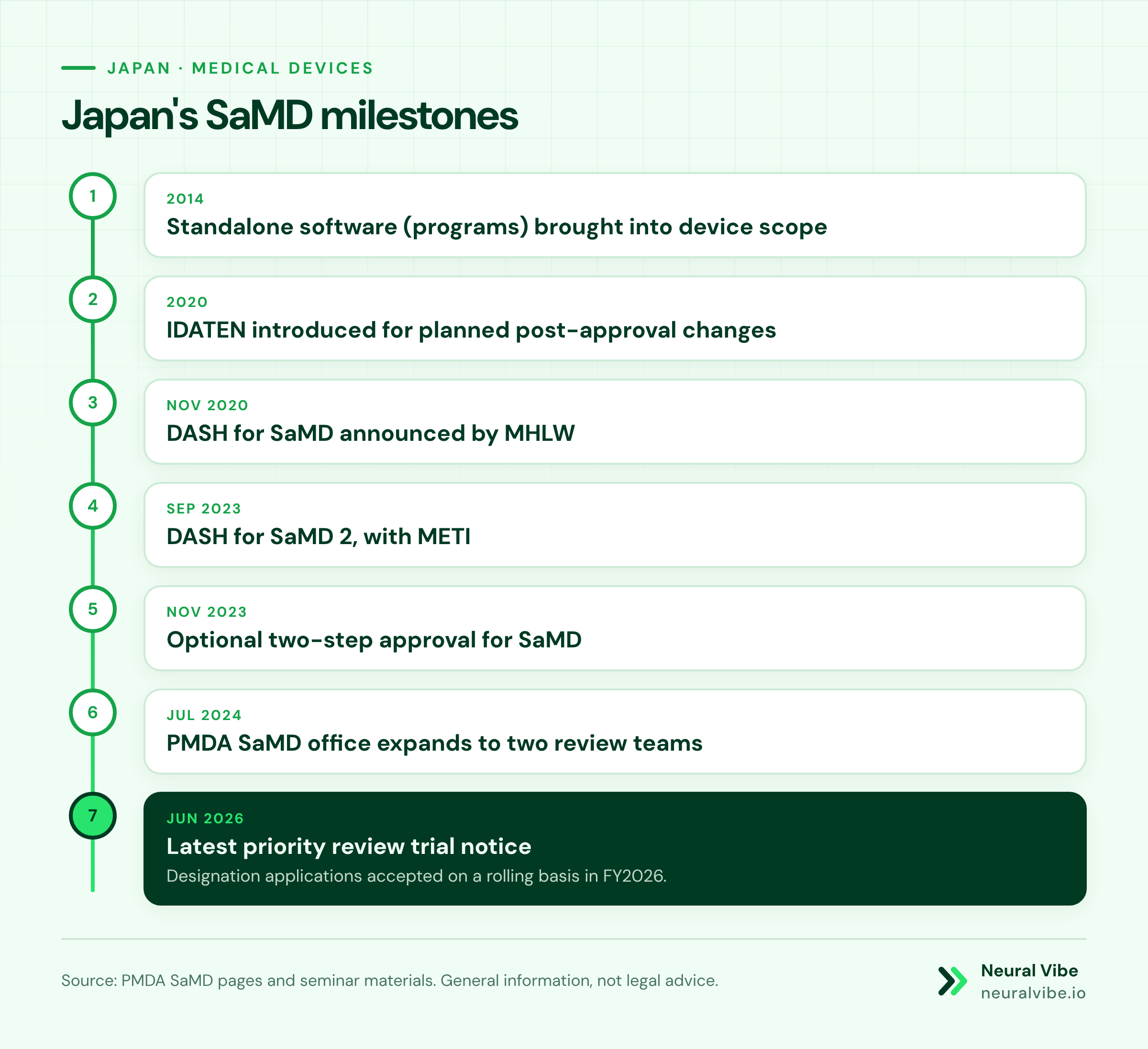
- DASH for SaMD. Announced by MHLW in November 2020 to speed up practical use of SaMD. PMDA strengthened its review system from April 2021.
- DASH for SaMD 2. Announced by MHLW and the Ministry of Economy, Trade and Industry in September 2023, to further promote SaMD and its international expansion.
- A dedicated review office. PMDA’s Office of Software as a Medical Device expanded to two review teams in July 2024.
- Two-step approval. An optional approach set out in a November 2023 MHLW notification, with a Q&A in June 2024.
- Priority review trials. The latest MHLW notice was issued in June 2026, with designation applications accepted on a rolling basis in FY2026.
- IDATEN. Introduced in 2020, it lets an MAH agree a change plan with PMDA in advance, so some planned post-approval changes can be made by notification. AI-based devices need extra information on how the plan and the AI will be managed.
- Review points. PMDA publishes review points for types of SaMD, including computer-aided diagnosis and home-use SaMD, and has published draft review points for devices using generative AI for feedback.
If your software will learn or change after launch, IDATEN is worth a close look. Our guide to FDA predetermined change control plans covers the US equivalent idea.
When should you talk to PMDA?
Early. PMDA offers free general consultations with no limit on number, fee-based pre-consultation and clinical trial consultations, and support aimed at universities, research institutes and venture companies. MHLW also offers a consultation to confirm whether your software is a medical device at all.
Book ahead: PMDA’s own SaMD page shows fee-based consultation slots booked well in advance. Build lead time into your plan.
Checklist: preparing to enter Japan
- Confirm your software meets the PMD Act device definition, using MHLW’s consultation if unclear.
- Work out your likely class and whether a certification standard applies.
- Choose your MAH, subsidiary or independent, with the right licence class.
- Register your manufacturing sites with MHLW.
- Prepare your QMS for Japanese inspection, and consider MDSAP.
- Book a PMDA general consultation early.
- If your software will change after launch, consider an IDATEN change plan.
- Plan Japanese labelling, package inserts and post-market safety with your MAH.
FAQ
Can a foreign company hold a Japanese device approval directly?
PMDA’s guidance says foreign manufacturers must market devices through a Japanese MAH or an appointed Japanese manufacturer. Agree the right structure for your product before you choose a partner.
Is low-risk software regulated in Japan?
Software that would fall into Class I is excluded from the regulated software category, so it is not a medical device under the PMD Act. Higher-risk software usually needs certification or approval.
Does my CE mark or FDA clearance carry over to Japan?
No. Japan requires its own notification, certification or approval. Your technical documentation and clinical evidence can often be reused, but the submission must meet Japanese requirements.
Does MDSAP help with PMDA?
Yes, for the quality system. MDSAP reports can support Japanese QMS inspections and may avoid an on-site inspection, but they do not replace certification or approval.
Talk to us
Planning a Japanese launch for your software? We help you choose an MAH, map your route and prepare for PMDA. Get a costed proposal, or send us a note. We reply within one working day.
Sources
- PMDA: Regulations and Approval/Certification of Medical Devices
- PMDA: Software as a Medical Device (SaMD)
- PMDA SaMD Seminar: Regulation of SaMD under the PMD Act (provisional translation)
- PMDA SaMD Seminar: Overview of the IDATEN system (provisional translation)
- PMDA Updates 2025 Summer
- MHLW/PSB notice: Trial implementation of priority review for SaMD (provisional translation)

About the author
Brett Marshall
Founder and Principal Consultant at Neural Vibe. 25+ years in regulated technology, ISO lead implementer and auditor, and external DPO for health-tech companies.