Key points
- The QMSR took effect on 2 February 2026 and incorporates ISO 13485:2016 by reference into 21 CFR Part 820.
- FDA kept some US-specific requirements, for example on records, complaints, UDI and labelling, so an ISO 13485 QMS needs a short gap check.
- An ISO 13485 certificate does not replace FDA inspection, and internal audit, supplier audit and management review records are now open to inspectors.
Since 2 February 2026, FDA’s quality rules for medical devices (21 CFR Part 820) have been the Quality Management System Regulation (QMSR), which incorporates ISO 13485:2016 by reference. If you already run an ISO 13485 quality management system (QMS), you are most of the way there, but you still need a US-specific layer and should expect inspectors to read more of your records.
For startups, this is good news. One quality system can now serve the US, the EU, the UK and MDSAP markets, instead of two systems that drift apart.
At a glance
- In force: 2 February 2026, replacing the old Quality System Regulation (QSR).
- Core: ISO 13485:2016, incorporated by reference, plus a small FDA layer.
- No shortcut: an ISO 13485 certificate does not exempt you from FDA inspection.
- New exposure: management review, internal audit and supplier audit reports can now be inspected.
This article is general information, not legal advice.
What changed on 2 February 2026?
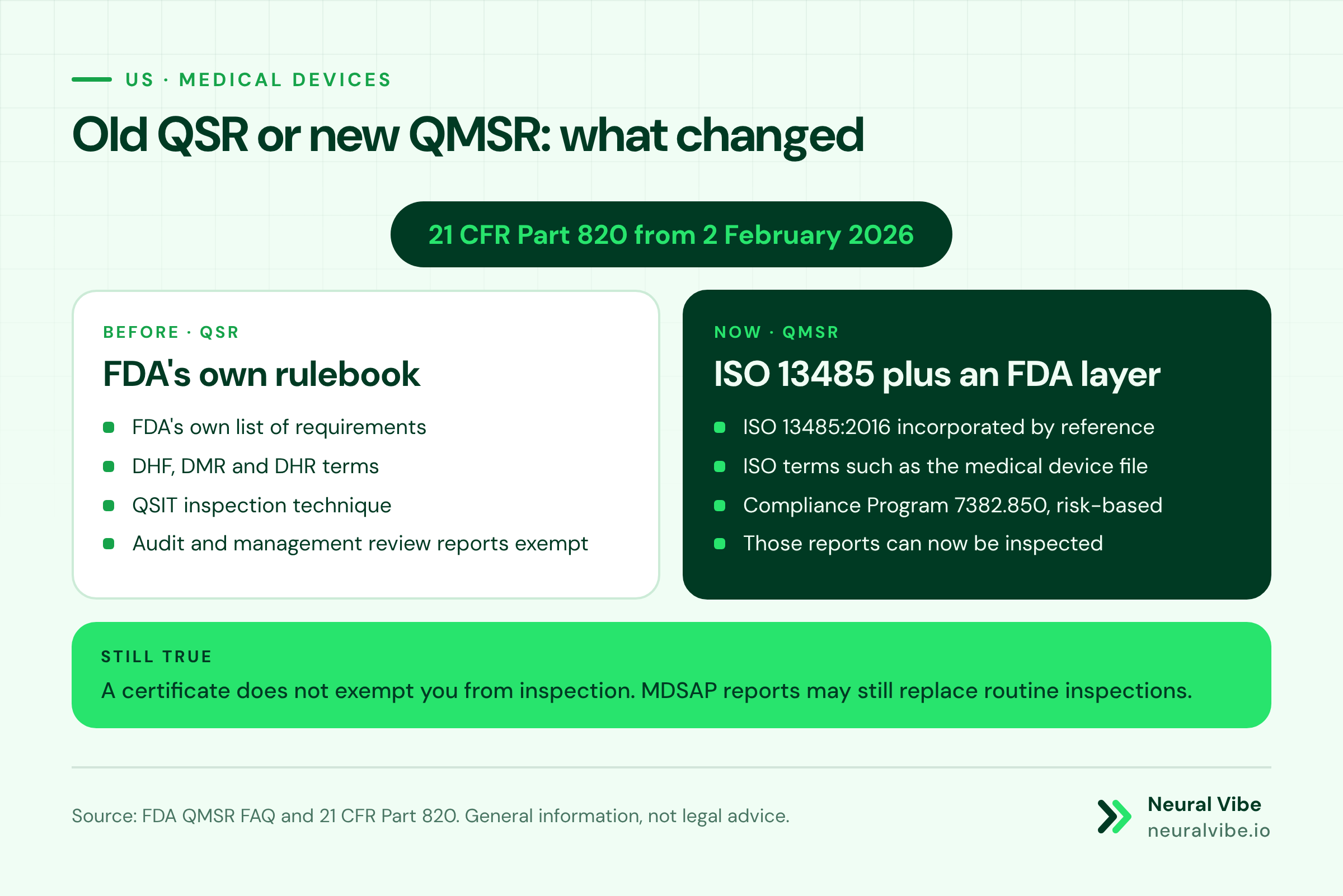
FDA issued the final rule on 31 January 2024. It was published in the Federal Register on 2 February 2024 and took effect two years later, replacing the old QSR.
- ISO 13485:2016 is now the core. Part 820 incorporates the standard by reference instead of restating its own long list of requirements. FDA also adopts relevant definitions from ISO 9000:2015 clause 3.
- A small FDA layer. Part 820 keeps some requirements and clarifications that sit alongside ISO 13485 (see below).
- New terminology. Part 820 now uses ISO 13485 concepts such as the medical device file. Expect to map your old Design History File (DHF), Device Master Record (DMR) and Device History Record (DHR) content to the ISO 13485 structure. The content you need is broadly the same.
- Risk management throughout. ISO 13485 expects a risk-based approach across the QMS, not only in design controls. Be ready to show it in suppliers, processes, complaints and corrective action.
- Technical amendments. FDA published technical amendments in the Federal Register on 4 December 2025. If your procedures quote Part 820, check them against the current eCFR text.
What stays US-specific?
Do not assume an ISO 13485 system is automatically QMSR compliant. Part 820 still includes FDA requirements you must build in:
| Section | What it adds |
|---|---|
| 820.3 Definitions | FDA terms replace some ISO ones, such as “manufacturer” and “organization”. “Safety and performance” is read as “safety and effectiveness”. |
| 820.10 Requirements for a QMS | Links ISO clauses to FDA rules: UDI (Part 830), Medical Device Reporting of complaints (Part 803), corrections and removals (Part 806). Design controls apply to Class II and III and certain Class I devices. |
| 820.35 Control of records | Specific content for complaint records, especially those reportable under Part 803, and servicing records. Record the UDI for each device or batch. |
| 820.45 Labelling and packaging | Examine labelling and packaging before release, including UDI and expiry dates. Document release and prevent mix-ups. |
How does FDA inspect under the QMSR?
FDA stopped using the Quality System Inspection Technique (QSIT) on 2 February 2026. Inspections now follow an updated compliance programme, Inspection of Medical Device Manufacturers (7382.850), and FDA schedules them based on risk factors.
What that means in practice:
- More records are in scope. Under the old QSR (section 820.180(c)), FDA did not inspect management review, quality audit or supplier audit reports. That exemption has not carried over. Write them as if FDA will read them.
- No certificate shortcut. FDA does not require or issue ISO 13485 certificates, and a certificate does not exempt you from inspection.
- MDSAP still counts. FDA says it may continue to accept Medical Device Single Audit Program (MDSAP) audit reports as a substitute for routine inspections. MDSAP is voluntary, and FDA’s own inspections do not follow the MDSAP audit plan. If you also plan to sell in Canada, Australia, Brazil or Japan, see MDSAP explained.
- Risk drives the visit. Expect investigators to follow the evidence across your QMS, from complaints to corrective action and design changes.
Our view: the records FDA could not see before are where we expect the surprises. Make sure they are factual, complete and closed out.
What does the QMSR mean for a startup?
It depends where you are starting from:
- Building your first QMS? Design it to ISO 13485:2016 from day one and add the FDA layer. You do not need a separate “FDA system”. Our guide to ISO 13485 for startups shows how to keep it lean.
- Already ISO 13485 certified for EU MDR or UKCA work? Your job is a gap assessment, not a rebuild.
- Built to the old QSR? Rewrite your procedures around ISO 13485 structure and terms, and train your team on what changed.
Software companies should note that ISO 13485 applies to software development and to software used in the QMS itself. Validation of QMS software, such as your eQMS, ticketing or document control tools, is an ISO 13485 requirement (clause 4.1.6).
Planning a submission too? See 510(k), De Novo or PMA for choosing your FDA route.
Your QMSR readiness checklist
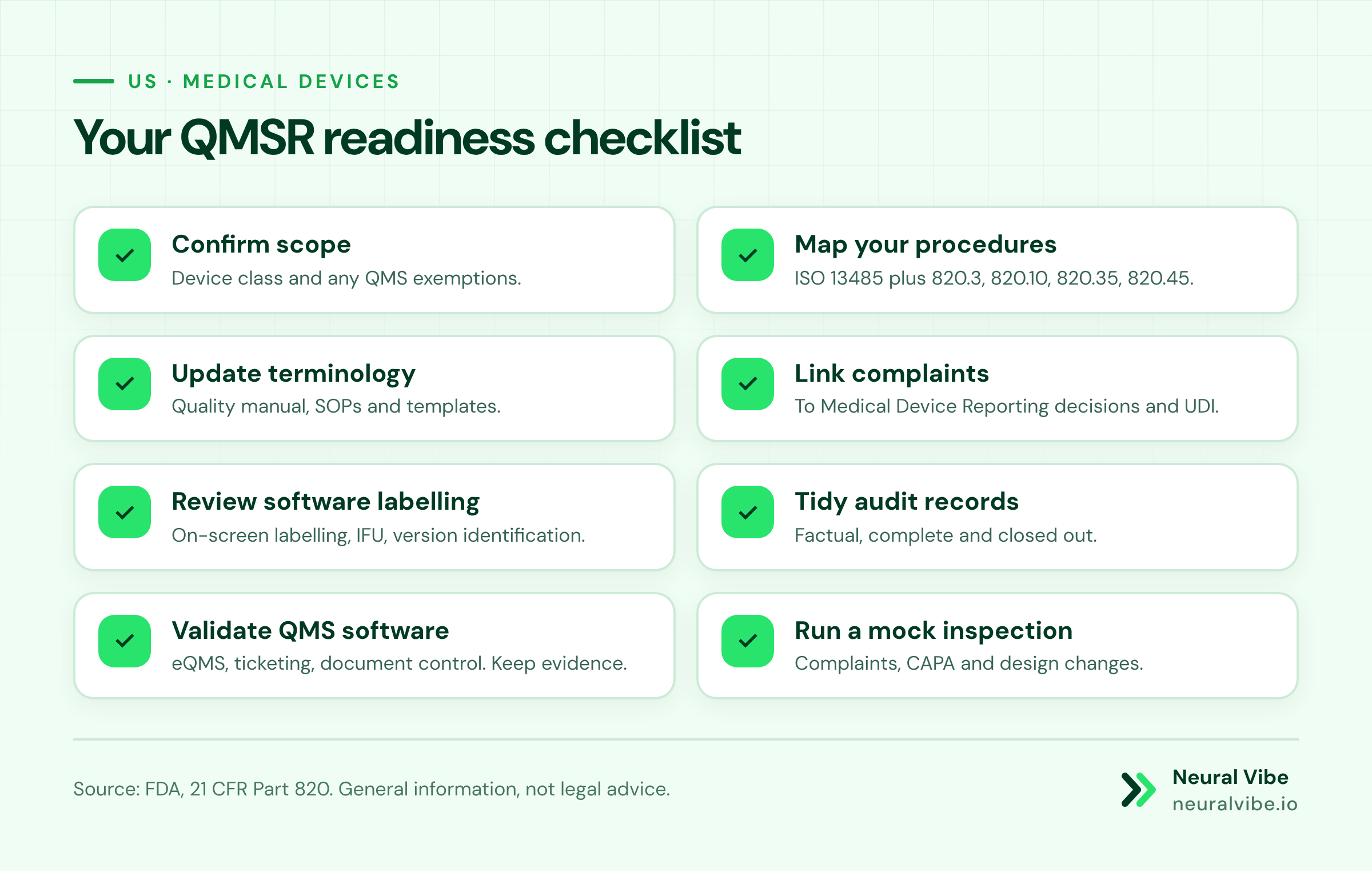
- Confirm scope. Check your device class and any QMS exemptions for your product.
- Map procedures to ISO 13485:2016 clauses and to Part 820 sections 820.3, 820.10, 820.35 and 820.45.
- Update terminology in your quality manual, SOPs and templates.
- Check complaint handling links to Medical Device Reporting (Part 803) decisions and UDI recording.
- Review labelling controls for software too: on-screen labelling, instructions for use and version identification.
- Tidy audit and management review records. Make them factual, complete and closed out.
- Embed risk management across purchasing, production and service, complaints and corrective and preventive action (CAPA).
- Validate QMS software and keep the evidence.
- Decide on MDSAP if you plan multiple markets.
- Run a mock inspection focused on complaints, CAPA and design changes.
FAQ
We are ISO 13485 certified. Are we automatically QMSR compliant?
No, but you are close. Add the FDA-specific requirements in Part 820 and check your processes link to FDA reporting, UDI and registration rules. FDA can still inspect you, and a certificate is not proof of compliance.
Do we need to buy a copy of ISO 13485?
Yes, in practice. FDA says it can be read free in read-only form through the ANSI Incorporated by Reference portal and the ISO Online Browsing Platform. You will still want your own copy to build and audit your system.
Does the QMSR apply before we get FDA clearance?
The QMSR applies to manufacturers of finished devices marketed in the US. Design controls matter much earlier, though: your records must show the design was controlled, and FDA may inspect before approval for some submissions, such as PMAs.
Will FDA still use Form 483 and warning letters?
We expect so. Inspection observations are recorded on Form FDA 483, and serious or unresolved issues can lead to warning letters and other enforcement. What changed is the rulebook and the inspection approach.
Talk to us
Need a QMSR gap assessment or an ISO 13485 QMS built for you? Get a costed proposal, or send us a note and we will reply within one working day.
Sources
- Quality Management System Regulation (QMSR), FDA
- Quality Management System Regulation: Frequently Asked Questions, FDA
- Medical Devices; Quality System Regulation Amendments, final rule (Federal Register, 2 February 2024)
- Medical Devices; Quality Management System Regulation Technical Amendments (Federal Register, 4 December 2025)
- 21 CFR Part 820, Quality Management System Regulation (eCFR)
- Medical Device Single Audit Program (MDSAP), FDA
- CDRH Compliance Programs, FDA

About the author
Brett Marshall
Founder and Principal Consultant at Neural Vibe. 25+ years in regulated technology, ISO lead implementer and auditor, and external DPO for health-tech companies.