Key points
- ISO/IEC 42001:2023 is a voluntary, certifiable standard for an AI management system, and accredited certification is now available.
- It is not a harmonised standard under the EU AI Act. The first AI Act harmonised standard, EN 18286 on quality management, was referenced in October 2026.
- For health-tech, ISO 42001 is a strong governance signal to buyers, but it does not replace medical device, data protection or clinical safety requirements.
No law requires ISO/IEC 42001, but if you build or deploy AI and sell to enterprise or health buyers, it is a credible way to show your AI is governed responsibly. Whether you should certify now depends on what your customers ask for, which regulations apply, and what management systems you already run.
We explain what the standard is, where it sits next to the EU AI Act, and how to decide.
At a glance
- What: ISO/IEC 42001:2023, requirements for an AI management system (AIMS)
- Mandatory? No. It is voluntary and certifiable
- EU AI Act: not a harmonised standard; no presumption of conformity
- First AI Act harmonised standard: EN 18286 (quality management), referenced October 2026
- NHS: we know of no requirement for it
This is general information, not legal advice.
What is ISO/IEC 42001?
ISO/IEC 42001:2023 sets requirements for an artificial intelligence management system (AIMS). It applies to any organisation that develops, provides or uses AI systems, whatever its size or sector.
Like ISO 27001, it follows ISO’s common management system structure:
- define the context and scope;
- set an AI policy and objectives;
- assess AI risks and impacts, and select controls;
- monitor, audit internally, review and improve.
Its annexes give reference controls and guidance on topics such as AI system impact assessment, data for AI systems, the AI life cycle and third-party AI.
Technology-neutral by design. It does not tell you which model to use or what accuracy to hit. It asks you to show that AI decisions are deliberate, documented and reviewed.
Can you be certified to ISO 42001?
Yes. It is a certifiable requirements standard. In 2025 ISO published ISO/IEC 42006, which sets requirements for bodies that audit and certify AI management systems. That gives accreditation bodies a consistent basis to assess certifiers.
In the UK, UKAS granted its first accreditation for ISO/IEC 42001 certification in January 2026, so accredited 42001 certification is now on offer.
If certification matters to your buyers, check two things:
- The certification body is accredited for ISO/IEC 42001 by a recognised accreditation body.
- The certificate’s scope covers the products and activities your customer actually buys.
How does ISO 42001 relate to the EU AI Act?
This is where we see the most confusion, so we will be precise.
The EU AI Act (Regulation (EU) 2024/1689) lets providers of high-risk AI systems rely on harmonised standards referenced in the Official Journal to gain a presumption of conformity. The European Commission asked CEN and CENELEC to develop them through their joint technical committee, JTC 21. They cover areas such as risk management, data governance, logging, transparency, human oversight, accuracy, robustness, cybersecurity, quality management and conformity assessment.
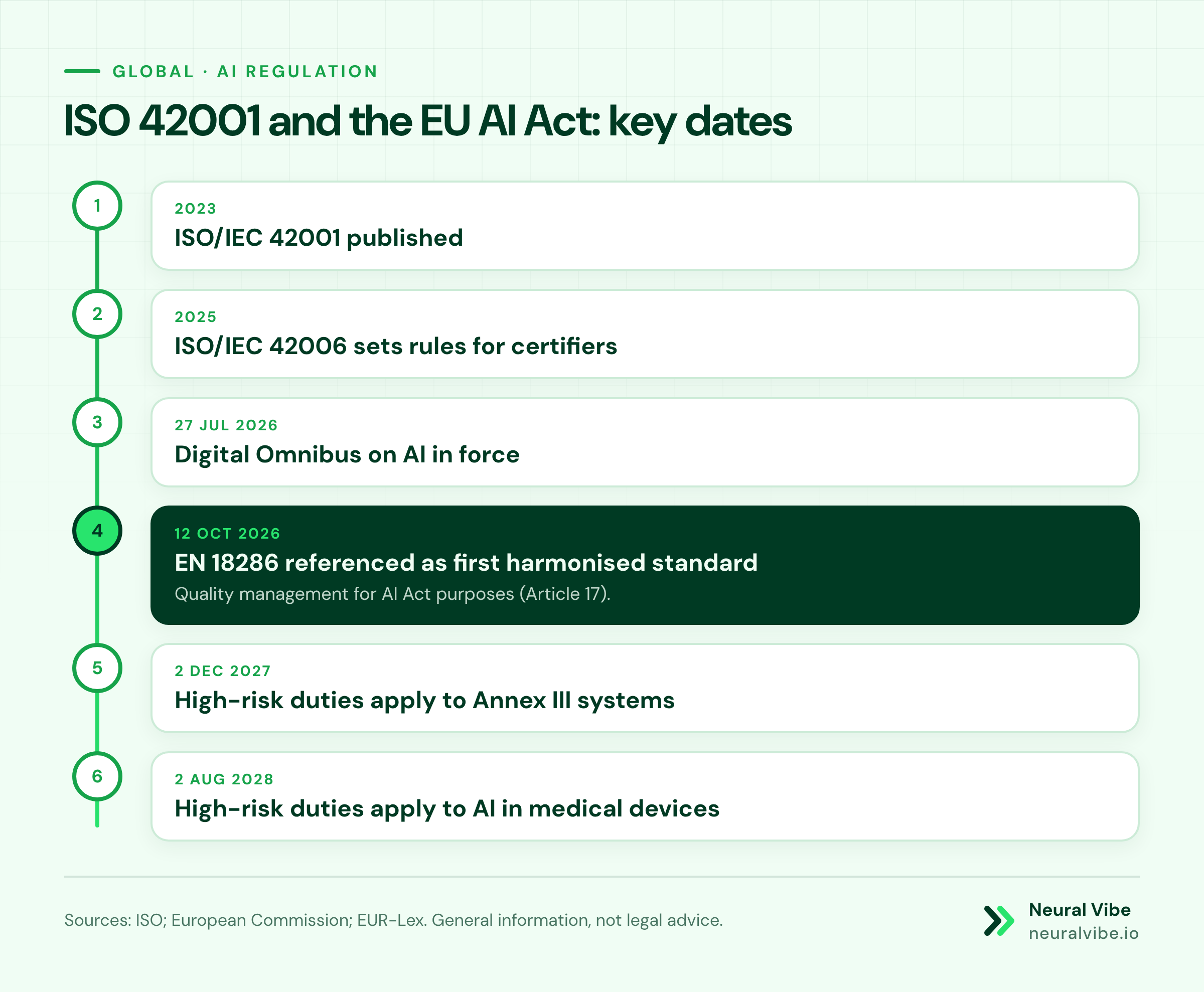
- ISO/IEC 42001 is not a harmonised standard under the AI Act. It is a general governance standard, not written to match the Act’s legal requirements. Certification does not give you a presumption of conformity.
- The first AI Act harmonised standard is in place. Commission Implementing Decision (EU) 2026/2274 of 12 October 2026 lists EN 18286:2026, “Artificial intelligence: Quality management system for EU AI Act regulatory purposes”. The decision describes it as covering quality management systems for providers of AI systems, including post-market monitoring, and the Commission links it to the quality management obligations in Article 17. Check the standard itself before assuming how closely it maps to ISO/IEC 42001.
- Other harmonised standards are still in development at JTC 21, with no fixed timetable.
- Application dates have moved. The Digital Omnibus on AI, Regulation (EU) 2026/1744, entered into force on 27 July 2026. It moved high-risk obligations for Annex III systems to 2 December 2027, and for AI in products under EU product law, such as medical devices, to 2 August 2028.
So where does 42001 fit? It is a sound governance foundation. AI risk assessment, life-cycle controls, supplier oversight and management review all overlap with what an AI Act quality management system needs. If you may be a high-risk AI provider, build on ISO 42001, then close the gaps against the Act and EN 18286. Our guide to the EU AI Act for health-tech sets out the first steps.
For AI that is also a medical device, the AI Act’s quality management requirements can be integrated into your existing quality system, so plan them with your ISO 13485 QMS.
What do health and NHS buyers expect?
We would be cautious about any claim that ISO 42001 is “required” by health buyers. To our knowledge, it is not a mandatory NHS procurement requirement.
NHS and other health buyers typically look for assurance against established frameworks:
- the Digital Technology Assessment Criteria (DTAC, refreshed in February 2026);
- the Data Security and Protection Toolkit;
- the DCB0129 and DCB0160 clinical safety standards;
- UK GDPR;
- medical device regulation, where your product is a device.
Buyers are asking more about AI, though: how models are trained and validated, how performance is monitored, how bias is handled, and who is accountable. An ISO 42001 system gives you organised, auditable answers. Some buyers may see certification as a differentiator where AI governance features in tenders.
Is ISO 42001 right for you?
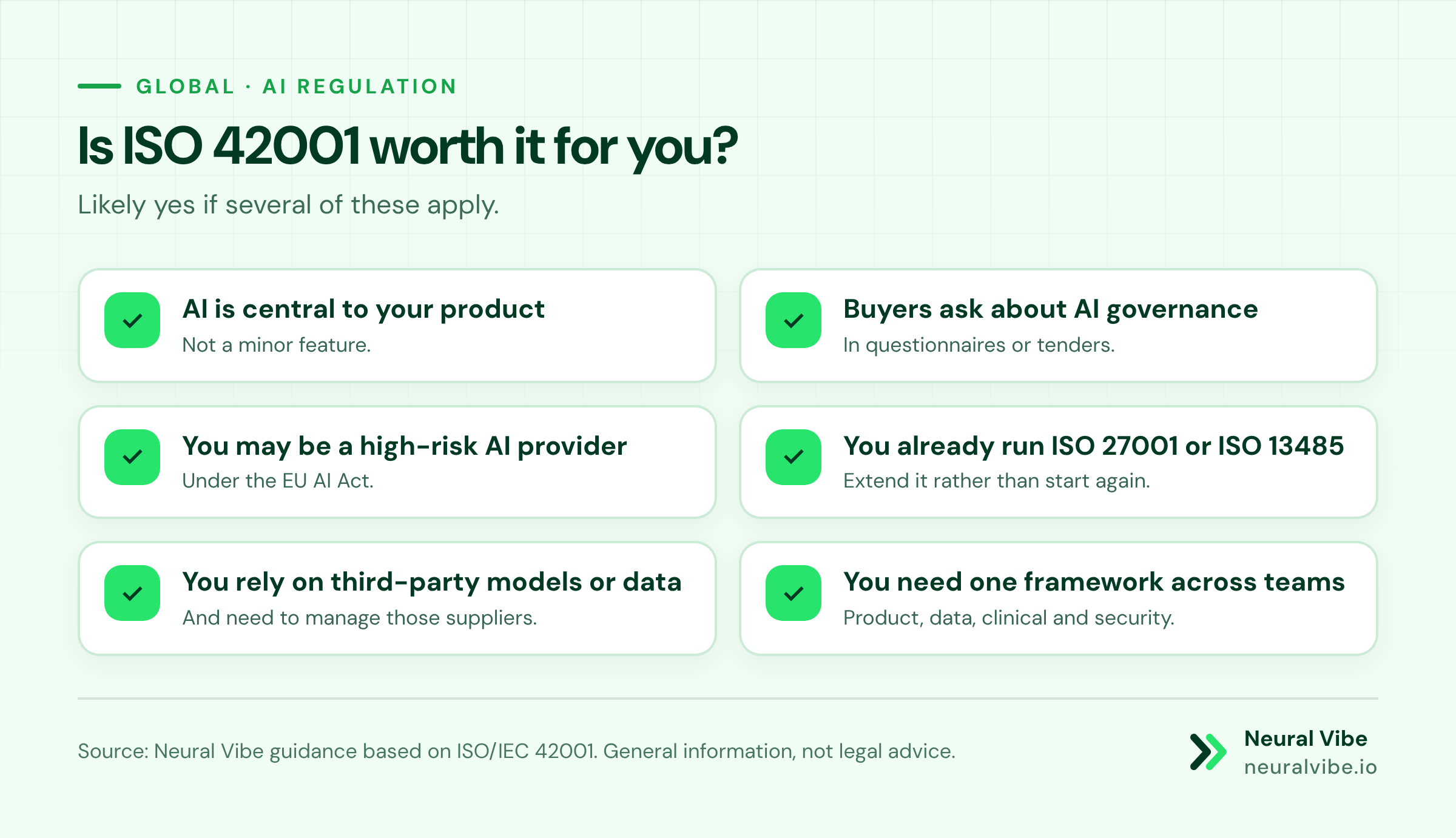
It is likely to be worth it if several of these apply:
- AI is central to your product, not a minor feature.
- Enterprise, public sector or health customers ask about AI governance in questionnaires or tenders.
- You may be a provider of a high-risk AI system under the EU AI Act.
- You already run ISO 27001 or ISO 13485, so you can extend an existing system.
- You rely on third-party models or data and need a structured way to manage those suppliers.
- You want one framework to coordinate AI risk across product, data, clinical and security teams.
How do you build an AI management system?
- Inventory your AI. List the AI systems you develop, provide and use, including third-party models and tools.
- Decide your role and scope. Developer, provider, user, or several? Keep the first scope to what customers buy.
- Map your obligations. Such as the EU AI Act, medical device rules and data protection law.
- Run AI risk and impact assessments. Consider effects on individuals and groups, not just your organisation.
- Integrate with what you have. Reuse document control, internal audit, management review and supplier processes.
- Operate, audit, then certify. Run it for real, complete an internal audit and management review, then book an accredited audit if you need one.
FAQ
Is ISO 42001 mandatory?
No. It is a voluntary standard. Some customers may ask for it, but no UK or EU law requires it.
Does ISO 42001 certification make us compliant with the EU AI Act?
No. ISO/IEC 42001 is not a harmonised standard under the AI Act and does not give a presumption of conformity. It is a useful foundation for the Act’s governance and quality management requirements.
Do we need ISO 42001 if we already have ISO 27001?
ISO 27001 covers information security, not AI-specific risks such as bias, transparency or model performance. Because both share the same structure, many organisations extend their existing system. See ISO 27001 or SOC 2?
Will the NHS require ISO 42001?
We are not aware of any NHS requirement for ISO 42001 certification. NHS buyers usually assess suppliers against DTAC, the Data Security and Protection Toolkit and clinical safety standards, and ISO 42001 can strengthen your AI governance answers.
Talk to us
We build AI management systems that fit alongside ISO 13485, ISO 27001 and the EU AI Act, and we do the work for you. Get a costed proposal, or send us a note. We reply within one working day.
Sources
- ISO/IEC 42001:2023 Information technology: Artificial intelligence: Management system (ISO)
- ISO/IEC 42006:2025 Requirements for bodies providing audit and certification of AI management systems (ISO)
- AI Act standardisation (European Commission)
- Commission Implementing Decision (EU) 2026/2274 on harmonised standards for high-risk AI systems, EUR-Lex
- Regulation (EU) 2024/1689 (Artificial Intelligence Act), EUR-Lex
- Regulation (EU) 2026/1744 (Digital Omnibus on AI), EUR-Lex
- Digital Technology Assessment Criteria (DTAC) (NHS England)
- UKAS grants first AIMS accreditation (UKAS, 15 January 2026)
- AI accreditation update (UKAS)

About the author
Brett Marshall
Founder and Principal Consultant at Neural Vibe. 25+ years in regulated technology, ISO lead implementer and auditor, and external DPO for health-tech companies.